“Mission critical” means saving lives at sea for an operator of fast, high-tech ambulance boats, which is why they turned to Kongsberg Kamewa Waterjets for reliable, high-speed performance and manoeuvrability
Most people can picture ambulances on the road – few imagine boats as ambulances. Yet Norway’s remote island communities rely on ambulance boats to perform a range of emergency services and ensure the same health care services to island dwellers as on the mainland.
The company that deploys these ambulance boats now relies on Kongsberg Kamewa Waterjets to provide the speed and manoeuvrability needed for job.
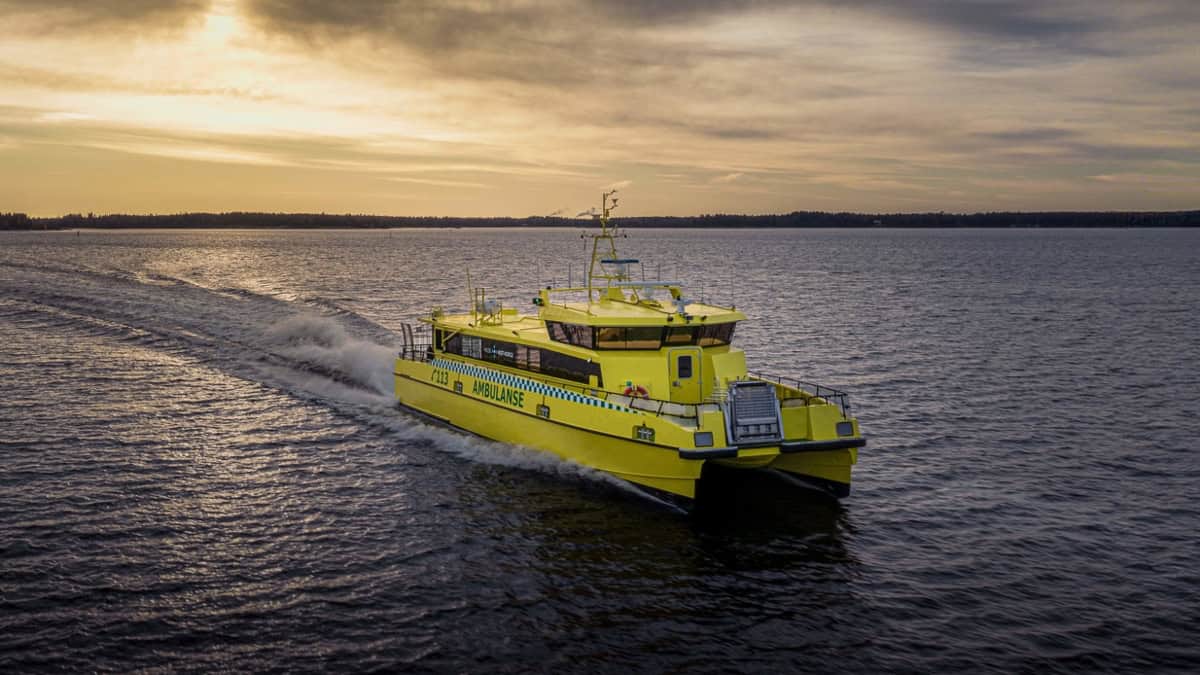
Buksér og Berging AS, a Norwegian marine services company, operates three of the latest model in ambulance boats, a 22-metre, high-speed aluminium catamaran called the Ambulance 2200 and built by Kewatec Shipyard in Finland.
The Ambulance 2200 is described as a “mini hospital on the water”, with a design that minimises noise, vibrations, and vertical movements. The vessels are stationed along the western Norwegian coastline. They and their crews are tasked with everything from search and rescue to transportation of emergency personnel.
”The design prioritises the needs and requirements of emergency medical care, including the safety and stability of the patient area, even in challenging weather conditions,” said Lars Olaussen, COO, Oy Kewatec AluBoat Ab. “Kamewa waterjets offer high acceleration and agility, which are crucial for rapid rescue operations. Additionally, their compact design enables optimal vessel handling even in shallow waters and tight spaces, making them an ideal choice for the Ambulance 2200.”
The boats have a service speed of around 30 knots, with seating for 12 and two complete stretcher patient areas. The crew has both maritime and paramedic training to handle transport operations and patient treatment – a sign of how critical their missions can be.
Buksér og Berging deployed their first Ambulance 2200 in 2022 with a Volvo IPS system, but for the next two boats, Buksér og Berging specified that the 2200 should be equipped with Kamewa waterjets.
”Our ambulance boats operate in various waters, depths, and weather conditions, often in emergency situations where time and safety are critical,” said Buksér og Berging’s Technical Superintendent, Arild Fjerstad. ”In these cases, it is essential to have a smooth, responsive propulsion system with excellent manoeuvrability. Kamewa waterjets have been a reliable choice for us.”
Kongsberg Maritime delivered Twin (2x) S45-3/CA Kamewa waterjets for each boat and provided the Jet Control System – Extended (JCS Extended). This is an advanced, compact control system for operating the waterjets. The JCS Extended control system provides accurate and reliable operation of the waterjet hydraulic valves using integrated feedback signals and optional GNSS antenna.
For each boat, Kongsberg Maritime delivered Twin (2x) S45-3/CA Kamewa waterjets plus the Jet Control System, an advanced control system for operating the waterjets’ steering, reversing buckets, and interceptors.
”Our partnership with Kongsberg Maritime in providing solutions for the Ambulance 2200 has been a key part of the vessel’s development,” said Olaussen of Kewatec. ”Together, we have been able to offer our customers reliable and efficient solutions for critical maritime rescue missions.”