



Consortium advances large-scale 3D printed marine propeller production using Wire Arc Additive Manufacturing
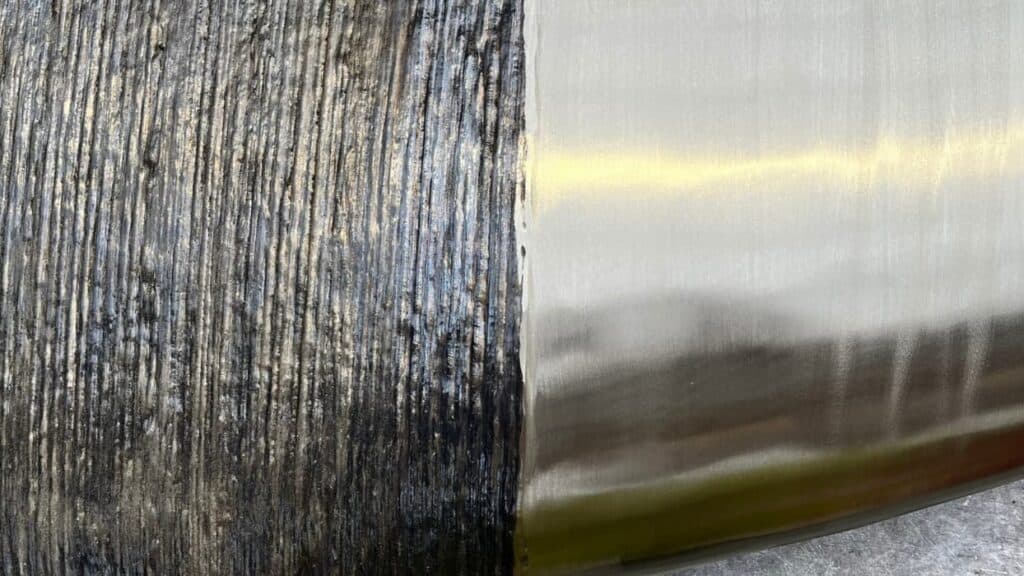
A 3D-printed section of a marine propeller has been completed, marking a step towards smarter, more efficient propulsion for the future of clean shipping. The milestone highlights increasing global momentum behind Wire Arc Additive Manufacturing (WAAM) and its growing role in the production of large-scale components for demanding marine environments.
The work forms part of the Digitally Enabled Efficient Propeller (D.E.E.P) project and marks a key milestone for a world-leading consortium supported by Innovate UK. Led by Enki Marine Ltd, the consortium comprises DEEP Manufacturing Ltd, Stone Marine Propulsion, TWI, Authentise, ASTM International and Newcastle University. Together, the partners bring expertise spanning propeller design, materials testing, digital manufacturing workflows, certification and hydrodynamic validation.
Marine propellers have traditionally been produced using casting processes. While well established, these methods can constrain design flexibility, limit opportunities for performance optimisation and introduce long lead times for complex geometries.
As demand increases for more efficient, lower-emission vessels, these constraints are becoming more pronounced. There is a growing need for manufacturing approaches that enable more advanced designs while improving delivery timelines and local supply chain resilience.
The propeller blade has been designed with internal cavities, reducing overall weight while maintaining structural performance and stiffness – an approach that would be difficult to achieve using conventional casting methods.
These internal geometries also create space for future integration of sensors and telemetry systems. In time, this could enable real-time monitoring of propulsion performance, allowing operators to optimise efficiency, adjust operating conditions and move toward predictive maintenance strategies.
DEEP Manufacturing is responsible for the development of the manufacturing approach and the transition from design into production, applying our large-scale DED-Arc (WAAM) capability to deliver the blade geometry in Nickel Aluminium Bronze (NAB).
This work reflects a broader shift from feasibility to industrial application. As additive manufacturing moves beyond prototyping, the ability to manufacture high-integrity components locally and at scale is becoming increasingly important across maritime and other critical sectors.
With production now complete, the propeller blade will be transported to DEEP Manufacturing’s Houston facility, where it will be showcased as part of our May launch event.
This milestone provides a real demonstration of how digitally enabled design and large-scale additive manufacturing can be applied to complex marine components, supporting the shift toward more efficient, responsive and resilient propulsion systems.









 and its growing role in the production)