Ship & Boat BuildingConversionsMEYER RE Secures 'Frisia I' Hybrid Conversion

MEYER RE Secures ‘Frisia I’ Hybrid Conversion

MEYER RE will upgrade ‘Frisia I’ with hybrid propulsion technology, targeting annual CO₂ emission reductions of up to 400 tonnes

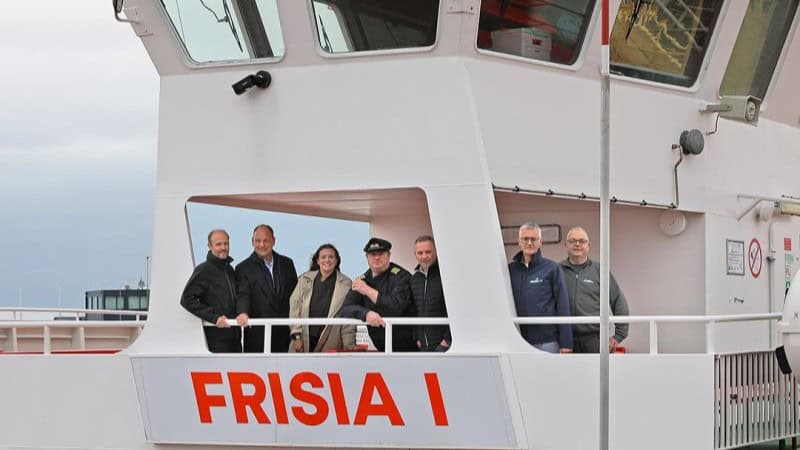
MEYER RE has secured a contract to modernise the propulsion system of Frisia I, an island ferry operated by German ferry company AG Reederei Norden-Frisia, converting the vessel to hybrid propulsion. The contract was signed in Norddeich, Germany, on 22 October 2026.

Built by MEYER WERFT in Papenburg in 1970, the ferry will undergo a comprehensive propulsion upgrade designed to improve energy efficiency and reduce emissions while extending the operational life of the existing vessel.

The new hybrid configuration will retain the ferry’s three-propeller arrangement, with the two Schottel propellers powered by more efficient diesel engines and the central propeller driven electrically. A 1,200 kWh battery system will supply power to the electric propulsion motor and the vessel’s onboard electrical grid.

As part of the conversion, the two existing diesel generators will be removed. Battery charging will rely primarily on photovoltaic installations and energy storage systems operated by AG Reederei Norden-Frisia, further supporting the vessel’s transition towards more sustainable operations.

The hybrid propulsion upgrade is expected to deliver fuel savings of more than 40% and reduce CO₂ emissions by up to 400 tonnes annually.

For MEYER RE, the project highlights the potential of modernising existing vessels to improve environmental performance and operational efficiency without replacing the entire vessel. By combining upgraded diesel engines, battery storage and electric propulsion, the conversion aims to support more energy-efficient island ferry services.

The conversion is scheduled to take place between September 2027 and 1 March 2028.

Latest News

The International Institute of Marine Surveying (IIMS), working in collaboration with the International Marine Contractors Association (IMCA) and the Workboat Association, has announced the publication of the International Workboat Code of Practice, a 122-page guide providing best-practice guidance for the construction, operation and surveying of commercial workboats.

IIMS, IMCA and Workboat Association Launch International Workboat Code of Practice

IIMS, IMCA and the Workboat Association collaborate on a 122-page guide covering vessel safety, operational standards and crew competency for commercial workboats worldwide The International...
The world’s largest battery-electric ship has officially entered commercial passenger service, marking a major milestone for maritime electrification and zero-emission vessel operations. Built by Incat Tasmania for long-standing customer Buquebus, the 130-metre China Zorrilla has completed its maiden commercial voyage between Buenos Aires, Argentina, and Colonia, Uruguay, across the River Plate.

China Zorrilla Begins Electric Ferry Operations

Built for Buquebus to connect Argentina and Uruguay, the China Zorrilla, the world’s largest battery-electric ferry, marks a major milestone in large-scale marine electrification...
Boluda Towage has expanded its Norwegian fleet with the addition of VB NORWEGIAN FALCON, a new tug built by Sanmar Shipyards to support towing, vessel assistance and offshore operations in demanding maritime environments.

Boluda Towage Takes Delivery of VB NORWEGIAN FALCON

Sanmar-built VB NORWEGIAN FALCON features RAstar 3200 SX design, ASD propulsion and more than 6,700 hp Boluda Towage has expanded its Norwegian fleet with the...
SWITCH Maritime has secured a Design Basis Agreement (DBA) from the United States Coast Guard (USCG) for its SWITCH-150 hydrogen fuel cell-electric ferry, marking a key milestone in the development of the 150-passenger vessel. Designed by naval architecture firm Incat Crowther, the SWITCH-150 combines hydrogen fuel cell-electric propulsion with onboard hydrogen storage to support high-frequency ferry operations without compromising service schedules or requiring shoreside charging infrastructure.

SWITCH Hydrogen Ferry Clears Key US Coast Guard Milestone

The US Coast Guard agreement establishes a regulatory framework to guide construction, commissioning and future commercial operation of the hydrogen-powered ferry SWITCH Maritime has secured...

Related news