Ship & Boat BuildingFerriesMolslinjen Orders Third 100% Electric High-Speed Ferry

Molslinjen Orders Third 100% Electric High-Speed Ferry

Incat Tasmania, a leading Australian shipbuilder, and Molslinjen, a major Danish ferry operator, have signed a contract for the construction of a third 100% battery-electric high-speed ferry. This new agreement strengthens the long-standing partnership between the two companies and represents another major step forward in what is recognized as the world’s largest electrification project at sea.

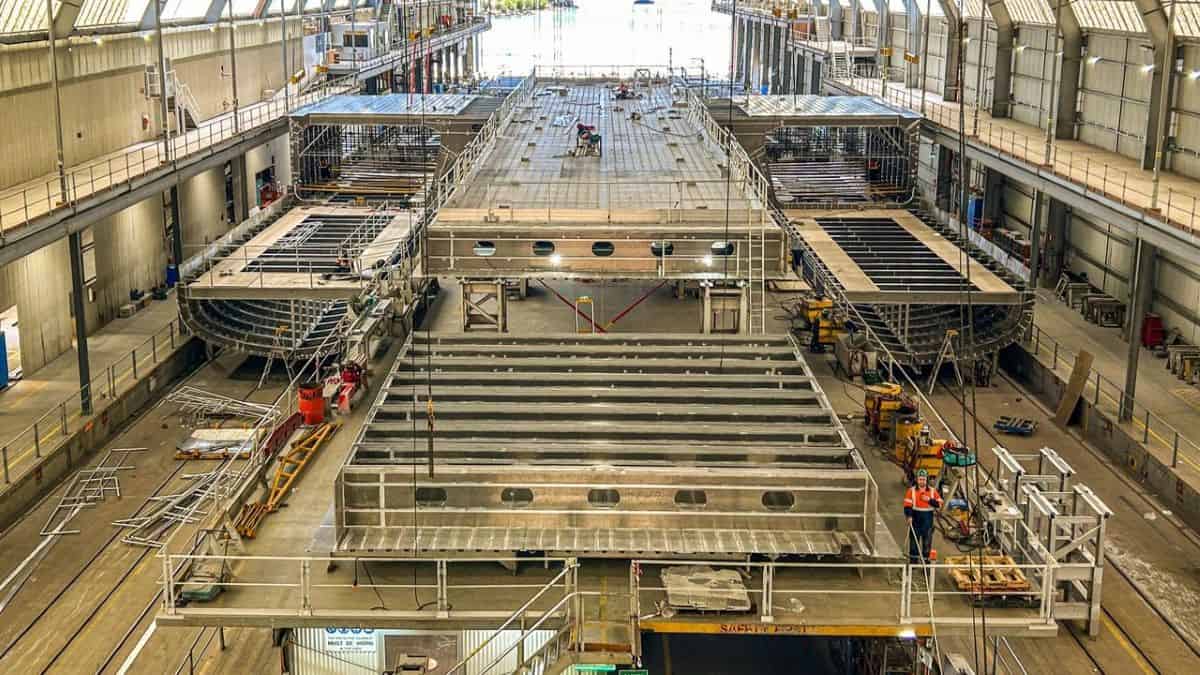
The new 129-metre vessel will join the two electric ferries already underway at Incat’s Hobart shipyard. Operating across the Kattegat routes between Aarhus–Odden and Ebeltoft–Odden, the fleet will provide fast, reliable and fully emissions-free transport on one of Denmark’s busiest domestic corridors.

Incat Tasmania CEO Stephen Casey said the commitment to a third ship demonstrates strong confidence in the companies’ collaboration and in the readiness of large-scale electric ferries for commercial service.

“This is an important milestone for both organisations,” Mr Casey said. “Molslinjen is leading the way in the decarbonisation of high-speed ferry services in Europe, and we are proud to be delivering vessels that will play a central role in Denmark’s clean-transport future.”

“This additional order reflects Molslinjen’s confidence in our people, our processes and our capability to build the world’s most advanced electric high-speed ferries. Together, we are showing what’s possible when innovation, ambition and real-world operational needs come together.”

Molslinjen CEO Kristian Durhuus said the decision to build all three ferries at Incat reflects the strength of the collaboration and the company’s commitment to accelerating the green transition.

“By building all three ferries at the same shipyard, we gain clear advantages and valuable learning from the first to the last vessel. And it is also important for us to have a stable and reliable partner, as we do with Incat. We and our owners are taking the lead and trying to show the way forward in the green transition using technology that, until recently, simply did not exist,” Mr Durhuus said.

Construction of all three electric ferries is already progressing in Hobart, with delivery of the three-ship program scheduled over the coming years.


Latest News

The International Institute of Marine Surveying (IIMS), working in collaboration with the International Marine Contractors Association (IMCA) and the Workboat Association, has announced the publication of the International Workboat Code of Practice, a 122-page guide providing best-practice guidance for the construction, operation and surveying of commercial workboats.

IIMS, IMCA and Workboat Association Launch International Workboat Code of Practice

IIMS, IMCA and the Workboat Association collaborate on a 122-page guide covering vessel safety, operational standards and crew competency for commercial workboats worldwide The International...
The world’s largest battery-electric ship has officially entered commercial passenger service, marking a major milestone for maritime electrification and zero-emission vessel operations. Built by Incat Tasmania for long-standing customer Buquebus, the 130-metre China Zorrilla has completed its maiden commercial voyage between Buenos Aires, Argentina, and Colonia, Uruguay, across the River Plate.

China Zorrilla Begins Electric Ferry Operations

Built for Buquebus to connect Argentina and Uruguay, the China Zorrilla, the world’s largest battery-electric ferry, marks a major milestone in large-scale marine electrification...
Boluda Towage has expanded its Norwegian fleet with the addition of VB NORWEGIAN FALCON, a new tug built by Sanmar Shipyards to support towing, vessel assistance and offshore operations in demanding maritime environments.

Boluda Towage Takes Delivery of VB NORWEGIAN FALCON

Sanmar-built VB NORWEGIAN FALCON features RAstar 3200 SX design, ASD propulsion and more than 6,700 hp Boluda Towage has expanded its Norwegian fleet with the...
SWITCH Maritime has secured a Design Basis Agreement (DBA) from the United States Coast Guard (USCG) for its SWITCH-150 hydrogen fuel cell-electric ferry, marking a key milestone in the development of the 150-passenger vessel. Designed by naval architecture firm Incat Crowther, the SWITCH-150 combines hydrogen fuel cell-electric propulsion with onboard hydrogen storage to support high-frequency ferry operations without compromising service schedules or requiring shoreside charging infrastructure.

SWITCH Hydrogen Ferry Clears Key US Coast Guard Milestone

The US Coast Guard agreement establishes a regulatory framework to guide construction, commissioning and future commercial operation of the hydrogen-powered ferry SWITCH Maritime has secured...

Related news