





In 2024, the world’s first green fuels vessel for offshore wind operations will launch off the UK East Coast, as the result of a ground-breaking agreement between Ørsted and ESVAGT. Now the two companies are expanding their partnership on green offshore operations by signing an agreement for a second green service operation vessel.
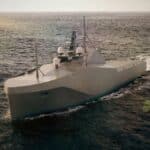
Ørsted and ESVAGT have signed an agreement for a sister vessel to the world’s first methanol-powered service operation vessel (SOV), which was announced in 2022, further deepening the companies’ commitment to reducing carbon emissions from the offshore wind supply chain. The SOV will be ready for launch in 2026, where it will operate out of Ørsted’s UK East Coast Hub on a 10-year contract.
The new SOV will be powered by dual fuel engines, capable of sailing on renewable e-methanol produced from renewable energy and biogenic carbon, which will lead to a yearly carbon emissions reduction of approx. 4,500 tonnes. Ørsted has established itself as a pioneer in the field of green maritime fuels by taking Europe’s largest final investment decision on a renewable e-methanol facility, FlagshipONE in Sweden, and Ørsted expects to supply its own methanol for both of the SOVs. Several other maritime companies have placed orders on methanol-powered vessels, demonstrating that the demand for green fuels is materialising rapidly.
An offshore wind farm already has 99 % lower emissions than a coal-fired power station seen over the entire lifetime of the asset, including production, construction, and installation. Ørsted targets to become carbon-neutral in its energy generation and own operations by 2025, and the additional, second green fuel SOV will build on that, as Ørsted works towards its science-based target of reaching net-zero emissions across the full value chain by 2040.

“As the world leader in offshore wind, Ørsted will continue to look for the best green alternatives to fossil fuels. E-methanol is a strong match for our SOVs, and we’re very pleased that we, along with ESVAGT, will soon welcome the second methanol-powered vessel to our fleet.”
Mark Porter, Head of Operations Europe at Ørsted
“We are delighted to expand our collaboration with Ørsted on this ground-breaking operation. As a global market leader in marine services for offshore wind, ESVAGT is deeply committed to continuously innovating to deliver lower emission solutions. We are looking forward to bringing the first methanol powered SOVs to the market”.
Søren Karas, Chief Strategy & Commercial Officer at ESVAGT
Ørsted has implemented a systematic approach for reducing emissions from its offshore logistics through efficiency initiatives, including route optimisations and sailing at fuel-saving speeds. Ørsted has also implemented light hybrid crew transfer vessels for increased fuel efficiency. Furthermore, Ørsted is taking industry-leading steps towards net-zero wind farms, by working with partners and suppliers on pursuing low carbon solutions across operations, construction and manufacturing.
ESVAGT pioneered the SOV concept and has continued its innovative and holistic approach to running an energy efficient, safe marine operation. From hull design and engine configuration to multi-model transfer options, crew training, digitization and alternative fuels; ESVAGT continues to explore all options to advance the green transition and sustainable operations.
Over the past two years, Ørsted has built up a diverse portfolio of green fuel projects, three of which focus on producing e-methanol for maritime transport. The portfolio includes FlagshipONE in Sweden, which is under construction, and which will produce 50,000 tonnes of e-methanol per year from 2025. Additional projects include ‘Project Star’ on the US Gulf Coast, which will supply 300,000 tonnes of e-methanol for A.P. Moller – Maersk’s fleet of zero-emissions vessels, and the ‘Green Fuels for Denmark’ project in Copenhagen, where Ørsted is working with major Danish players in heavy transport, including shipping.
Fact: The floating home of offshore wind
Servicing an offshore wind farm takes a great deal of effort and is handled by a highly specialised team of service technicians, who are often offshore for weeks at a time. During their stay offshore, the technicians live on a service operation vessel (SOV), which also hosts an on-board workshop and much of the equipment and spare parts needed to service an offshore wind farm.
The new state-of-the-art ESVAGT SOV incorporates the newest technologies and the ESVAGT crew is highly trained and enabled by digital tools. The SOV is designed for comfort and high workability, providing a highly efficient workspace and safe transfer of technicians at the wind farm via a motion-compensated gangway and transfer boats as well as a crane for lifting heavy spare parts. As a floating home, it also offers recreational activities for the on-board crew and technicians, including fitness facilities, a game room, a cinema, and individual accommodation. The SOV is also equipped with a helipad for fast access and transfers to and from shore.
Ship fact sheet
Main particulars:
Length overall: 93.00 m
Breadth: 19.60 m
Maximum draught: 6.50 m
Speed: approx. 14 knots
Accommodation; 124 persons
Helideck: Diameter=18m/9T











, which was announced in 2022, further deepening the companies’ commitment to reducing carbon emissions from the offshore wind supply chain. The SOV will be ready for launch in 2026, where it will operate out of Ørsted’s UK East Coast Hub on a 10-year contract. The new SOV will be powered by dual fuel engines, capable of sailing on renewable e-methanol produced from renewable energy and biogenic carbon, which will lead to a yearly carbon emissions reduction of approx. 4,500 tonnes. Ørsted has established itself as a pioneer in the field of green maritime fuels by taking Europe’s largest final investment decision on a renewable e-methanol facility, FlagshipONE in Sweden, and Ørsted expects to supply its own methanol for both of the SOVs. Several other maritime companies have placed orders on methanol-powered vessels, demonstrating that the demand for green fuels is materialising rapidly. An offshore wind farm already has 99 % lower emissions than a coal-fired power station seen over the entire lifetime of the asset, including production, construction, and installation. Ørsted targets to become carbon-neutral in its energy generation and own operations by 2025, and the additional, second green fuel SOV will build on that, as Ørsted works towards its science-based target of reaching net-zero emissions across the full value chain by 2040.)