



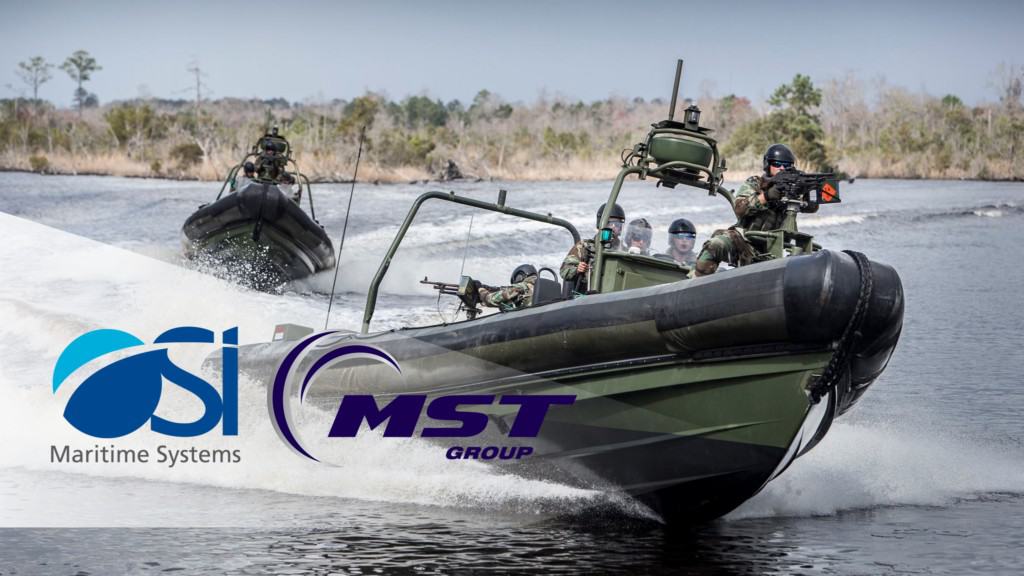
OSI Maritime Systems (OSI) is pleased to announce that it has been contracted by Marine Specialised Technology Group (MST) to deliver 12 sets of OSI’s T-ACT Tactical and High-Speed Navigation Systems to the German Navy.
T-ACT will be installed on the MST built Fast Raiding Interception and Special Forces Craft (FRISC®). These powerful 12-meter small craft, called “Einsatzboote,” will be used by the German Navy operating from the four F126 frigates built by Damen Naval, by the Seebataillon (Force Protection – Marines), the Kampfschwimmer Marine (Special Forces) and the Operational School.
The prime capability of T-ACT, powered by ECPINS Small Craft (SC), is High-Speed Navigation. Radar, WAIS and various navigation sensors are integrated with ECPINS SC software delivering radar control and dedicated NATO WECDIS-based high-speed navigation features to the navigator and the driver. The ECPINS SC software is based on ECPINS WECDIS for surface combatants and submarines, but the HMI and functionality are tailored to small craft operations.
Advanced Tactical C2 capabilities are delivered to support planning and coordination of complex small craft operations such as Search & Rescue (SAR), Humanitarian Aid & Disaster Relief (HA&DR), Non-combatant Evacuation (NEO), Maritime Security (MSO), Amphibious and Special Forces (SF) operations.
“In addition to powerful small craft navigation capabilities, T-ACT offers Interoperability,” stated Jim Davison, Vice President, Business Development. “With ECPINS fitted on both small craft and motherships, the German Navy has the potential to operate their (amphibious) small craft with other NATO partners.”
Missions can be planned at the HQ or on board a mothership and shared with the small craft before they leave. Secure Tactical Data Exchange allows Blue Force Tracking and 2-way transmission of mission-critical information, (local) situational awareness picture and messages overtly or covertly.
Ken Kirkpatrick, President and CEO, OSI added, “Over 35 German Navy vessels are currently being fitted with OSI’s navigation suite; the benefit is that each vessel potentially can act as a mothership for the T-ACT fitted small craft.”











 is pleased to announce that it has been contracted by Marine Specialised Technology Group (MST) to deliver 12 sets of OSI’s T-ACT Tactical and High-Speed Navigation Systems to the German Navy.T-ACT will be installed on the MST built Fast Raiding Interception and Special Forces Craft (FRISC®). These powerful 12-meter small craft, called “Einsatzboote,” will be used by the German Navy operating from the four F126 frigates built by Damen Naval, by the Seebataillon (Force Protection – Marines), the Kampfschwimmer Marine (Special Forces) and the Operational School.The prime capability of T-ACT, powered by ECPINS Small Craft (SC), is High-Speed Navigation. Radar, WAIS and various navigation sensors are integrated with ECPINS SC software delivering radar control and dedicated NATO WECDIS-based high-speed navigation features to the navigator and the driver. The ECPINS SC software is based on ECPINS WECDIS for surface combatants and submarines, but the HMI and functionality are tailored to small craft operations.Advanced Tactical C2 capabilities are delivered to support planning and coordination of complex small craft operations such as Search & Rescue (SAR), Humanitarian Aid & Disaster Relief (HA&DR), Non-combatant Evacuation (NEO), Maritime Security (MSO), Amphibious and Special Forces (SF) operations.“In addition to powerful small craft navigation capabilities, T-ACT offers Interoperability,” stated Jim Davison, Vice President, Business Development. “With ECPINS fitted on both small craft and motherships, the German Navy has the potential to operate their (amphibious) small craft with other NATO partners.”Missions can be planned at the HQ or on board a mothership and shared with the small craft before they leave. Secure Tactical Data Exchange allows Blue Force Tracking and 2-way transmission of mission-critical information, (local) situational awareness picture and messages overtly or covertly.Ken Kirkpatrick, President and CEO, OSI added, “Over 35 German Navy vessels are currently being fitted with OSI’s navigation suite; the benefit is that each vessel potentially can act as a mothership for the T-ACT fitted small craft.”)