


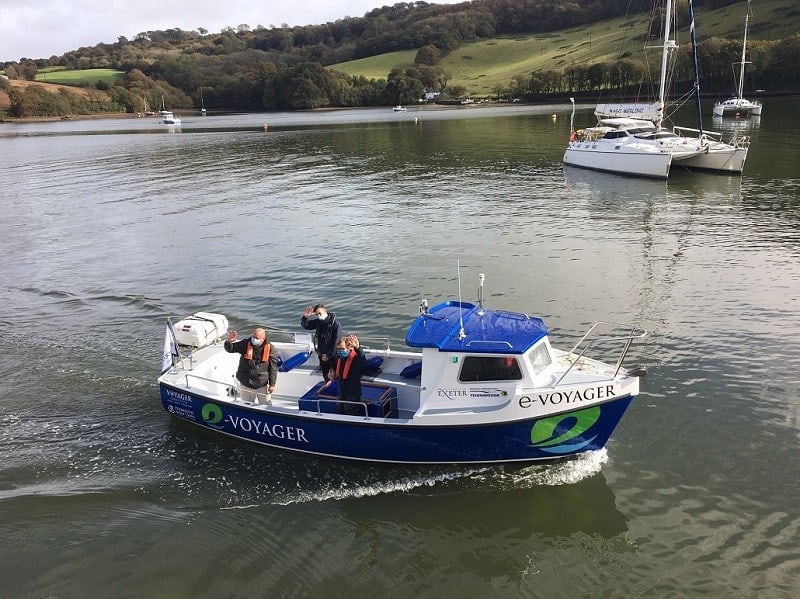
Plymouth Boat Trips and Voyager Marine, Cornwall have launched e-Voyager, the UK’s first sea-going electric ferry. Designed and developed in partnership with the University of Plymouth, the University of Exeter, Teignbridge Propellers, MarRi-Uk and EV Parts, the green ferry will now undergo rigorous running trials, before carrying passengers on Plymouth Boat Trips’ ferry routes from April 2021.
The project has been funded through the £1.4M Clean Maritime Call: a Maritime Research and Innovation UK (MarRI-UK) initiative supported by the Department for Transport (DfT) and launched to support the UK’s goal of zero emission shipping.
Project leader for Plymouth Boat Trips and Voyager Marine, Andy Hurley, said: “It’s hugely exciting to see the launch of e-Voyager and the result of such a progressive collaboration to create a cleaner and more sustainable future for the marine industry. Through developing the technology and maritime applications, Voyager Marine is helping to place Plymouth and the South West as UK leaders in the conversion and new build of zero-carbon, fully electric commercial vessels.”
Partnerships and Funding
Support from the universities came via Environmental Futures & Big Data Impact Lab, a £6.4M project to support small businesses, and the £4M Marine Business Technology Centre, both part-funded by the European Regional Development Fund.
Dr Richard Pemberton, lecturer in Mechanical and Marine Engineering Design at the University of Plymouth added: “Through our diverse mix of staff and specialisms, the University of Plymouth has supported Plymouth Boat Trips and its partners in both data analysis and regulatory advice. The University firmly believes that the work conducted on e-Voyager will pave the way for larger scale innovation towards meeting the Government’s target of a 50% reduction in emissions from the maritime sector by 2050.”
Technology and Design
Engineering technology company, EV Parts, designed the battery storage and motor installation. An advanced electric motor, together with fly-by-wire controls, have replaced the traditional diesel engine, a process which will be directly transferable in under 24m commercial vessels.
The motors, energy storage, control and charging systems are now being tested in a real-world environment, enabling the team to gain approval from regulatory bodies so they can be used in vessels across the sector and carry passengers.
Through duty cycle modelling and advanced simulation of propeller performance, Teignbridge Propellers worked on the project to ensure every kilowatt hour of battery capacity is put to efficient use, ensuring maximum vessel range and safe and effective handling.
Mark Phare, Sales and Marketing Director said: “This pioneering project provides an ideal platform to explore the myriad technical challenges associated with the industry’s accelerating move to full electric propulsion and a low carbon future.”
Commercial Benefits
Repurposed, Nissan Leaf batteries, used in e-Voyager, mean low maintenance and present clear commercial benefits for businesses in the marine sector. The University of Plymouth’s scientists carried out research during the build, measuring emissions including noise pollution, air pollution and fuel consumption.
Brian Lambert, a University of Exeter Research Fellow in the Marine Business Technology Centre project joined the consortium to shape the bid into MarRi-UK. He and Professor Chris Smith worked closely with the team, bringing expertise in project management and innovation to support the development of e-Voyager. The team at Exeter are using their knowledge to investigate safe charging solutions for marine applications, including deposition of nano materials and inductive charging technologies.
Charging Points
Plymouth City Council will install three 22kWh chargers on the Barbican Landing Stage, and using this system e-Voyager will take under three hours to achieve a full charge. The vessel will be charged overnight when berthing, providing enough power to run for a full day and complete its journey on a single charge. If required, the boat can simply plug in and recharge between runs as passengers embark. The council is working with local ferry companies to further develop a charging infrastructure for marine transport in the city.
Green marine future
e-Voyager will be the first vessel to have been recognised by both the MCA and a Classification Society, for satisfying the exacting standards of both organisations. The partners are now progressing to the conversion of larger passenger vessels in Plymouth Boat Trips’ fleet of cruise boats and ferries, along with the new build of similar vessels.