


Latest NewsUncrewed Surface Vessels (USVs)Plymouth Trio Team Up on Autonomous Underwater Sensing Network

Plymouth Trio Team Up on Autonomous Underwater Sensing Network

ZeroUSV, Oshen and Marine AI Team Up on UK Defence Innovation Backed Autonomous Underwater Sensing Network

A trio of Plymouth-based maritime technology specialists, ZeroUSV, Oshen and Marine AI, have unveiled a joint initiative to develop an autonomous underwater sensing network, supported by UK Defence Innovation (UKDI).

All three companies are co-located at Turnchapel Wharf in Plymouth, enabling close, on-site collaboration that is accelerating the development, integration and testing of autonomous maritime systems. The project brings together uncrewed surface vessels, distributed passive sensing and autonomous mission software to create a next-generation underwater sensing network for defence and critical infrastructure protection.

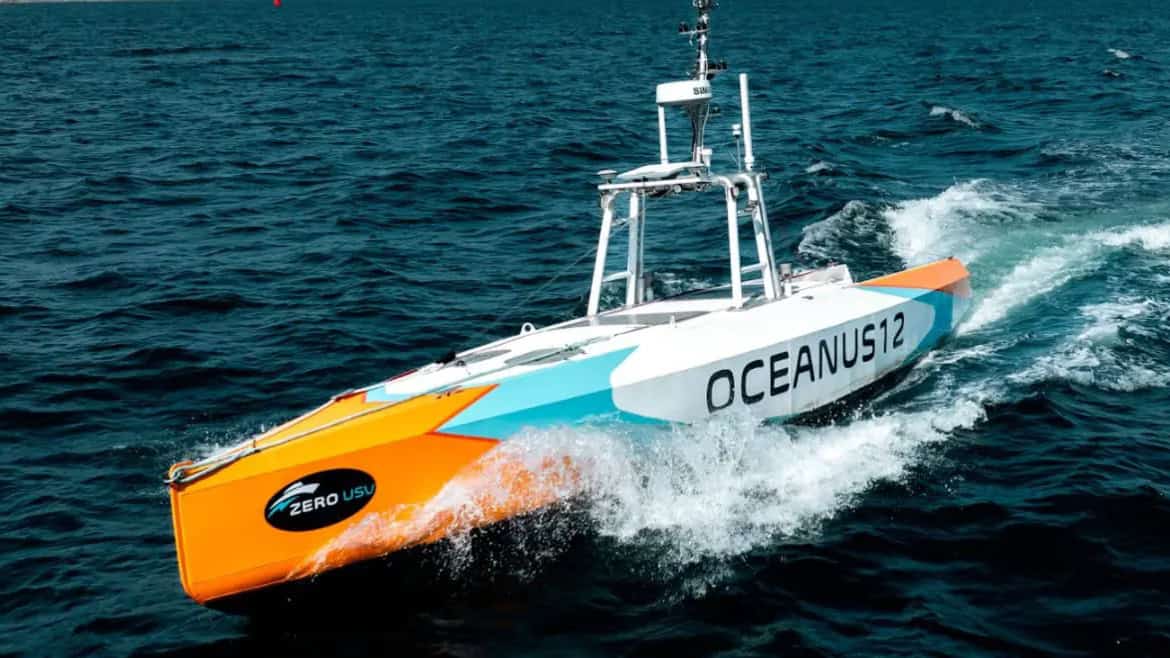
The programme will centre on Oceanus12, an uncrewed surface vessel (USV) developed by ZeroUSV, which will be used to deploy and recover a cluster of Oshen’s C-Star vessels. Acting as a distributed passive acoustic network, the C-Stars will detect and track signals from underwater platforms, including the XV Excalibur, representing an Extra Large Uncrewed Underwater Vehicle (XLUUV).

Funding for the project is provided by UKDI, formerly known as the Defence and Security Accelerator (DASA). The system combines autonomous deployment with passive sensing capabilities to support the monitoring and protection of critical subsea infrastructure, such as underwater cables and pipelines.

MarineAI will integrate the C-Star launch and recovery system with its GuardianAI software aboard Oceanus12, enabling autonomous mission planning, coordination and control of the deployed vessels.

“Underwater operations depend on knowing where assets are and whether they’re operating as intended, but direct communications aren’t always desirable or possible,” said Matthew Ratsey, Co-founder and Managing Director of ZeroUSV. “This project allows us to explore an alternative approach, using Oceanus12 to deploy a small constellation of surface vessels that can listen passively and provide assurance without compromising the mission.”


Latest News

MED MARINE has completed the construction and delivery of two RAmparts 2500-W harbour tugs, MED İskenderun and MED Ceyhan, as part of its ongoing fleet investment programme. Built at EREGLI SHIPYARD, the sister vessels have joined the YAKAMOZ fleet, established through the partnership between MED MARINE and MARIN TUG, and have now entered operational service.

MED MARINE New Tugs for YAKAMOZ Joint Venture

MED İskenderun and MED Ceyhan strengthen YAKAMOZ fleet with additional towing and ship-handling capacity MED MARINE has completed the construction and delivery of two RAmparts...
Inmarsat Maritime, a Viasat company, has launched a new Maritime Safety Data Hub, giving the maritime industry access to data-driven insights into the risks shaping global shipping. The new platform combines three years of Global Maritime Distress and Safety System (GMDSS) data with an industry-first analysis of 106,975 maritime safety broadcasts transmitted in 2025.

Inmarsat Maritime Launches Maritime Safety Data Hub

Industry-first analysis combines three years of GMDSS distress call data with almost 107,000 maritime safety broadcasts, revealing how extreme weather, operational pressures and geopolitical...
LD Armateurs has reached another milestone in the development of its offshore wind service fleet with the launch of Wind of Ocean, the first of two next-generation Service Operation Vessels (SOVs) being built for Vattenfall. The vessel was launched on August 30 at ZPMC shipyard in China, following the keel-laying ceremony earlier this year. The launch moves Wind of Ocean into the next stage of construction, with outfitting, systems integration and sea trials now planned ahead of scheduled delivery in 2027.

LD Armateurs Launches Wind of Ocean SOV

Wind of Ocean will support operations and maintenance activities across Vattenfall’s North Sea wind farms LD Armateurs has launched Wind of Ocean, the first of...
Rolls-Royce Power Systems is expanding its mtu marine propulsion portfolio with a new exhaust gas after-treatment system for Series 2000 engines, designed to meet stringent IMO Tier III emission requirements. The new system is being certified in collaboration with exhaust gas after-treatment specialist Eminox for Series 2000 mtu engines.

Rolls-Royce unveils Tier III emissions solution for mtu Series 2000

New integrated SCR system enables mtu Series 2000-powered vessels to meet IMO Tier III emissions requirements Rolls-Royce Power Systems is expanding its mtu marine propulsion...

Related news