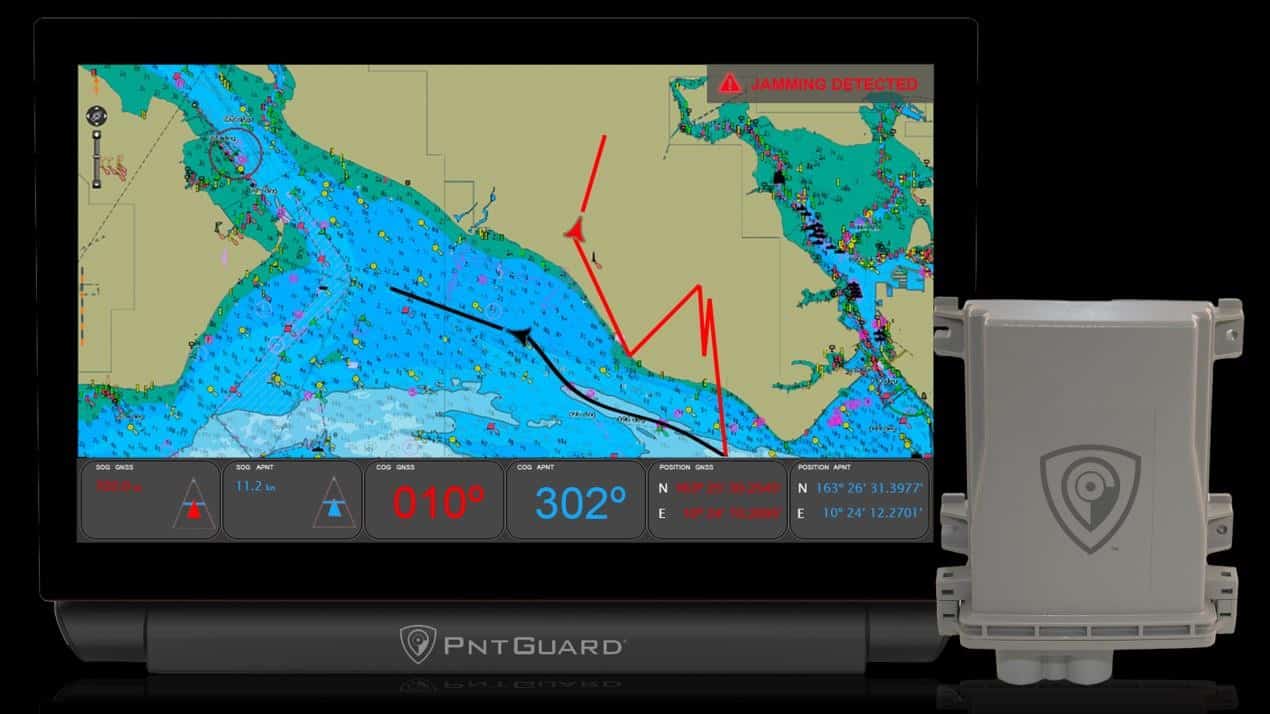
Tschudi Shipping Company, NAL Research, and SGM Technology AS announce the commercial launch of PntGuard™, a next-generation maritime security solution designed to protect vessel navigation against the rising threat of GNSS disruption and spoofing.
PntGuard™ delivers pinpoint situational awareness and ensures the veracity of vessel positioning data at a time when GNSS signals can no longer be taken for granted. Operating as a standalone navigational aid entirely independent of existing bridge systems, PntGuard™ provides instant alerts the moment a vessel’s position is falsified or manipulated — enabling navigators to maintain full control and operational safety even when primary systems are compromised.
It supports navigational integrity at a time when GNSS signals can no longer be taken for granted. A standalone navigational aid independent of all other bridge systems, PntGuard™ delivers instant alerts the moment a vessel’s position is falsified, providing true position data when other bridge systems are compromised.
Malicious disruption of GNSS/GPS signals is increasing at an alarming pace. Attacks can originate from land-based systems, hostile or “dark-fleet” vessels, or even occur opportunistically in congested sea lanes – often without vessel crews ever realising their position has been manipulated.
Such interference is now recognised as a strategic threat with the potential to cause serious physical, commercial, and legal damage. By corrupting GNSS/GPS signals using a proliferation of low-cost equipment, attackers can place a ship miles away from its actual location, fabricate AIS tracks, and trigger cascading errors across bridge systems jeopardising crew safety. This amplifies the risk of various critical scenarios including:
- Collisions and groundings (especially in low visibility, at night, and in dense traffic zones with risk to life, assets, and the environment)
- Unintended or manipulated entry into restricted waters
- Claims of sanctions evasion / calling at ports in sanctioned states
- Port delays / disruptions to cargo logistics including deviations causing delays, increased fuel consumption, and emissions.
- Charter disputes and insurance challenges when a vessel appears to have breached compliance boundaries
- Concern is being voiced at the highest levels in shipping, while all major marine insurers are recommending urgent action to safeguard operational resilience.
Leveraging leading Assured Positioning, Navigation and Timing (APNT) technology, PntGuard ™ is the most resilient solution on the market. Most solutions available today can only warn that GNSS/GPS is disrupted, but do not provide an alternative authenticated, trusted position. Enabled by the Iridium® low-Earth orbit (LEO) satellite network, PntGuard™ receives a secured PNT signal that is about 1,000 times more powerful than GNSS/GPS and is resilient to jamming and spoofing of those systems. The solution complements a vessel’s navigation feed with accurate situational awareness and immediately alerts the crew to manipulation or interruption.
Easy to install and use, PntGuard ™ comprises two compact components – an above-deck unit (receiver) that connects to the Iridium PNT service and a below-deck unit (bridge display) that shows both the falsified GPS track and the vessel’s true position on a nautical chart in real time.
Most crews would never know they’re being spoofed until it’s too late. PntGuard ™ provides a single point of truth so crews can react rapidly and continue to navigate with confidence.
Shore offices can also receive an accurate record of a vessel’s true position at any time – proof that can be shared with charterers or insurers to defend against claims based on false data – safeguarding both revenue and reputation.
PntGuard ™ is built on the same technology that enables APNT solutions for many aspects of critical infrastructure, including telecommunications networks, data centers, and utilities. Its performance for maritime use has been thoroughly proven through multi-month sea trials with leading international shipowners through a proof-of-concept pilot program with Norway’s DNK, one of the world’s leading maritime war risk insurers, and through independent evaluations for two consecutive years at Jammertest in Andøya, Norway.