


Eleven partners from five European countries join forces to accelerate zero-emission inland shipping with a next-generation long-range electric vessel demonstrator
A European consortium of eleven partners from five countries has launched Riverboost, a Horizon Europe-backed project aimed at overcoming one of the biggest barriers to zero-emission inland shipping by demonstrating a 110-metre fully electric container vessel with a sailing range up to 40% greater than comparable electric vessels currently in operation.
Coordinated by CEA LITEN in France, the project will run until October 2029, bringing together expertise from across the inland shipping, research and technology sectors. Dutch inland shipping operator Nedcargo will provide the demonstration vessel.
While inland waterways remain a key component of Europe’s freight transport network, operators face mounting pressure to decarbonise without compromising operational reliability. Riverboost seeks to address the current limitations of battery-electric vessels by integrating advanced energy storage, high-efficiency powertrain technologies, river-water cooling systems, modular DC electrical architecture and hydrodynamically optimised hull designs.
The impact of Riverboost will be demonstrated through a new 110-metre fully electric inland container vessel built for Nedcargo, a frontrunner in electric inland shipping. Replication studies by CMA CGM will explore pathways towards commercial roll-out, while inland waterway transport authorities, knowledge centres, consortium partners and the project advisory board will help ensure alignment with infrastructure, regulation and deployment needs.
The vessel will feature a swappable hybrid energy storage system that combines solid-liquid and LFP battery chemistries, supported by advanced battery management and energy management systems. This approach is intended to increase energy density, extend system lifetime and improve operational flexibility.
Further efficiency gains will be delivered through a modular DC architecture designed to improve system efficiency by 15%, together with hydrodynamic hull optimisation aimed at reducing energy consumption by up to 20%. Riverboost will also develop safety guidelines for approving next-generation battery systems, supporting regulatory alignment and future scalability across Europe’s waterways. Alongside these technical innovations, Riverboost will explore new commercial models, including Battery-as-a-Service.
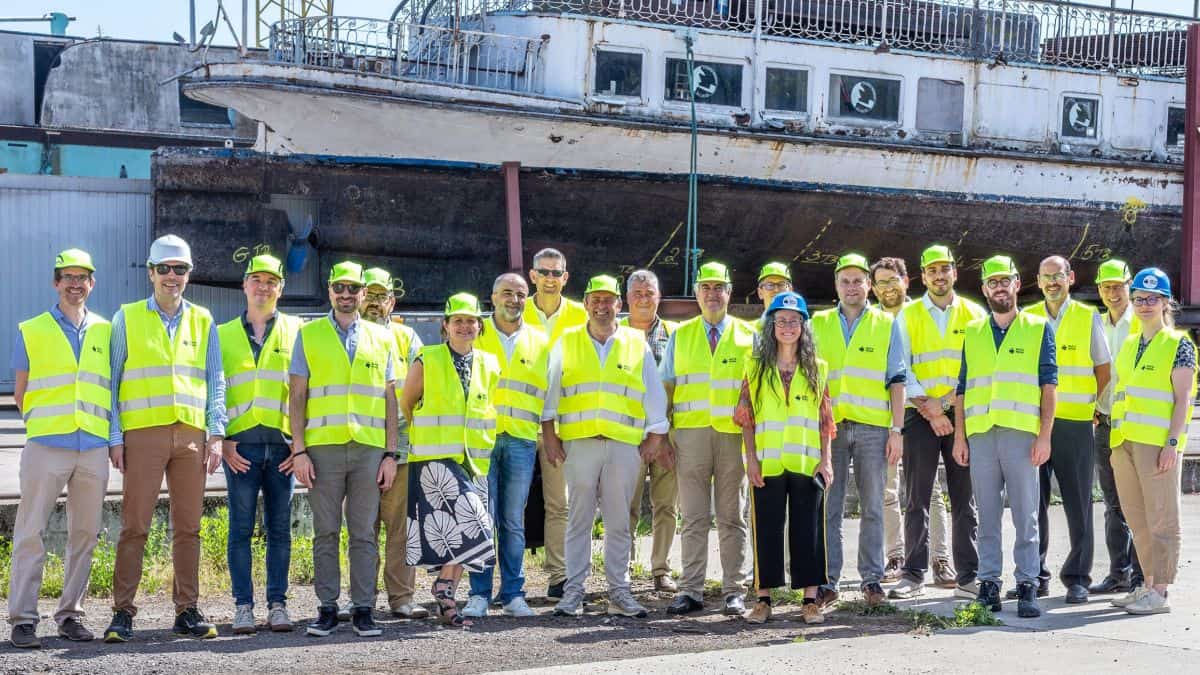
Riverboost brings together CEA, DST, VAAR, BATIA MOSA, ABS, SPB/EICB, AVL, AUTH, VNF, CMA CGM and Nedcargo. The kick-off meeting was held in the headquarters of BATIA MOSA, where the attendees had fruitful discussions about the work to be done and were shown around the impressive wharf. At the end of the day, the partners were eager to start their work in this exciting project.
The project runs from 1 May 2026 to 31 October 2029, with a total budget of €9.08 million and a European contribution of €7.49 million.