



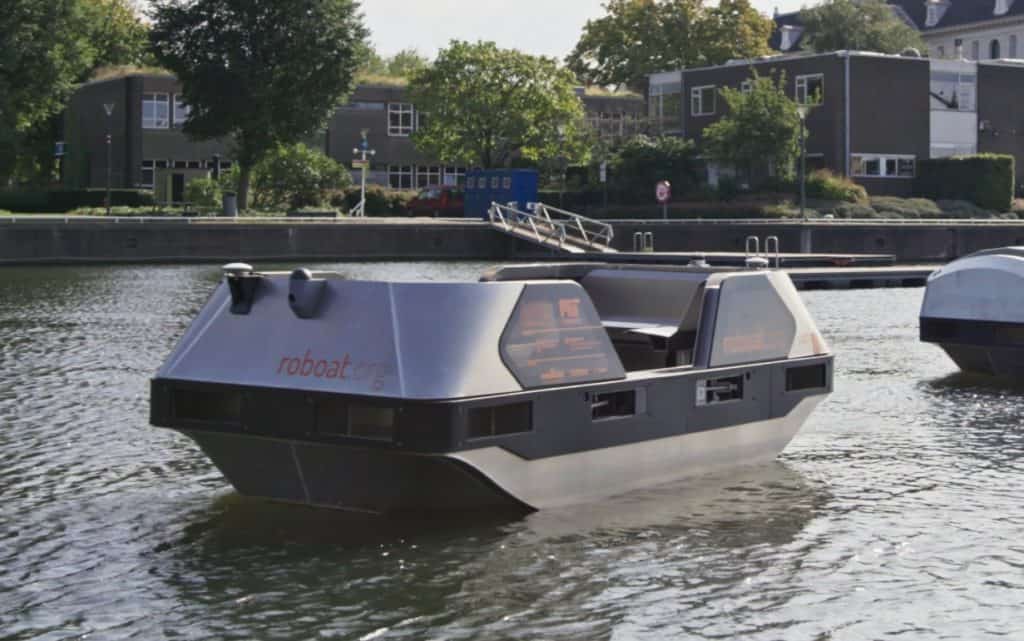
Roboat is ready for the next steps towards pilots and commercialization. Starting Nov 2021, the project will continue developing 3 use cases: passenger transport, logistics (waste collection), surveying water infrastructure, and monitoring water quality.
What if autonomous boats could help the city of Amsterdam to move part of the road traffic to the water, while creating innovative solutions for urban challenges? Roboat – a research project by Massachusetts Institute of Technology (MIT) and Amsterdam Institute for Advanced Metropolitan Solutions (AMS Institute) – successfully developed autonomy for two full-scale prototypes. After five years of R&D, the project is ready for the next steps towards pilots and commercialization. Starting November 2021, the project will continue developing three use cases: passenger transport, logistics (waste collection) and surveying water infrastructure and monitoring water quality.
“The historic centre of Amsterdam with its network of canals and modern-day challenges – such as congestion and logistics – are a perfect place to start the real-life pilots aimed at creating more sustainable and smart transport over water.” Stephan van Dijk Director of Innovation
A self-learning boat that adapts based on experiences on the water
Roboat has come a long way since the team first started prototyping small vessels in the MIT pool in late 2015. With two full-scale boats now sailing in Amsterdam, Roboat is more than a proof of concept. This year the researchers and engineers focused on developing autonomy for the two full-scale prototypes, including: way-point finding, autonomously docking and undocking, and collision avoidance. Roboat is self-learning and adapts its abilities based on experiences on the water.
“Picture being amid the hustle and bustle on the Amsterdam canals – this urban context involves tight space maneuvering, including high complexity and not a lot of structure, caused by a great variety of obstacles that can be encountered. To navigate the bustling waters of Amsterdam, Roboat needs a meticulous fusion of proper navigation, perception, and control software.” Ynse Hendrik Deinema Roboat Project Coordinator
What makes Roboat navigate autonomously?
The Roboat team deploys algorithms to, among others, categorize specific objects it detects during its pathway. Tests take place at the inner-harbor of Marineterrein Amsterdam Living Lab – a testbed for innovation located at the heart of Amsterdam.
To autonomously determine a free path, Roboat uses LIDAR and cameras to enable a 360-degree view. This is also referred to as the “perception kit” and lets Roboat understand its surroundings. When the perception picks up a new object, for instance a canoe – the algorithm flags the item as “unknown.”
When the team later looks at the collected data from the day, the object is manually selected and tagged as “canoe.” This way the algorithm is trained to – in time – outperform the human eye in object recognition. Furthermore, the boat’s latching mechanism allows the boat to connect to a docking station, or to another Roboat.
What makes Roboat navigate autonomously?
To autonomously determine a free path, Roboat uses LIDAR and cameras to enable a 360-degree view. This “perception kit” lets Roboat understand its surroundings. ©MIT/AMS Institute
Perception kit
To autonomously determine a free path, Roboat uses LIDAR and cameras to enable a 360-degree view. This “perception kit” lets Roboat understand its surroundings. ©Oculus film
Roboat’s eyes and ears
How Roboat perceives its surroundings. Roboat autonomously responds to objects on the water – such as boats that pass by. ©MIT/AMS Institute
“Every time the vessel navigates the area, it gains experiences and learns from previous situations and object encounters. As a result of the continuous feedback loops Roboat can now autonomously navigate in this area.”Ynse Hendrik Deinema Roboat Project Coordinator
“With the latching mechanism, Roboat can form temporary bridges to create new urban infrastructure, as well as floating stages and bridges.” Carlo Ratti Professor at MIT Senseable City Lab & AMS PI
Next phase: ‘one autonomous taxi, please’
The next step for Roboat is to commercialize the technology. Next year the team will focus future developments on three use cases: passenger transport, logistics (waste collection) and surveying/monitoring applications.
“By, for instance, using Roboat to collect waste from Amsterdam’s city center, the number of traffic movements within the city can be reduced, which alleviates pressure from the fragile bridges and quay-walls.”
Stephan van Dijk Director of Innovation
Roboat collaborates with pioneering companies and cities to further scale up the technology. “Whereas autonomous shipping focuses on more straightforward trajectories, Roboat is designed to navigate dynamic and busy urban waterways, such as the Amsterdam canals. Which makes Roboat relevant for delta cities and harbour areas world-wide. It also creates new possibilities for flexible urban infrastructures. Combined with its ability to perform its tasks 24/7, Roboat can add great value for a city,” van Dijk concludes.
Roboat is designed to navigate the urban dynamics of the Amsterdam canals. ©MIT/AMS Institute
Background
With 165 canals winding alongside busy city streets, about a quarter of Amsterdam’s surface area is water. Five years ago, MIT and AMS Institute set the ambition to develop a fleet of autonomous vessels. An idea that was born to alleviate pressure from Amsterdam’s busy city center and re- imagine the Amsterdam canals.
Roboat is a research project of MIT and AMS Institute. Project partners: City of Amsterdam and Waternet. Project sponsors: Murata (12kW battery pack), Torqeedo (thruster pods), VETUS (bow thrusters). Boat-hull constructed by Stormer Marine.









, surveying water infrastructure, and monitoring water quality.What if autonomous boats could help the city of Amsterdam to move part of the road traffic to the water, while creating innovative solutions for urban challenges? Roboat – a research project by Massachusetts Institute of Technology (MIT) and Amsterdam Institute for Advanced Metropolitan Solutions (AMS Institute) – successfully developed autonomy for two full-scale prototypes. After five years of R&D, the project is ready for the next steps towards pilots and commercialization. Starting November 2021, the project will continue developing three use cases: passenger transport, logistics (waste collection) and surveying water infrastructure and monitoring water quality.)