


RPA 8 retrofit to guide future procurement and operational planning across the fleet.
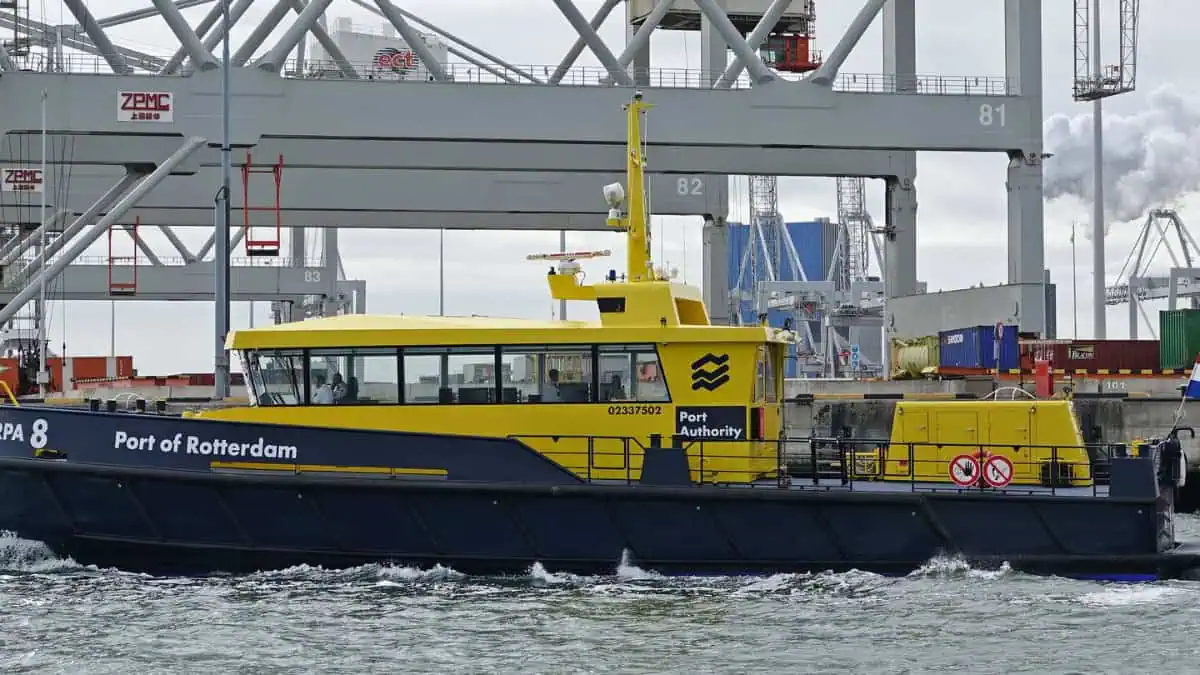
The Port of Rotterdam Authority has confirmed plans to convert the patrol boat RPA 8 to full electric propulsion, marking a significant milestone in its drive toward an emission-free operations fleet. The electrified patrol boat will act as a real-world testbed, allowing the organisation to build hands-on expertise in electric sailing, onboard energy management, and the lifecycle upkeep of advanced electrical systems—insights that will directly inform future fleet renewal strategies.
In parallel with the upgrade programme, the Port Authority has also finalised new long-term maintenance agreements covering its existing vessel portfolio, ensuring continuity and reliability as the transition to cleaner operations accelerates.
Kooiman Marine Group, which built the vessel ten years ago, will carry out the electric retrofit of the RPA 8 in collaboration with Gebhard Electro for the Port of Rotterdam Authority. Berte Simons (COO Port of Rotterdam Authority) signed a contract for this together with Rinus Kooiman (Director of Shipyard Gebr. Kooiman) and Gerard Kraaij (Director Gebhard Electro).
The Port of Rotterdam Authority uses the RPA 8 for surveillance, inspections, and daily safety tasks in the port. The vessel is already a hybrid patrol vessel: it can run on both diesel and diesel-electric propulsion. This made the vessel significantly more fuel-efficient than comparable vessels in this segment. During the full electrification of the vessel, the Port Authority will also gain experience with the battery packs, including their lifespan, charge and discharge times, sailing profiles, and the necessary infrastructure.
Over the next eleven years, the Port of Rotterdam Authority’s vessels will reach the end of their technical lifespan. The Port Authority is seizing this opportunity to renew its entire fleet, make it more sustainable, and simplify maintenance processes by standardizing and opting for a modular design.
The Port of Rotterdam Authority’s management has expressed its ambition to make the new fleet as emission-free as possible, thus contributing to a sustainable port. The priority is that the new vessels must be available 24/7 to ensure a clean, safe, and efficient port.
At the same time, Berte Simons also signed agreements with Olav Bos of De Haas Rotterdam and Chiel Redelijk of Shipyard Rotterdam. This agreement allows the Port of Rotterdam Authority to ensure that the vessels remain reliable and comply with all required certifications.
De Haas Rotterdam and Shipyard Rotterdam will provide fourth-line maintenance for the Port Authority’s vessels over the next ten years. This includes large-scale maintenance—work that goes beyond daily or periodic maintenance. Regular damage repairs are also included in this agreement. This is crucial for a fleet that is operational 24/7.
“With these signings, we are strengthening our course toward a modern, sustainable, and future-proof fleet for the Port Authority,” says Berte Simons. “We are investing not only in technology and innovation, but also in collaboration with regional partners who share our ambitions. These partnerships ensure that we can continue to provide our services safely, cleanly, and efficiently in the future.”