Ship & Boat BuildingTugsSanmar sells powerful compact tug to UK port authority

Sanmar sells powerful compact tug to UK port authority

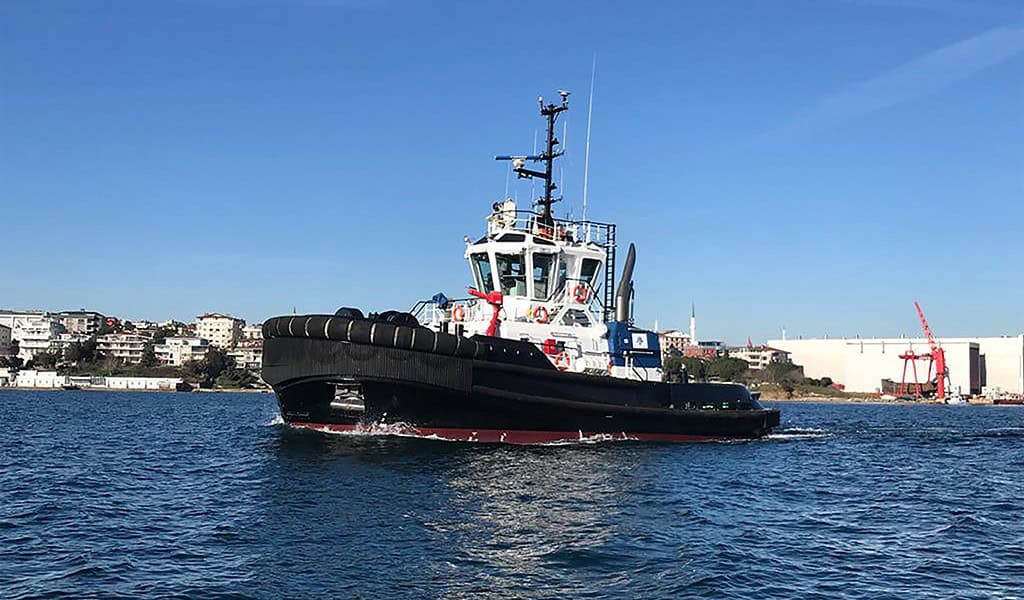
Sanmar Shipyards has sold the tug Sirapinar Xll to Portland Harbour Authority which operates the former Royal Navy harbour at Portland, Dorset, on the UK’s south coast.

Formerly operating as part of Sanmar’s own fleet, the 2019-built Sirapinar Xll is a twin Z-drive, diesel powered tugboat designed for maximum efficiency when performing ship-handling duties for sea-going ships.

Langham Industries took over control of Portland Harbour from the Royal Navy in 1997, since then it has developed into a thriving commercial port, that handles cruise ships, cargos, bunker vessels and also maintains a strong relationship with the Royal Navy and the Royal Fleet Auxiliary.

Powered by two Caterpillar 3512C main engines, each producing 1,500kW at 1,600 rev/min, the 22.4m x 10.80m x 4.89m Sirapinar Xll has a bollard pull of 50 tonnes and can achieve a speed ahead of 12 knots. Propulsion is provided by Schottel SRP 360 FP Z-drives and the vessel has a fuel oil capacity of 70m3.

Vimal Choy, Head of Regional Sales, Europe of Sanmar, said: “The Sirapinar series is exclusive to Sanmar and has been one of our most successful in terms of popularity and achievement. A compact, yet powerful little sister to our larger Bogacay tugs, it combines the low operational and maintenance costs associated with a compact hull, with manoeuvrability and a hefty bollard pull.”

Mike Shipley, General Manager (Marine) at Portland, said: “We are extremely happy with the tug and that of Sanmar’s professionalism and attention to detail from initial contact to final delivery of the tug here in Portland. The ‘Rupert Best’ will prepare us well for future port developments.”

Bill Reeves, CEO at Portland, said: “I am delighted that we have added the new Sanmar tug to our fleet. The people at Sanmar have been a pleasure to deal with and have been professional and responsive throughout.”


Categories:

Latest News

The International Institute of Marine Surveying (IIMS), working in collaboration with the International Marine Contractors Association (IMCA) and the Workboat Association, has announced the publication of the International Workboat Code of Practice, a 122-page guide providing best-practice guidance for the construction, operation and surveying of commercial workboats.

IIMS, IMCA and Workboat Association Launch International Workboat Code of Practice

IIMS, IMCA and the Workboat Association collaborate on a 122-page guide covering vessel safety, operational standards and crew competency for commercial workboats worldwide The International...
The world’s largest battery-electric ship has officially entered commercial passenger service, marking a major milestone for maritime electrification and zero-emission vessel operations. Built by Incat Tasmania for long-standing customer Buquebus, the 130-metre China Zorrilla has completed its maiden commercial voyage between Buenos Aires, Argentina, and Colonia, Uruguay, across the River Plate.

China Zorrilla Begins Electric Ferry Operations

Built for Buquebus to connect Argentina and Uruguay, the China Zorrilla, the world’s largest battery-electric ferry, marks a major milestone in large-scale marine electrification...
Boluda Towage has expanded its Norwegian fleet with the addition of VB NORWEGIAN FALCON, a new tug built by Sanmar Shipyards to support towing, vessel assistance and offshore operations in demanding maritime environments.

Boluda Towage Takes Delivery of VB NORWEGIAN FALCON

Sanmar-built VB NORWEGIAN FALCON features RAstar 3200 SX design, ASD propulsion and more than 6,700 hp Boluda Towage has expanded its Norwegian fleet with the...
SWITCH Maritime has secured a Design Basis Agreement (DBA) from the United States Coast Guard (USCG) for its SWITCH-150 hydrogen fuel cell-electric ferry, marking a key milestone in the development of the 150-passenger vessel. Designed by naval architecture firm Incat Crowther, the SWITCH-150 combines hydrogen fuel cell-electric propulsion with onboard hydrogen storage to support high-frequency ferry operations without compromising service schedules or requiring shoreside charging infrastructure.

SWITCH Hydrogen Ferry Clears Key US Coast Guard Milestone

The US Coast Guard agreement establishes a regulatory framework to guide construction, commissioning and future commercial operation of the hydrogen-powered ferry SWITCH Maritime has secured...

Related news