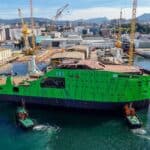
SCHOTTEL, a global leader in marine propulsion systems, has been selected to equip the world’s first large purpose-built methanol dual-fuel escort tugs with its innovative rudderpropellers featuring the SYDRIVE-M mechanical hybrid solution. The groundbreaking tugs to be named “SD Aisemaht” and “SD Qwiy Aanitsa Sarah”, are currently in the final stages of construction at Turkish Sanmar Shipyards. After their completion in Q3 2025, they will service Canada’s Trans Mountain Expansion Project, escorting laden crude oil tankers from the outer harbour limits of the Port of Vancouver to the open Pacific Ocean through the commercial shipping lanes of the Salish Sea.
“We are pleased to move forward and implement these newbuild green solutions to the Trans Mountain Expansion Project enhanced tug escort program,” says Laurens Korporaal, Business Development Manager, KOTUG Canada. “These tugs, propelled by modern climate-friendly SCHOTTEL propulsion systems, exhibit the aspirations of the British Columbia tug market to improve environmental performance of shipping activity and advance new solutions to local and global environmental challenges.”
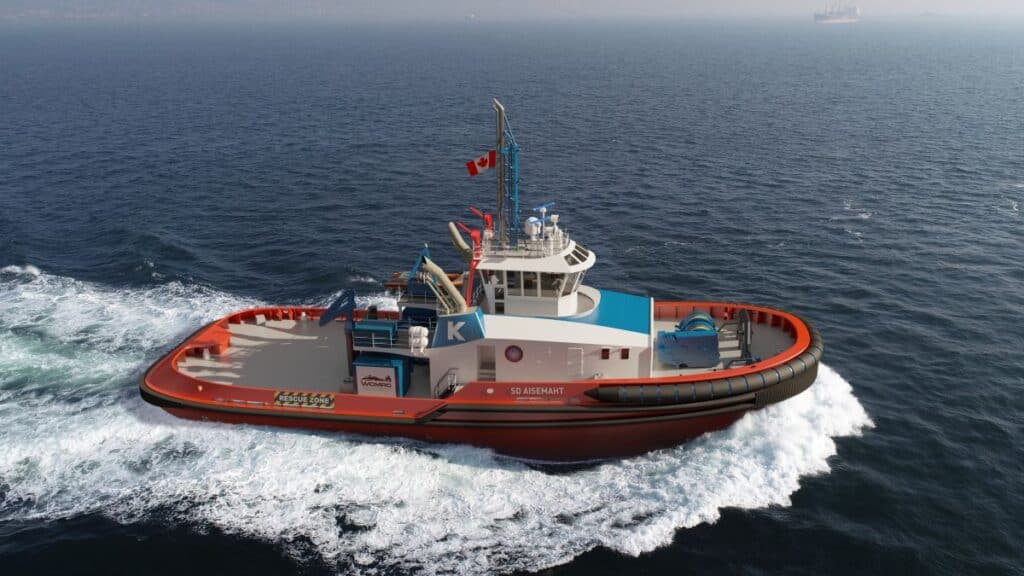
In order to provide the best performance for their tasks, the methanol dual-fuel escort tugs require a propulsion system that offers both transit efficiency and high bollard pull. For this purpose, the vessels are each equipped with two SCHOTTEL RudderPropellers type SRP 710: The 360-degree steerable SRP combines bollard pull with high propulsion efficiency and provides the ships with excellent manoeuvring capabilities. In addition, the tugs are also each fitted with a SCHOTTEL TransverseThruster type STT 170. With this propulsion system, the vessels will achieve a free sailing speed of up to 14 knots and an impressive bollard pull of over 120 tonnes, making them the most powerful escort tugs in Canada.
Less fuel consumption due to SCHOTTEL SYDRIVE-M and graphene paint
Since the tugs operate along the shores of the Salish Sea and the respective Salish Sea communities including the Sc’ianew First Nation, they have to meet special environmental requirements in terms of their equipment, which is also reflected in the chosen propulsion system: To further optimize fuel savings and reduce underwater radiated noise, all four of the ordered SRP azimuth thrusters feature SCHOTTEL SYDRIVE-M. The mechanical hybrid solution allows the two thrusters per vessel to be driven together by only one of the main engines. This reduces main engine operating hours, resulting in lower maintenance costs as well as less fuel consumption and lower emissions. Furthermore, the system needs no additional electrical components. In addition, the hulls of both tugs are coated with a graphene paint to minimize biofouling and enhance the hull-smoothness of the vessels which reduces underwater radiant noise and makes the vessels more fuel efficient.
About the Trans Mountain Expansion Project (“TMEP”)
The Trans Mountain Expansion Project (“TMEP”) is a recently completed expansion of a 1,180-kilometre pipeline, carrying crude and refined products from Edmonton, Alberta, to the coast of British Columbia, Canada, at Westridge Terminals in Burnaby. The expanded pipeline system has an increased capacity of 890,000 barrels per day, boosting the number of exports of crude oil by ship significantly.