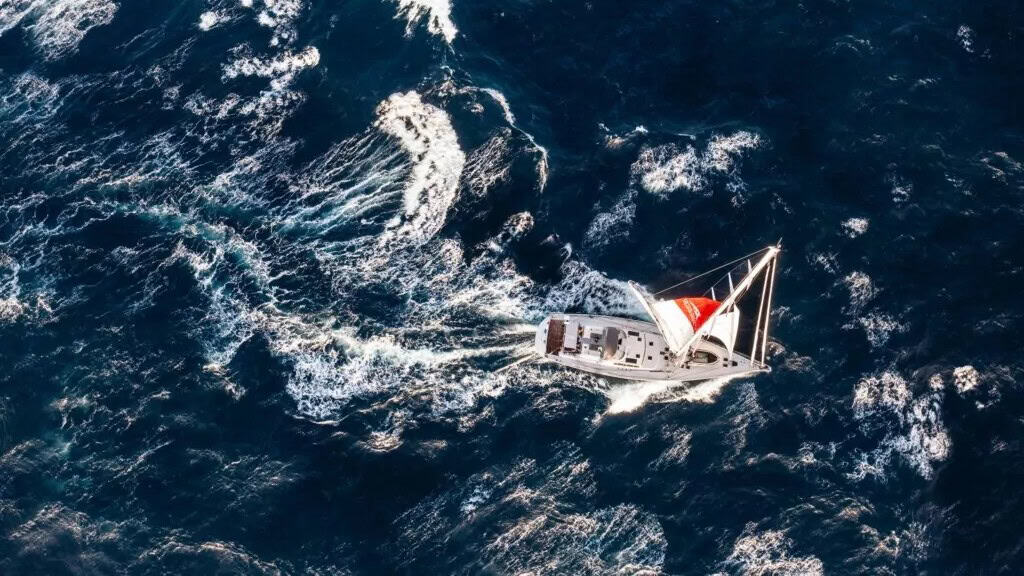
SEA.AI, a pioneer in AI-powered maritime safety solutions, has joined forces with Team Malizia to equip the revolutionary research vessel Malizia Explorer with advanced hazard detection technology. This collaboration merges cutting-edge AI with global ocean conservation efforts, reinforcing the vessel’s mission to collect critical environmental data while safeguarding marine ecosystems
This isn’t a new alliance. SEA.AI has worked closely with Boris Herrmann’s team since 2020, beginning with the Malizia – Seaexplorer IMOCA.
During high-speed offshore races, our system helped detect surface hazards—including boats, drifting objects, debris, and marine life—proving its reliability under extreme conditions.
More than just users, Team Malizia actively contributed to the system’s evolution, sharing onboard experience and technical feedback that helped refine and improve the technology.
So, when Team Malizia launched a full-time research vessel, bringing SEA.AI aboard again was the obvious next step. The Malizia Explorer is equipped with SEA.AI’s AI-powered hazard detection system, which will be used to:
- Detect and alert crews to surface-level hazards in real time—marine animals, vessels, debris, and more
- Minimize collision risk, especially at night and in remote or low-visibility regions
- Feed valuable detection data into conservation and maritime safety networks
- Collect real-world inputs that will help improve SEA.AI’s AI models
The data collected during these expeditions, especially in remote regions and in the presence of marine life, will provide valuable input for improving SEA.AI’s detection models.
Supported by the onboard crew, who help capture essential context before the labeling phase, this collaboration will contribute to future software updates rolled out across all SEA.AI systems.
SEA.AI is proud to be part of this project alongside some of the most respected institutions in marine science and climate research.
Partners on board include the Alfred Wegener Institute, GEOMAR Helmholtz Centre for Ocean Research Kiel, Helmholtz-Zentrum Hereon, UNESCO’s Intergovernmental Oceanographic Commission, the Swiss Polar Institute, and the Prince Albert II of Monaco Foundation, to name a few.
F. Laeisz, a historic German shipping company which currently manages a dedicated fleet of research vessels, is a key partner of the Malizia Explorer project.
Being part of this international effort means not only providing technology, but also engaging in a shared mission rooted in collaboration, curiosity, and ocean protection.
Team Malizia brings a mobile research platform with a global mission, experienced crew, and world-class scientific partners.
SEA.AI provides the tool for safe navigation and data acquisition that will help improve safety at sea and reduce the risk of collisions with marine mammals.
Together, they’re proving that exploration and protection can, and should, go hand in hand.
“Our mission has always been about raising awareness around climate change and the Ocean. With Malizia Explorer we are able to expand our impact, venture to new regions, collaborate with scientists, and communicate the urgent message about Ocean health and climate change. We want to not only collect data but also bring the story of what’s happening beneath the surface to life. SEA.AI helps us operate safely in remote areas while also feeding AI that will benefit sailors and scientists far beyond our own crew.”Boris Herrmann, Skipper, Team Malizia
“Team Malizia has already pushed our technology in ways only real missions can. With Malizia Explorer, we’re gaining access to rare, high-value data—from wildlife encounters to regions few vessels reach—that will directly shape how our AI evolves across all systems.”Marcus Warrelmann, CEO, SEA.AI
Powered by the wind and equipped with state-of-the-art technologies, Malizia Explorer offers an exceptional platform for international scientists.
It combines clean mobility with advanced systems, creating new opportunities for ocean research across remote and under-explored regions.
Now setting out on its scientific missions (missions we’ll be following with great enthusiasm) we wish all the best to Malizia Explorer and its crew on this important journey.