Autonomous VesselsRemotely Operated Vessels (ROV)SMD announced the sale of its first electric ROV to Jan De...

SMD announced the sale of its first electric ROV to Jan De Nul

Global subsea engineering and technology company, SMD, today announced the sale of its first electric ROV to Luxembourg-based marine contractor, Jan De Nul Group.

SMD’s Quantum EV will be integrated into Jan De Nul Group’s new cable laying vessel, Fleeming Jenkin, and deployed to offshore energy projects globally.

The new fully-electric ROV offers superior levels of stability, position-keeping, efficiency and reliability, for increased performance across a wide range of subsea applications, at a lower operational cost. Speaking on the sale, SMD’s deputy CEO, Paul Davison, said: “We are delighted to have received the first order for our pioneering and powerful Quantum EV, the only vehicle of its kind currently market-ready.

“We have delivered solutions to Jan De Nul for many years and their talented team is as innovative as they come. Their new cable laying vessel, Fleeming Jenkin, will be powered by engines which can run on biofuel and green methanol, in combination with large batteries and exhaust gas treatment systems, which perfectly aligns with our sustainability targets.”

As a tier-one marine contractor, Jan De Nul Group offers a range of offshore services to clients around the globe. Commenting on its latest partnership with SMD, Jan Van de Velde, Director Newbuilding at Jan De Nul Group, said: “It is a pleasure to announce our continued collaboration with fellow innovator, SMD. Once built, the Fleeming Jenkin will be the world’s largest and cleanest cable-laying vessel. Our attention to environment and climate is mirrored in SMD’s Quantum EV, which not only offers superior efficiency and reliability but also consumes less energy and drastically reduces the risk of oil contamination.”

Mark Collins, Innovation Director at SMD, added: “Jan De Nul is a company which shares our commitment to building a better future underwater – a notion epitomised in our electric range of modular robotic vehicles. With the Quantum EV operated from the vessel’s central control positions, this pioneering vessel will be future-proofed, paving the way for offshore energy projects globally.”


Latest News

The International Institute of Marine Surveying (IIMS), working in collaboration with the International Marine Contractors Association (IMCA) and the Workboat Association, has announced the publication of the International Workboat Code of Practice, a 122-page guide providing best-practice guidance for the construction, operation and surveying of commercial workboats.

IIMS, IMCA and Workboat Association Launch International Workboat Code of Practice

IIMS, IMCA and the Workboat Association collaborate on a 122-page guide covering vessel safety, operational standards and crew competency for commercial workboats worldwide The International...
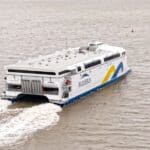
The world’s largest battery-electric ship has officially entered commercial passenger service, marking a major milestone for maritime electrification and zero-emission vessel operations. Built by Incat Tasmania for long-standing customer Buquebus, the 130-metre China Zorrilla has completed its maiden commercial voyage between Buenos Aires, Argentina, and Colonia, Uruguay, across the River Plate.

China Zorrilla Begins Electric Ferry Operations

Built for Buquebus to connect Argentina and Uruguay, the China Zorrilla, the world’s largest battery-electric ferry, marks a major milestone in large-scale marine electrification...
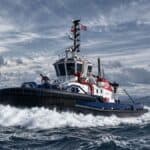
Boluda Towage has expanded its Norwegian fleet with the addition of VB NORWEGIAN FALCON, a new tug built by Sanmar Shipyards to support towing, vessel assistance and offshore operations in demanding maritime environments.

Boluda Towage Takes Delivery of VB NORWEGIAN FALCON

Sanmar-built VB NORWEGIAN FALCON features RAstar 3200 SX design, ASD propulsion and more than 6,700 hp Boluda Towage has expanded its Norwegian fleet with the...
SWITCH Maritime has secured a Design Basis Agreement (DBA) from the United States Coast Guard (USCG) for its SWITCH-150 hydrogen fuel cell-electric ferry, marking a key milestone in the development of the 150-passenger vessel. Designed by naval architecture firm Incat Crowther, the SWITCH-150 combines hydrogen fuel cell-electric propulsion with onboard hydrogen storage to support high-frequency ferry operations without compromising service schedules or requiring shoreside charging infrastructure.

SWITCH Hydrogen Ferry Clears Key US Coast Guard Milestone

The US Coast Guard agreement establishes a regulatory framework to guide construction, commissioning and future commercial operation of the hydrogen-powered ferry SWITCH Maritime has secured...

Related news