



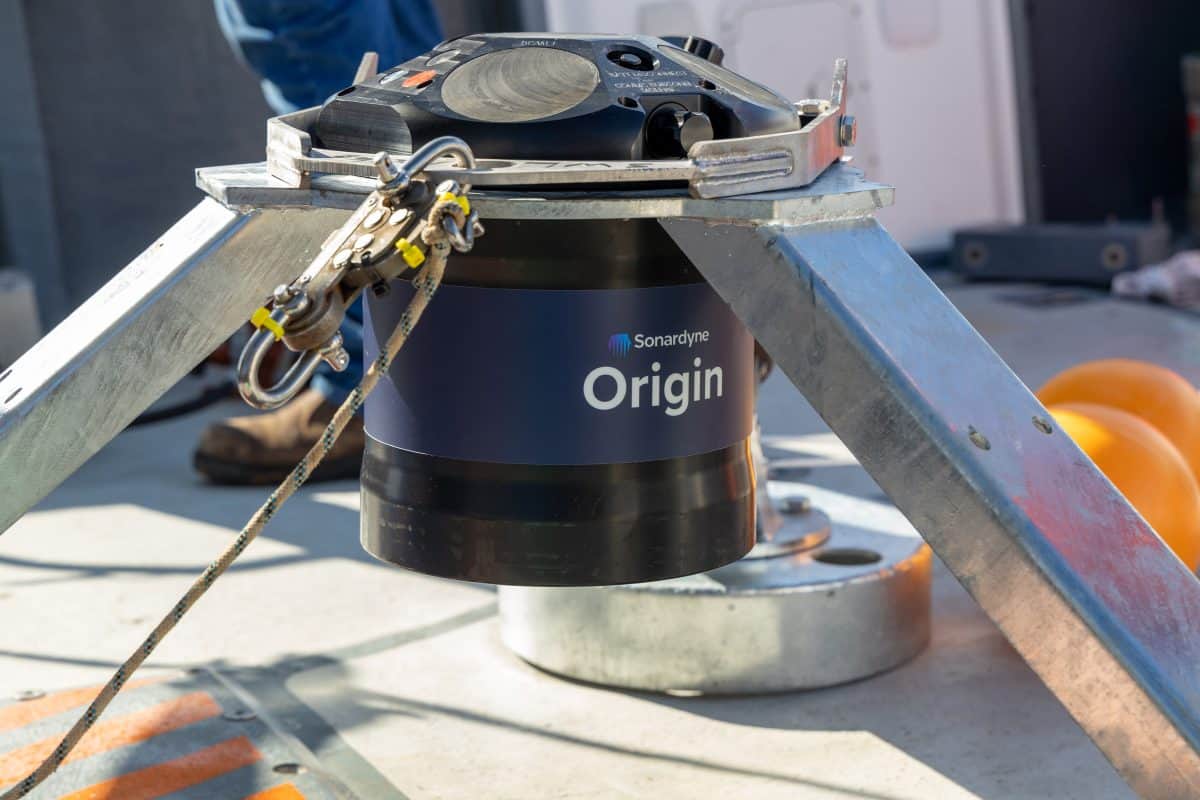
Marine energy, defence and science company Sonardyne has been selected to provide a subsurface communications and navigation network for the Smart Sound Connect Subsurface (SSCS) Project. Sonardyne will partner with the University of Plymouth and Plymouth Marine Laboratory to install, operate and manage an underwater acoustic communications and navigation network that will link to the existing surface assets.
Located in the city of Plymouth and the waters in and around Plymouth Sound, SSCS builds on the existing Smart Sound Plymouth infrastructure that underpins the National Centre for Coastal Autonomy. The £1.2million initiative, supported by funding from the Heart of the South West Local Enterprise Partnership, will further enhance the unique proving ground for businesses to test, trial, prototype and commercialise new products and services.
During 2023, Sonardyne will provide nine navigation and communications nodes based on its 6th Generation (6G®) technology, which can be deployed on the seabed either as fixed or mobile networks. In addition, two integrated sensor nodes will be supplied to enable real-time reporting of key subsurface operational safety parameters, including water temperature and currents. Sonardyne’s new Origin 600 ADCP with integrated acoustic communications and onboard Edge processing will be at the heart of these. In addition, two gateways to the subsea networks will be provided: Firstly, a Ranger 2 GyroUSBL, which can be mounted on either a crewed or uncrewed surface vessel, will act as a mobile gateway, and secondly, a Mini-Ranger 2 system, which will be mounted on the L4 buoy as a fixed gateway. Sonardyne will also be providing a comprehensive training and support package.
Geraint West, Head of Science at Sonardyne, said: “We’re really excited that our technology will be heading the next chapter in Smart Sound Plymouth’s evolution. We are proud members of the Plymouth maritime ecosystem, and this project is set to be a great showcase not only for our technology, but also the region as a whole.”
Dr Alex Nimmo-Smith, Associate Professor of Marine Physics at the University of Plymouth, said: “This initiative expands on the already unique capabilities and facilities of Smart Sound Plymouth, and creates unrivalled opportunities for research that will advance our understanding of the ocean. It will also enable us to work even more closely with businesses across the marine and maritime sector, and to use our collective knowledge to inspire the workforce of the future.”
Smart Sound is designed to be a unique proving ground for businesses and researchers to test, trial, prototype and commercialise new products and services. Its aim is to accelerate the adoption and deployment of advanced marine and maritime technologies across multiple sectors, including offshore energy, aquaculture, defence, and advanced engineering.
With nearly 1,000 km2 of authorised and deconflicted water space and a unique combination of infrastructure facilities and local expertise, Smart Sound Plymouth is already one of the UK’s premier maritime proving and trials facilities. SSCS will elevate its capabilities to a new level to create the first truly multi-domain connected offshore environment in the UK.
Dr James Fishwick, Head of Smart Sound Plymouth, said: “Smart Sound Plymouth is central to Plymouth’s ambition to be a world-leading academic and business cluster for the development of the next generation of maritime technologies in order to better understand our oceans and create new sustainable businesses. We look forward to working with Sonardyne to realise this ambition.”
Karl Tucker, Chair of the Heart of the South West LEP, said: “We are delighted to support the University of Plymouth and Plymouth Marine Laboratory in advancing the capabilities of Smart Sound through Sonardyne’s technologies. The upgraded Smart Sound will provide even more opportunities for world-class testing and research, adding to Plymouth’s unique offering as a global centre of excellence for ocean technologies including autonomous marine vessels.”










 Project. Sonardyne will partner with the University of Plymouth and Plymouth Marine Laboratory to install, operate and manage an underwater acoustic communications and navigation network that will link to the existing surface assets. Located in the city of Plymouth and the waters in and around Plymouth Sound, SSCS builds on the existing Smart Sound Plymouth infrastructure that underpins the National Centre for Coastal Autonomy. The £1.2million initiative, supported by funding from the Heart of the South West Local Enterprise Partnership, will further enhance the unique proving ground for businesses to test, trial, prototype and commercialise new products and services. During 2023, Sonardyne will provide nine navigation and communications nodes based on its 6th Generation (6G®) technology, which can be deployed on the seabed either as fixed or mobile networks. In addition, two integrated sensor nodes will be supplied to enable real-time reporting of key subsurface operational safety parameters, including water temperature and currents. Sonardyne’s new Origin 600 ADCP with integrated acoustic communications and onboard Edge processing will be at the heart of these. In addition, two gateways to the subsea networks will be provided: Firstly, a Ranger 2 GyroUSBL, which can be mounted on either a crewed or uncrewed surface vessel, will act as a mobile gateway, and secondly, a Mini-Ranger 2 system, which will be mounted on the L4 buoy as a fixed gateway. Sonardyne will also be providing a comprehensive training and support package.)