



Ship & Boat BuildingFerriesTECO 2030 and Umoe Mandal submits fuel cell high-speed vessel design for...

TECO 2030 and Umoe Mandal submits fuel cell high-speed vessel design for approval in principle

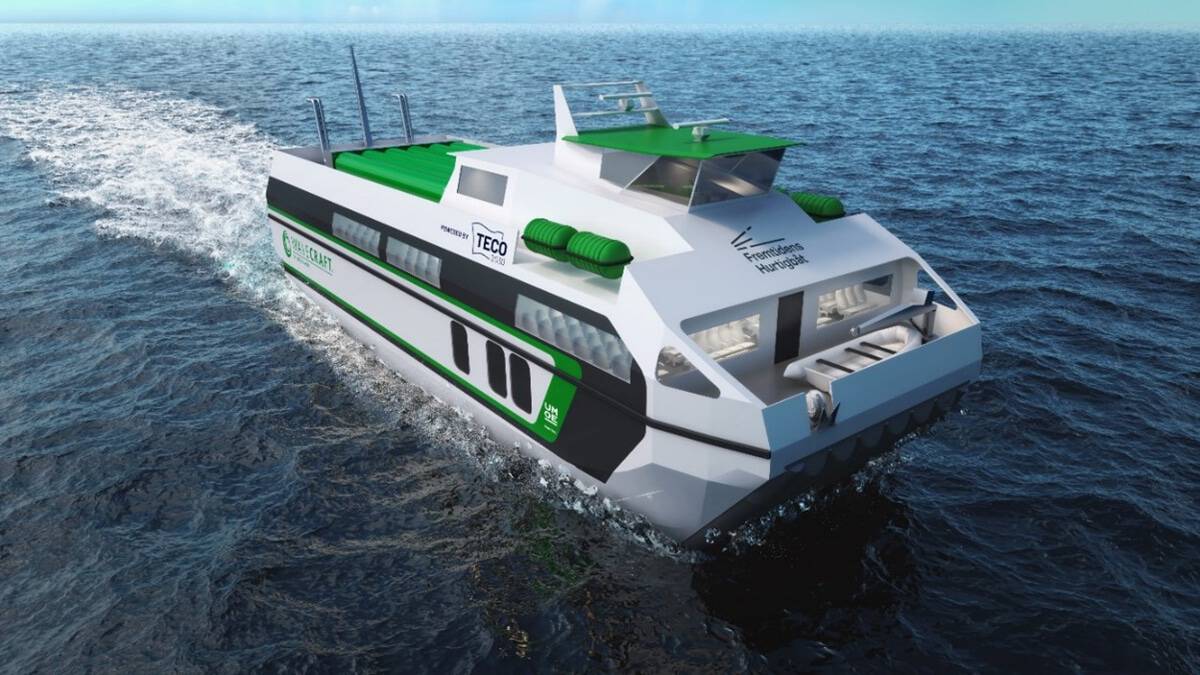
TECO 2030 and Umoe Mandal has just delivered the documentation package to the Norwegian Maritime Authority for an approval in principle application of the World’s first fuel cell high-speed vessel design. The designed vessel is designed to be installed with a multimegawatt fuel cell system for full propulsion.

The ship will be constructed based on Umoe Mandal’s proven Crew Transfer Vessel (CTV) Surface Effect Ship (SES) technology and with the air-cushion catamaran design it will offer low imprint on surrounding environment, even in challenging and vulnerable ocean conditions. CTVs are often used during the construction, maintenance, and operation of offshore wind farms. This specific vessel will be a passenger vessel and have a service speed of 35 knots, a range of minimum 160 nautical miles and carry 275 passengers.

This vessel design is expected to raise a tremendous amount of interest from the global maritime industry as they seek alternatives to transform away from fossil fuels, towards more sustainable fuels. The vessel design aims at being a first of its kind, a zero-emission high-speed passenger vessel sailing along the coast without emitting anything but warm air and water.

Once the vessel design and hydrogen propulsion plant has received the approval in principle, TECO 2030 and Umoe Mandal together with suppliers will continue the process of reaching Final Approval.

“It is a major accomplishment for us to announce our developed partnership with Umoe Mandal and submit all documentation to Norwegian Maritime Authority for an approval in principle on a ship designed for the future of zero emission maritime transportation. I am excited to continue to build on this design platform as we move forward together with our strong partner Umoe Mandal,” says Tore Enger, Group CEO TECO 2030. “This achievement demonstrates the industry’s readiness to embrace commercial and public tenders for passenger vessels powered by hydrogen, thereby contributing to efforts to reduce and eliminate pollution in the maritime industry,” Enger concludes.


Latest News

Marine Futures has launched applications for the 2027 MarineShift360 Impact Accelerator Programme, offering marine businesses a ten-month programme of free support to assess and reduce environmental impact and make better design, purchasing and investment decisions.

Applications Open for MarineShift360 Accelerator

Marine Futures invites applications for its third annual MarineShift360 Impact Accelerator Programme, providing lifecycle assessment expertise and tailored sustainability guidance at no cost. Marine Futures...
SANMAR Shipyards has signed a contract with Greek towage operator NEMECA for the construction of a new BOĞAÇAY Class tug, BOĞAÇAY XCVII, as the company continues to expand and modernise its fleet in the Mediterranean.

SANMAR to Build New Tug for Greek Operator NEMECA

Greek towage operator NEMECA has ordered an 80+ tonne bollard pull tug from SANMAR Shipyards, building on a partnership established with the delivery of...
SEA.AI has integrated its maritime machine vision technology into unmanned surface vessels (USVs) developed by MARTAC, enhancing the sensor capabilities of the company’s autonomous maritime platforms for intelligence, surveillance, reconnaissance (ISR), security and patrol missions.

MARTAC USVs Integrates SEA.AI Machine Vision Technology

The partnership combines SEA.AI’s visual intelligence technology with MARTAC’s scalable autonomous platforms for maritime security and surveillance SEA.AI has integrated its maritime machine vision technology...
Robosys Automation has completed a test campaign at MARIN (Maritime Research Institute Netherlands), evaluating its VOYAGER AI Autonomous Navigation System (ANS) against 55 recognised DNV benchmark marine traffic scenarios to assess its collision avoidance performance and compliance with international navigation regulations.

Robosys Validates VOYAGER AI Against 55 DNV Scenarios

Robosys Automation’s VOYAGER AI underwent evaluation at MARIN as part of the development of its Autonomy Testbed for testing and comparing collision avoidance systems Robosys...

Related news











