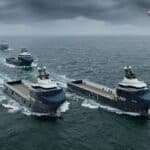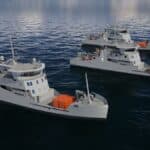




The Norwegian Ship Design are pleased to announce that a shipyard contract has been signed for the construction of their flagship project, the world’s two largest hydrogen ferries. These ferries have been designed and developed in collaboration with Torghatten Nord and will be built at Myklebust shipyard in Norway.
The project “hydrogen ferry to Vestfjorden” began for us back in 2019 with preparations for a tender that was announced in 2021. In 2022, Torghatten Nord signed a contract with the Norwegian Public Roads Administration, and an extensive development process has been underway since then, including Hazid, preliminary approvals, safety analyses, and model tests. After working on this prestigious project for such a long time, it is exciting to finally start building the ferries.
Each of the two 117m long ferries will have a capacity of 120 cars and 599 passengers. As the ferries will operate in the outer Vestfjorden in Lofoten, one of the longest and most challenging ferry routes in Norway, they are designed with closed car decks and a special hull design for operate in exposed waters. The vessels incorporate new technology, ensuring safety and comfort for passengers and crew without compromising.
Hydrogen fuelled passenger transportation over such a long and demanding route has not been conducted anywhere else in the world. It is essential for us to emphasize that the design and technical solutions used meet all safety aspects for ferries navigating in highly exposed waters. The ferries will be the world’s largest hydrogen-powered vessels and will feature the largest hydrogen installation ever installed on a ship. Each vessel will have 6400 kW of fuel cells with associated auxiliary systems. The onboard hydrogen is stored in compressed form.
The ferries are designed for 100% zero-emission and feature a multi-hybrid propulsion system with hydrogen-electric as the primary mode and diesel-electric as the secondary mode.
CEO, Gjermund Johannessen, highlights the complexity of the project: “Extensive safety analyses have been conducted for the onboard hydrogen system to ensure that the ferries are as safe as modern diesel ferries.” He further states, “Extensive model tests of the new hull design have also been conducted to ensure low energy consumption and good roll damping in the rough sea area that is the outer Vestfjorden. Through close collaboration with Torghatten Nord and their technical team, the project is now more than ready to welcome the respected shipyard, Myklebust Verft, on board!”
Project manager, Stian Holsen, explains, “Norwegian Ship Design delivers an extensive design package, including everything from design to 3D modelling and delivery of construction / working drawings. We look forward to an exciting and groundbreaking project, as well as a good collaboration with Torghatten Nord, Myklebust Verft, and all involved suppliers.”
Being a part of this prestigious project is significant for all at The Norwegian Ship Design Company and they stand behind Torghatten Nord and CEO Marius Hansen, comment about the project: “I am proud that we are achieving this in Norway, as this is a major lift for the Norwegian technology and shipbuilding environment. Together with the authorities, we are setting the standard for a completely new class of ships, with a world-class innovation and climate project.”