Power & PropulsionBattery TechnologyTrafikverket Drives Forward with Battery Hybrid Retrofit of Ferry Neptunus

Trafikverket Drives Forward with Battery Hybrid Retrofit of Ferry Neptunus

Trafikverket, a division of the Swedish Transport Administration responsible for operating Sweden’s state-owned road ferries, together with Stockholms Reparationsvarv (Stockholm Shipyard), has selected Zeabuz, a specialist in intelligent navigation solutions for the maritime industry, and Metstech, an electrical and automation systems integrator, to deliver advanced automation and energy management technologies for the conversion of the road ferry Neptunus to battery-hybrid operation.

The conversion is one step in a much larger process outlined in Trafikverket’s Vision 45 document. The aim is to decarbonise the entire fleet of ferries by 2045 – the year in which the Swedish government has set the target for the country to become climate neutral.

The joint delivery will provide a complete automation and energy solution to support safer, cleaner, and more efficient operations on the Gullmarsleden route. As part of the retrofit, Zeabuz will supply an automated transit system enabling Neptunus to navigate precisely between docks with automated control of acceleration, steering, and positioning. The system will optimize battery use, reduce operator workload, and ensure stable and predictable operations on this high-frequency public route. 

Metstech is delivering the battery system to be retrofitted on board. The systems will allow Neptunus to operate with high energy efficiency and recharge safely and quickly during normal turnaround times, minimizing downtime and emissions while securing reliable service. 

Neptunus operates on the Gullmarsleden route between Finnsbo and Skår in Bohuslän, a critical link in Sweden’s national transport infrastructure. The SEK 97 million retrofit will be carried out at Stockholm Repair Yard and represents a major investment in next-generation ferry capability. 

This joint project demonstrates how automation and smart energy systems together can deliver immediate performance gains for public ferry fleets. Zeabuz and Metstech are proud to support Färjerederiet in delivering real-world progress toward maritime sustainability and operational excellence. Theuy thank Trafikverket Färjerederiet for their continued trust and collaboration and look forward to launching Neptunus as a model for modern, net-zero ferry transport. 

Latest News

Boluda Towage has expanded its Norwegian fleet with the addition of VB NORWEGIAN FALCON, a new tug built by Sanmar Shipyards to support towing, vessel assistance and offshore operations in demanding maritime environments.

Boluda Towage Takes Delivery of VB NORWEGIAN FALCON

Sanmar-built VB NORWEGIAN FALCON features RAstar 3200 SX design, ASD propulsion and more than 6,700 hp Boluda Towage has expanded its Norwegian fleet with the...
SWITCH Maritime has secured a Design Basis Agreement (DBA) from the United States Coast Guard (USCG) for its SWITCH-150 hydrogen fuel cell-electric ferry, marking a key milestone in the development of the 150-passenger vessel. Designed by naval architecture firm Incat Crowther, the SWITCH-150 combines hydrogen fuel cell-electric propulsion with onboard hydrogen storage to support high-frequency ferry operations without compromising service schedules or requiring shoreside charging infrastructure.

SWITCH Hydrogen Ferry Clears Key US Coast Guard Milestone

The US Coast Guard agreement establishes a regulatory framework to guide construction, commissioning and future commercial operation of the hydrogen-powered ferry SWITCH Maritime has secured...
Norwegian ocean surface measurement specialist Miros has introduced a new 3D vessel view for its WaveSystem wave monitoring platform, giving crews and offshore operators a consolidated view of measured sea conditions around their vessel.

Miros Introduces 3D Vessel View for Real-Time Wave Monitoring

Miros introduces a vessel-specific 3D visualisation to help operators interpret real-time wave measurements at critical offshore working locations Norwegian ocean surface measurement specialist Miros has...
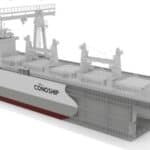
Elegant Exit Company (EEC) has partnered with Conoship International to develop a high-capacity Floating Dry Dock (FDD) concept designed to provide a controlled, environmentally responsible alternative to traditional ship dismantling methods. Ship recycling through beaching remains a major environmental and humanitarian challenge for the maritime industry, exposing coastal ecosystems to potential contamination and workers to hazardous operating conditions.

EEC and Conoship Develop Versatile Floating Dry Dock Concept

The high-capacity floating dry dock concept is designed to support shipbuilding, maintenance and green ship recycling while improving environmental protection and worker safety Elegant Exit...

Related news