Van Oord has taking a significant step forward in its commitment to sustainability by successfully installing advanced Selective Catalytic Reduction (SCR) systems on its cable-laying vessel, Nexus. The installation was carried out by Damen Shipyards Group, further enhancing the vessel’s environmental performance and reducing its emissions.
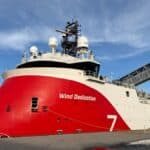
The Nexus is a Damen Offshore Carrier (DOC) 8500 delivered in 2014. The 122.68 x 27.45 metre vessel undertakes cable laying operations, principally in the offshore wind sector. With the SCRs installed, Van Oord has reduced the NOX emissions of its vessel by up to 80%.
The project required the installation of five SCR units, one for each of the Nexus’ engines. Damen developed its Marine NOX Reduction system in 2015 in preparation for IMO Tier III regulations. The system has proven itself on multiple applications on tugs, workboats, yachts and inland shipping vessels.
The system uses a catalyst to react with injected urea to chemically reduce NOX from the vessel’s exhaust gases. Damen adapted its proven, standard system to meet the specific requirements of the Nexus.
This project demonstrates the synergy to be found within the Damen Group, an important factor for Van Oord, says Manager Projects Fleet Hein Leemhuis, “We chose Damen based on their familiarity with the Nexus as the original builder. Additionally, they were able to offer us a one-stop-shop solution, taking care of the entire project.”
Damen’s included the undertaking of a feasibility study to assess, and make proposals for the installation of the SCRs. Furthermore, Damen was responsible for the engineering, production and installation of the systems. Additionally, Damen’s scope included unburdening the client by taking care of the arrangements for the verification and certification for class notation of the vessel.
A further factor in Van Oord’s decision to contract Damen is that the Marine NOX Reduction system is a relatively compact system, with all component parts combined.
“Damen’s system combines the damper and scrubber in one unit. With an existing vessel that has not been built with an SCR installation in mind, there is a minimum of space available, so a system such as this, which requires less volume, is ideal for a retrofit project.”
Reduced NOX emissions is increasingly becoming a license to operate, particularly in the offshore wind sector in which the Nexus is active. Next to this, Van Oord, like Damen is committed to increased maritime sustainability.
The company operates its own Sustainability Programme, within which it focuses on the four pillars of enhancing the energy transition, accelerating the energy transition, accelerating climate action, empowering nature and communities, and achieving net zero emissions.
Following the completion of the project, the Nexus has been extensively, independently tested and the effects of the Selective Catalytic Reduction installation on her NOX emissions verified.
Speaking of the successful conclusion to the project, Damen’s Program Manager Sustainable Propulsion André de Bie says, “There is a good match in the culture and mentality between Damen and Van Oord – we both want to go forward. When you’re both looking in the same direction, things are easier. As a result, there has been a very pleasant cooperation that has helped to ensure such a positive result.”