


Vessev expands into the US with FlyTahoe partnership and fresh capital to accelerate electric hydrofoil commercialisation
Vessev has secured $19 million in Series A and follow-on financing as the New Zealand marine technology company, which develops electric hydrofoiling vessels, announces FlyTahoe as its first US commercial customer, alongside a series of demonstrations and industry activations planned for New York City, Washington, D.C., and Lake Tahoe.
The developments mark a significant step in Vessev’s international growth strategy, bringing its electric hydrofoiling technology to US customers, policymakers, investors and maritime industry leaders.
The funding was led by Blackbird Ventures, an early backer of Canva and one of Australia’s leading venture firms. New investors GD1 and Rypples joined the round alongside existing investors K1W1 (early investor in Rocket Lab), Icehouse Ventures (early investor in Halter), Shasta Ventures, NZVC, and existing angel investors. The capital will accelerate in-house serial production of Vessev’s VS–9 vessel line, expand the company’s global go-to-market team, advance development of its onboard software and telemetry platform, accelerate the development of larger vessels, and support plans to manufacture in the United States.
“Hydrofoiling doesn’t just make boats better, it redefines what’s possible on water,” said Eric Laakmann, co-founder and CEO of Vessev. “By combining electric propulsion, advanced foiling systems, and software, we’re making vessels significantly more efficient, better for passengers and more scalable for operators. Lake Tahoe is an ideal place to demonstrate our technology and we’re excited to work with our first U.S. customer, FlyTahoe, to help communities rethink mobility on the lake, offering a faster, more reliable alternative.”
Lake Tahoe welcomes more than 15 million visitors annually, yet congestion around the lake has become a persistent challenge for residents and visitors alike, with up to 20,000 vehicle trips a day between North and South Shore. FlyTahoe wants to offer a faster, more reliable alternative by moving people over water instead of around it.
“This technology unlocks an entirely new era of sustainable water transit – offering a faster alternative to Tahoe’s infamous traffic while helping preserve the lake’s famous clarity,” said Ryan Meinzer, Founder & CEO of FlyTahoe. “We’re proud to be Vessev’s first U.S. customer and to add the VS–9 to our growing fleet of electric hydrofoiling vessels.”
Vessev’s first stop and debut in the U.S. will be in New York City just ahead of New York Climate Week, with demonstrations continuing throughout the week, showcasing its technology in a city where waterways have long been central to moving people. As New York looks to expand sustainable transportation options and reduce pressure on its streets, electric hydrofoiling offers a new model for faster, quieter, and more efficient ferry services that could serve as a blueprint for cities across the United States and around the world.
Timed with America’s 250th anniversary, Vessev’s next U.S. stop will be the Washington, D.C. Navy Yard on the historic Potomac River in late September. In collaboration with the DC Mobility Innovation District, the company will host a series of on-water demonstrations for government leaders, media, investors, and industry partners.
The U.S. debut will also include on-water demonstrations at Lake Tahoe, showcasing the VS–9 in one of the country’s most iconic waterways. Together, the Washington, New York and Lake Tahoe initiatives form Vessev’s U.S. go-to-market strategy, bringing electric hydrofoiling directly to the policymakers, operators, investors and industry leaders shaping the future of transportation while showcasing real-world commercial demand.
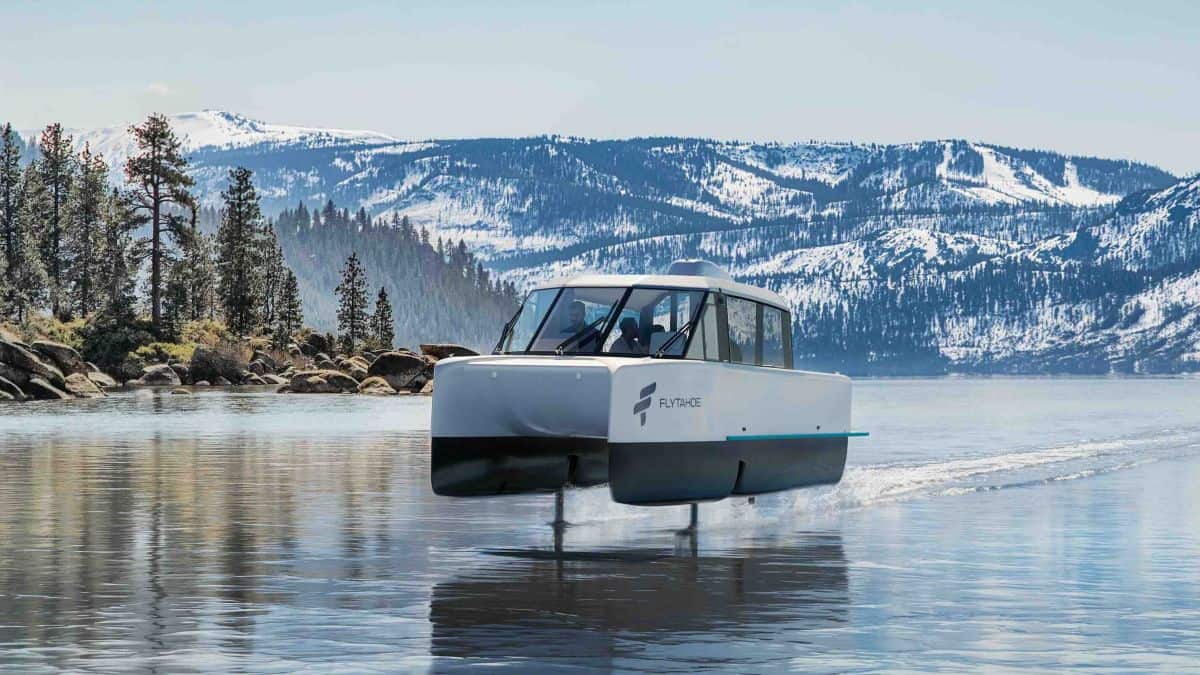
Vessev’s electric hydrofoiling technology allows vessels to lift above the water, eliminating hull drag and producing virtually no wake. The foil systems, inspired by America’s Cup racing designs, dynamically adjust to changing conditions up to 100 times per second, delivering a smooth, stable ride that is three times more efficient than conventional vessels. Powered by advanced sensing and telemetry, Vessev’s technology unlocks entirely new transportation applications.
As it expands in the U.S., Vessev plans to work with U.S.-based shipbuilders while continuing to design, engineer and build its core technology in-house, including foils, hardware, and flight control systems, maintaining a tightly integrated technology stack that enables high performance and full quality control across all areas.
FlyTahoe selected the VS–9 for its purpose-built commercial design and premium passenger experience, with panoramic glass windows, connecting passengers to Lake Tahoe’s scenery. Its efficiency in both size and charging requirements makes it easy to integrate with existing marina infrastructure, and well suited for FlyTahoe’s planned operations.
FlyTahoe’s proposed sustainable water transit network is highlighted in the Lake Tahoe Regional Transportation Plan (RTP) and remains subject to Tahoe Regional Planning Agency (TRPA) permits and approvals that FlyTahoe is actively working to obtain.
Electric hydrofoiling is emerging as a foundational technology for maritime transport. By unlocking battery electric propulsion with greater range and simpler charging, it enables smaller, more agile vessels and a superior onboard experience. No equivalent technology exists in aviation or automotive that can deliver this level of performance gain.
“Vessev is bringing world-class engineering from Apple, Tesla, the America’s Cup and Rocket Lab to a massive, long-stagnant industry,” said Phoebe Harrop Meadows, Partner at Blackbird. “Its combination of foiling technology and software unlocks lower operating costs while improving the passenger experience and shows how waterways can function as near-zero-emission transit networks, in the U.S. and beyond.”
With more than 11,000 nautical miles logged, the VS–9 is a commercially certified vessel already operating in commercial service in New Zealand, with demand now spanning five continents. The 10-passenger, battery-electric vessel has a range of up to 40 nautical miles with a full load, and 50 nautical miles with a light load. Larger platforms are in development.
The combination of commercial certification, passenger comfort, and operating efficiency explains why Vessev is now working with cities and operators globally, including projects underway in Northern Ireland, Sydney and Hobart, to activate underutilized waterways as scalable transit networks.