


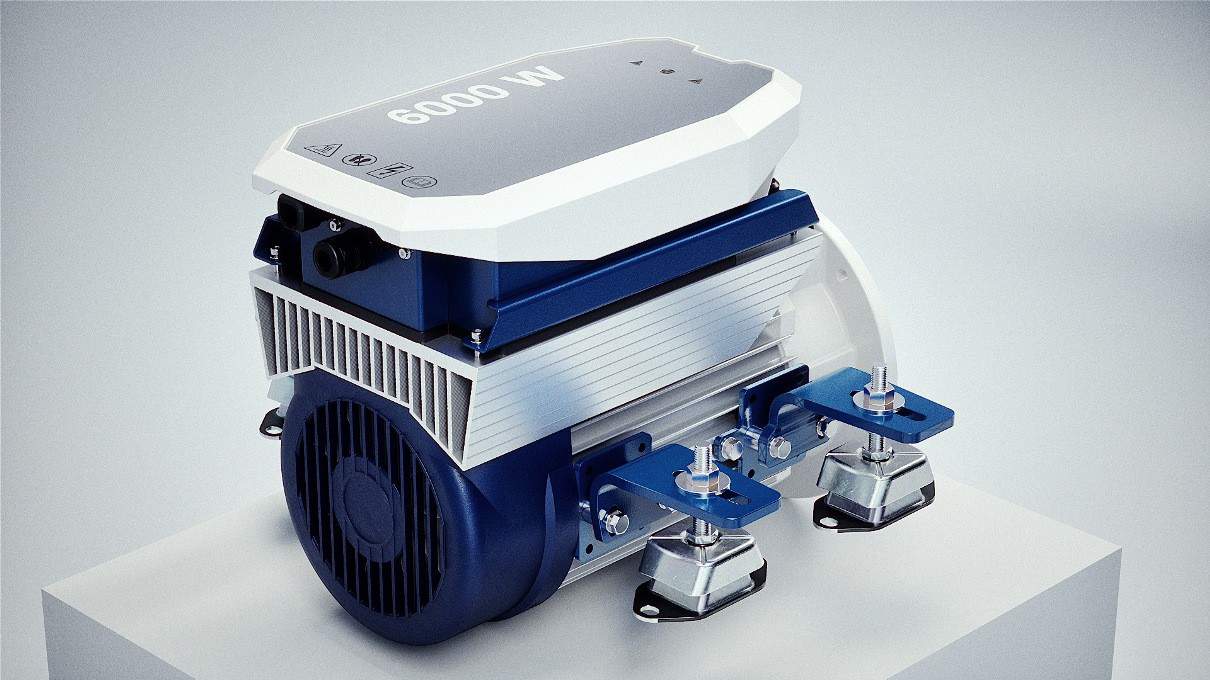
VETUS has unveiled a new range of three air cooled propulsion systems at this year’s boot Düsseldorf. This latest innovation in electric motors from VETUS brings the many benefits of electric propulsion to a wider range of boats and navigation areas.
Available in three sizes, the EAIR04024, EAIR040, and EAIR060 offer outputs of 4kW at 24 volts, 4kW at 48 volts and 6kW at 48 volts respectively, making them ideal for newbuild or repower projects for a variety of hull types up to around 8 metres.
Air cooled electric propulsion systems can offer certain vessels a range of benefits over water cooled variants. Firstly, in areas of possible cooling water inlet blockages such as weed infested inland waterways, with air cooling there is no water inlet to block. The cooling is also provided by a simpler system with a lower parts count; a lightweight arrangement of fan and ducting requiring less maintenance than a water-cooled pump, pipework and strainer. During the cold winter months, air cooling also prevents potentially costly water pump or pipe freezing issues.
The VETUS E-LINE AIR models have a dry weight of just 65kg making them very lightweight. The use of existing transmission hardware reduces electrification project costs, and compact dimensions ensure that in repowering situations, the E-LINE AIR usually requires less engine space, including an allowance for cooling air circulation, than the unit it is replacing.
Fitting an E-LINE AIR motor is straightforward compared with many alternatives. Simply mount the motor, align the shaft using the adjustable Swap&Go brackets plus specialized motor mounts, connect a battery pack and you’re good to go.
Because the E-LINE motors are both a modular and fully integrated design, later upgrading the system is a straightforward process. With key components such as the motor controller integrated within the unit, the job of correctly specifying a system and ensuring cross-component compatibility is easy, opening up the benefits of marine electrification to more boat owners than ever before. VETUS also offers a selection of Deep-Cycle, AGM deep-cycle and lithium batteries for its electric propulsion solutions.
The motors in the E-LINE AIR range are all 1:1 direct drive meaning the propeller always spins at the same speed as the motor. As well as saving the additional cost, noise and complexity of a mechanical gearbox, direct drive marine electric propulsion systems provide near instantaneous shifting between forward and reverse.
With the VETUS E-LINE AIR models, propeller speed can be controlled down to zero at the tip of the skipper’s fingers and the shift between forward and reverse is an instantaneous flick of an electronic controller rather than the much slower mechanical shift of a gearbox. These models feature active engine
braking, providing yet more responsiveness and control when reducing speed or shifting between forward and reverse.
Running out of range is a valid concern for many potential electric boaters. As part of the VETUS E-DRIVE systems range the air cooled EAIR04024, EAIR040, and EAIR060 are all compatible with NMEA2000 solutions via the VETUS CANV2N CANverter and the modular digital CAN-bus communication system VETUS V-CAN. Unique to VETUS, this connectivity in combination with the E-Drive CANNS500 battery monitoring shunt solution, means the user has crucial visibility of real-time remaining battery charge and runtime.
Just like its sister series, the E-LINE and E-POD, the E-LINE AIR series is extremely quiet for a carefree and peaceful boating experience in common with all VETUS boat-equipment products, the E-LINE AIR series comes with a 3-year warranty.