


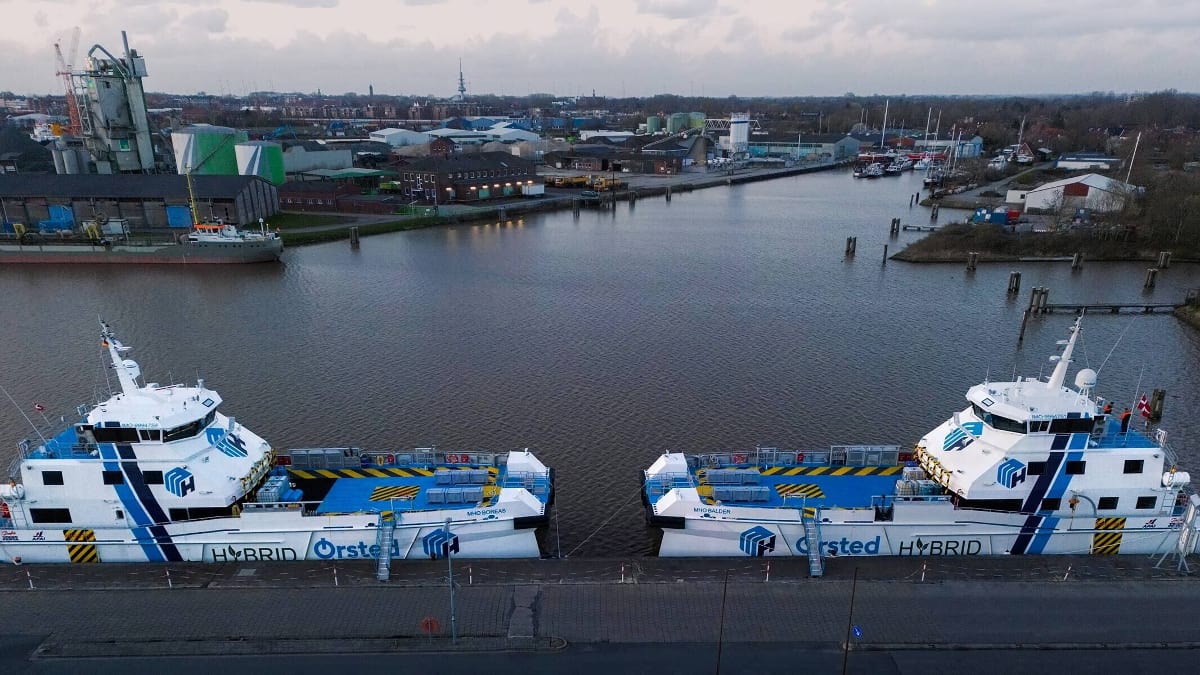
Two new advanced Crew Transfer Vessels have entered operation for MHO-Co, debuting an exciting progression of the hybrid technology from Volvo Penta and Danfoss Drives. The vessels are set to bring class-leading levels of efficiency to marine transport thanks to a fully integrated solution and intelligent ‘Power of Plenty’ design that combines Danfoss drives and machines with Volvo Penta IPS drivelines.
MHO-Co is seeking to optimize more efficient marine transport with its two latest pioneering Crew Transfer Vessels (CTV) which entered operation in March 2024 to transport technicians to and from offshore facilities in the North Sea. The new MHO-Boreas and MHO-Balder feature a fully-integrated design that marks a significant step forward in the journey towards electromobility. It’s a notable evolution of the collaboration between Volvo Penta and Danfoss Drives which has already produced effective results from pilot projects. The partnership between the two is built on experience and innovation and began back in 2021 with the launch of two early examples of hybrid CTVs (also for MHO-Co).
At the heart of MHO-Co’s latest deliveries are four electric IPS drivelines from Volvo Penta. In a notable change to previous designs, there are no traditional diesel engines used for propulsion. The Volvo Penta electric IPS drives are fed by a battery bank for full electric mode and by eight Volvo Penta D8 IMO III variable speed gensets to increase the range of the vessel. As with previous designs, Volvo Penta and Danfoss Drives have focused on maximum uptime, efficiency and maneuverability.
“These new vessels move us further into the future. Because the drivelines are all-electric, we can create a future-proof design running off our drives and electric machines. There’s also the flexibility to run on future power sources (such as hydrogen or fuel-cells), once those are commercially viable,” said Claus Larsen, Head of Sales, Northern Europe, Central Europe and EMEA Marine & Electrification at Danfoss Drives.
“This is a significant step forward in our journey because we’ve included an electric version of our Volvo Penta Inboard Performance System (IPS). This is combined with a ‘Power of Plenty’ philosophy to optimize power use and recharging to deliver a design with the potential to reach new heights for marine efficiency,” adds Jan-Willem Vissers, Director, Marine Commercial at Volvo Penta.
New intelligent design and technology make the difference
The vessels will support multiple facilities in the North Sea and their introduction aims to support a wider goal for the operator to have efficient power usage across its supply chain.
“For these latest CTV deliveries, the customer is adopting a ‘Power as a Service’ model, paying only for the energy that is consumed. This made the world-class efficiency of Volvo Penta IPS immediately attractive because of the great reductions in energy usage due to the Danfoss energy management system, the battery bank, and a Power of Plenty generator network that delivers only the power that is needed,” explained Mik Henriksen, CEO of MHO-Co.
Volvo Penta’s established and proven IPS offers a unique forward-facing, counter-rotating design. On the new electric version of the IPS which features on the CTVs, Volvo Penta will be analyzing energy savings to assess these both against the mechanical IPS as well as against other alternatives. Because Volvo Penta IPS is designed for more efficient output, it also delivers space and weight savings in the vessel, as fewer batteries and gensets are required.
On the MHO-Boreas and MHO-Balder, Danfoss provided the DC-grid and energy management system and there are four 94 kWh batteries supplied by Volvo Penta subsidiary ZEM. The vessels also have the latest upgraded Electronic Vessel Control (EVC) from Volvo Penta, EVC 2.0, in addition to their new propulsion system.
“With the ‘Power of Plenty’ design, the gensets can be tailored to the load required. CTVs spend only a limited time running at full power and data shows that over 50% of the time they are running in idle mode. So, in situations that don’t require full power, the system can run on fewer gensets – even just one, when operating in the lowest setting. This allows the overall configuration to save running time and fuel consumption,” explained Lars Persson, Sales Project Manager at Volvo Penta.
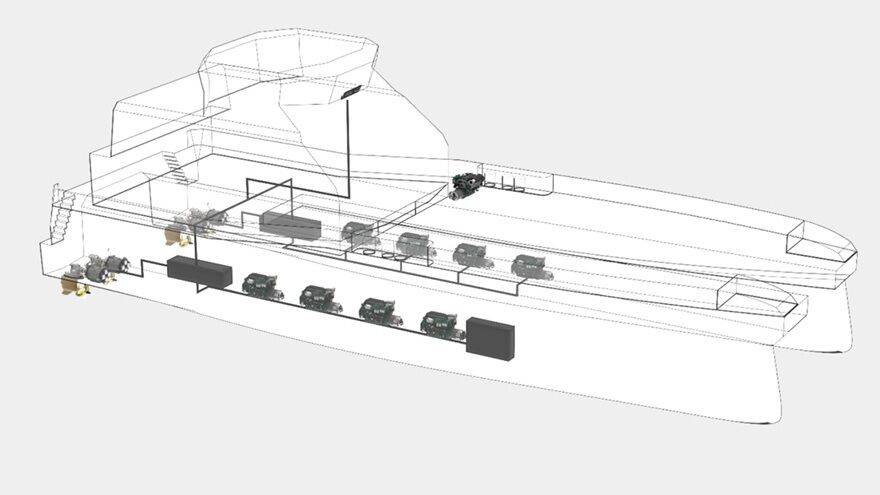
An engineering drawing showing the propulsion set-up inside the new CTVs.
Strong interest from industry
The potential of the electric IPS through adding electric power to the popular and established Volvo Penta IPS is something that is already attracting strong interest in the marine industry. With Volvo Penta IPS, captains can enjoy exceptional maneuverability paired with maximum power and precision. It delivers comprehensive control from the helm to the propellers as well as gains in efficiency, fuel economy and noise reduction. Customers say they are also excited about the potential to integrate alternative power into designs that include other Volvo Penta favorites, such as Joystick Steering, Joystick Docking and Dynamic Positioning System (DPS).
The new MHO-Boreas and MHO-Balder CTVs are 36m vessels able to carry up to 24 operators and eight crew.