





MHO-Co’s two new crew transfer vessels (CTVs) – MHO Asgard and MHO Apollo – have been put through their paces, having traveled from China to Denmark. The 12,000 nautical mile journey was a voyage of discovery for Volvo Penta and Danfoss Editron, with the many lessons learned helping to create a tailor-made solution fit for the owner’s requirements.
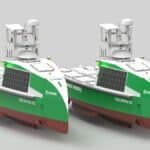
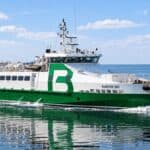
Earlier this week, two new hybrid crew transfer vessels (CTVs) –MHO Asgard and MHO Apollo – arrived at MHO-Co’s headquarters in Esbjerg, Denmark, after making the 12,000 nautical mile journey from China’s AFAI Southern Shipyard. Measuring 34.4 meters in length and with an 11-meter beam, these vessels will be run by operator MHO-Co and service the Hornsea Project 2 offshore wind farm in the North Sea.
The vessels’ power system is the result of a collaboration between world-renowned developers of new propulsion technology – Volvo Penta and Danfoss Editron. The companies have developed a fully integrated solution made up of a Danfoss Editron electric drivetrain supported by Volvo Penta variable speed gensets that drive two of the first Electric Volvo Penta Inboard Performance System (IPS) units as well as two D13 Volvo Penta IPS units. The new IPS units have already achieved 1,000 hours of operation before even reaching the customer. This impressive milage has given all the teams time to test and adjust the system to create a tailor-made solution that fits the owner’s requirements.
“These systems are a very important first step towards the future of sustainable operations at sea,” says Mik Henriksen, CEO of MHO-Co. “We believe it is our shared responsibility to drive more sustainable solutions in the marine sector, and the best way to do this is through collaboration.”
Listening, learning, and tweaking
Danfoss Editron and Volvo Penta treated the journey from China to Denmark as a pilot project and a time to work with the captains and crew to tweak the novel technology onboard and make it as reliable and efficient as possible for the customer. The companies were able to test different power combinations, such as diesel-electric operation or diesel-only. In Dynamic Postitioning System-mode (DPS-mode) fuel consumption is below 20 liters/hr. and can be as low as 17 liters/hr. which is exceptional for vessels of this size class.
All these tests were carried out with the captain and stakeholders, which meant the result was a solution that was fit for purpose for the operator’s requirements. From these initial learnings, the teams have started adapting the drivetrain – not just the motors themselves – to all-electric propulsion needs.
Volvo Penta also worked with captains during the design phase to reimagine existing systems. For example, to take the electric propulsion dimension into account, Volvo Penta created a completely new HMI. To do this, the company worked closely with the captains during the design phase. Volvo Penta took advantage of options offered by the power of plenty, different kind of captain controls, and reading diagnostics differently to develop the HMI.
“The design, build, and delivery of these vessels was all about teamwork and collaboration,” explains Erno Tenhunen, Danfoss Editron’s Marine Director. “Ultimately, these are learning projects on all sides. We are trying to push the limits of technology, and the best way to do this is to bring our unique ideas, perspective, and knowledge together. That’s exactly what we have done here.”
Next steps
Before the vessels enter operation, batteries are being installed in Denmark to provide stored power for zero-emissions operation. This system will allow the vessels to operate in zero-emission electric mode for up to eight hours or, in combination with diesel propulsion, to achieve a maximum speed of approximately 24 knots. Using multiple modular generators allows operators to tailor power generation to the operational profile and enhance flexibly.
“We’re excited to see these vessels go into action in the North Sea. This pilot project has been hugely beneficial in helping us create the building blocks for future projects,” adds Jacob Vierø, Sales Project Manager, Volvo Penta. “Each operation will be different and require a tailor-made propulsion solution, but this project has allowed us to both develop the technology and collaborative process that can be adapted for future commercial operations.”







 –MHO Asgard and MHO Apollo – arrived at MHO-Co’s headquarters in Esbjerg, Denmark, after making the 12,000 nautical mile journey from China’s AFAI Southern Shipyard. Measuring 34.4 meters in length and with an 11-meter beam, these vessels will be run by operator MHO-Co and service the Hornsea Project 2 offshore wind farm in the North Sea. The vessels’ power system is the result of a collaboration between world-renowned developers of new propulsion technology – Volvo Penta and Danfoss Editron. The companies have developed a fully integrated solution made up of a Danfoss Editron electric drivetrain supported by Volvo Penta variable speed gensets that drive two of the first Electric Volvo Penta Inboard Performance System (IPS) units as well as two D13 Volvo Penta IPS units. The new IPS units have already achieved 1,000 hours of operation before even reaching the customer. This impressive milage has given all the teams time to test and adjust the system to create a tailor-made solution that fits the owner’s requirements.)