
Commercial marine operators will get their first look at Volvo Penta’s New IPS Hybrid at Seawork 2026.
Volvo Penta will give commercial marine operators their first opportunity to experience its new IPS Hybrid propulsion system at Seawork 2026, showcasing a fully integrated hybrid-electric solution engineered specifically for demanding workboat applications.
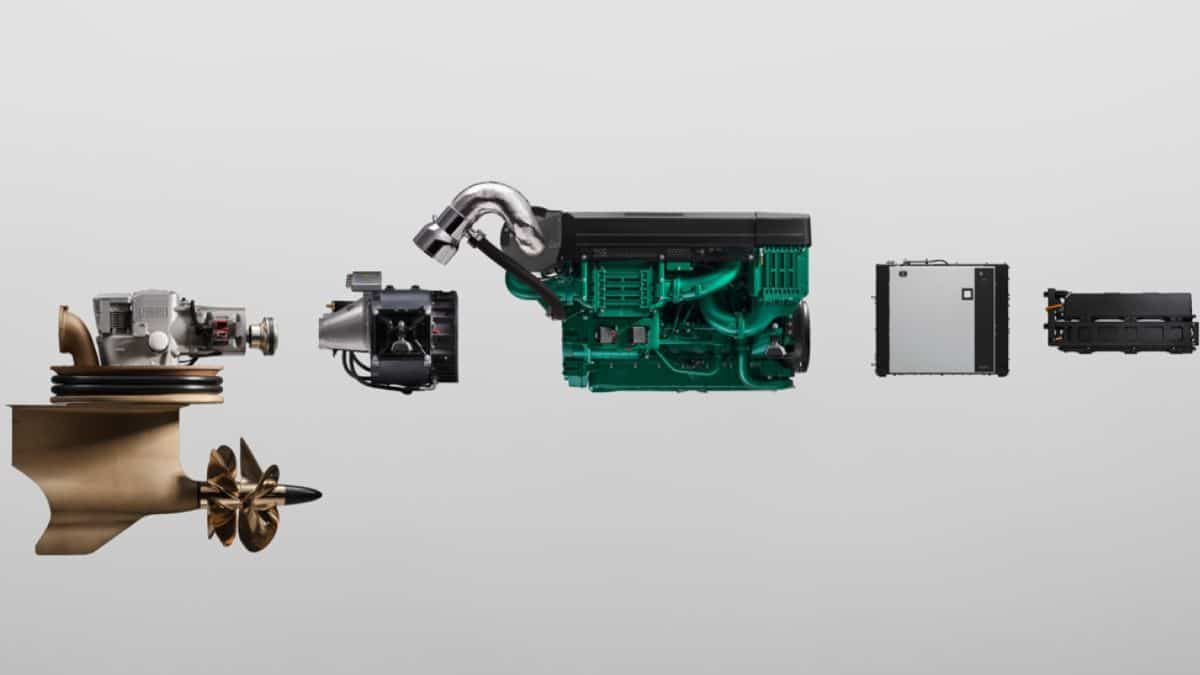
Building on the proven commercial and operational benefits of Volvo Penta’s IPS platform, the new IPS Hybrid combines propulsion, electric motors, batteries, energy management and controls within one integrated system. Developed for a wide range of marine commercial applications – including passenger ferries, coast guard vessels, offshore crew transfer vessels, short sea and river transport and work boats – the platform is engineered to simplify service responsibility, improve operational control and support dependable performance where uptime matters most.
The Volvo Penta IPS Hybrid has been developed with optimising uptime as a priority. By delivering a fully integrated helm-to-propeller package through one supplier, the system helps reduce complexity across installation, operation and service. Propulsion, batteries, controls, and energy management are designed to work together as one cohesive package. This gives operators a clearer maintenance path, fewer interface touchpoints, and one point of responsibility across the full system.
Combined with Volvo Penta’s global service and support network, the result is a hybrid-electric solution designed to help protect fleet availability and reduce operational risk across key markets.
“Marine commercial operators need solutions they can rely on every day, in every condition,” says Hanna Ljungqvist, President of Volvo Penta Marine Business. “Our IPS Hybrid has been developed to meet those expectations by bringing together the manoeuvrability and efficiency of our IPS platform with integrated hybrid-electric capability in a complete package designed to support uptime, simplify operations and deliver long-term value.”
Built on more than 20 years of Volvo Penta IPS heritage and over 45,000 operational driveline units delivered, the IPS Hybrid takes trusted vessel control into hybrid-electric propulsion.
At the heart of the system is Volvo Penta’s Electronic Vessel Control (EVC) platform, which integrates propulsion and energy management into one operator interface. Captains have access to real-time overview of energy use, charging, battery status and power flow alongside trusted Volvo Penta features including Joystick Driving, Assisted Docking and a new 24” TAD (Type Approved Display).
This integrated control experience is designed to reduce workload in demanding operating environments such as tight harbours, dock-and-go operations, or when working close to infrastructure.
Responsive low-speed handling, precise manoeuvring and seamless power transitions support confident vessel control through every phase of operation.
The Volvo Penta IPS Hybrid has been developed for commercial duty cycles with operating modes tailored to the realities of professional marine operations.
Selectable modes including Pure Electric, Hybrid Electric, Hybrid Fuel and Cross-over allow operators to adapt performance according to vessel activity – from low-speed manoeuvring and harbour approach to transit and higher-load operations. Together, they provide a flexible operating toolkit designed to optimise performance, reduce fuel consumption, and match energy output to the job at hand.
The electric motor can also support acceleration and manoeuvring while generating power to recharge batteries underway or at anchor, giving operators more flexibility across the working day.
Designed for tough marine conditions, the IPS Hybrid has been developed with durability, safety and ease of use at its core. Continuous monitoring and built-in protective functions support reliable hybrid operation over time, while the compact, standardised system architecture supports easier installation, reduced complexity, and simplified servicing. Early-phase co-engineering support also enables designers and shipyards to align hull and propulsion from the start, helping streamline builds and reduce integration complexity.
The platform also supports lower-emission operations today while helping operators prepare for tomorrow’s regulatory environment. With compatibility for HVO100, alongside compliance with IMO III and EPA Tier 3, IPS Hybrid provides a practical decarbonisation pathway that can be deployed now. It also helps reduce compliance risk in increasingly regulated operating zones and future procurement frameworks.
Hanna Ljungqvist concludes – “Commercial operators are balancing increasing demands around efficiency, emissions, performance and availability. With the IPS Hybrid, we’re bringing these priorities together in one integrated solution designed not just to support lower emissions, but to help protect uptime, simplify service and deliver confident control where it matters most.”