


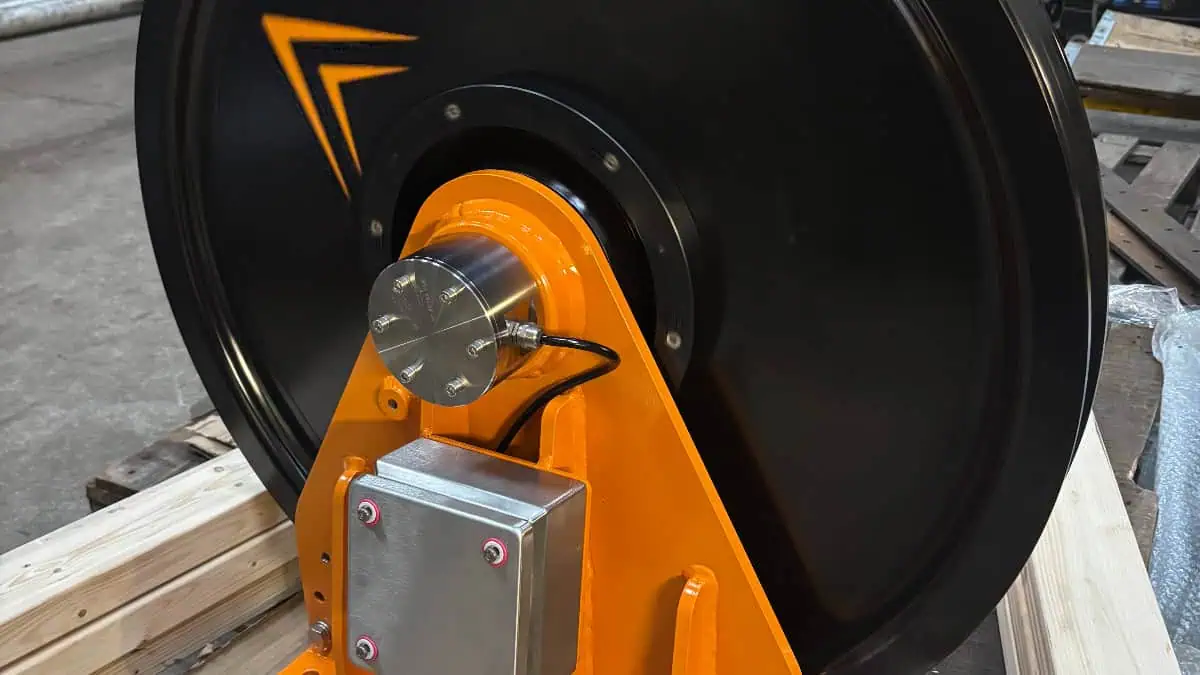
Vulcan Offshore supplies instrumented 750-mm sheave to the National Oceanography Centre for a marine research campaign in New Zealand.
Vulcan Offshore has successfully delivered a fully instrumented sheave, incorporating specialist components from sister company Dynamic Load Monitoring (DLM), to the National Oceanography Centre (NOC) for deployment in a research project offshore New Zealand.
The 750-mm diameter sheave has been designed to capture real-time tension and payout readings from a towing umbilical deployed behind a survey vessel. The customer will use the system to monitor loads while towing a subsea sensor, ensuring safe, consistent, and traceable data collection throughout the operation. Supplied on a rental basis, the 230-kg unit features DLM’s proven Line Tension Load Pin,
Vulcan is a specialist in manufacturing equipment for the subsea geotechnical and geophysical sector. It principally works for companies that own or charter vessels for subsea geotechnical and cable laying operations within the offshore wind farm or the subsea telecommunications and power industry. DLM, meanwhile, is a supplier of load cells, load monitoring technology, and cable working equipment to the lifting, rigging, wind energy, and wider renewables sector.
Chris Scrutton, managing director at Vulcan; and technical director at DLM, said: “The project is underpinned by the companies’ combined experience in engineering design, load monitoring, and manufacturing. Individually, DLM wouldn’t have supplied it; individually, Vulcan wouldn’t have supplied it. It is the joint connection that enabled a good product to deliver the complete solution to the point of use on the other side of the world.”
The two companies share a machining facility, and six machines, in Vancouver Wharf, Southampton. Similarly, both Vulcan and DLM employ three people in each of these machine areas. Scrutton explained that, while it is a shared entity in the sense of the premises, the businesses operate independently from a customer facing perspective.
The instrumented sheave facilitates a fixed angle of entry for the cable, and a varying exit angle of 120 degrees, while maintaining an accurate tension reading. Load pins always feature a custom design element and vary greatly in capacity from 1t up to DLM’s largest to date, which was a 2,800t feat of engineering. Both companies continue to invest in machining upgrades to meet demand from subsea cable lay vehicle and deck equipment manufacturers.
Scrutton added: “In essence, NOC engaged Vulcan with their towing umbilical challenge, and DLM’s expertise was sought here in Southampton to provide the sheave. On-site, the data is fed into a piece of software [called Sheave Sense], which Vulcan have produced. It will display the live load and payout readings but also record them as data logs to a CSV file.”
The product includes a mounting base, which is bolted to the structure of the ship to hold the assembly in place. The umbilical runs around the (black) sheave wheel. When tension is placed on the umbilical, it pushes down on the wheel against the shear pin running through the middle of the wheel, generating the reading.
“The sheave wheel can be changed over,” Scrutton said, “So if a customer wants a different diameter wheel, or to allow a different diameter cable to run through the wheel, this can be achieved.”
Provision of the instrumented sheave represents Vulcan’s first foray into Australasia; DLM is on more familiar territory, upheld by established distribution in Australia. Upon return — the hire is anticipated to span 30 days — the sheave will join Vulcan’s expansive rental fleet.