



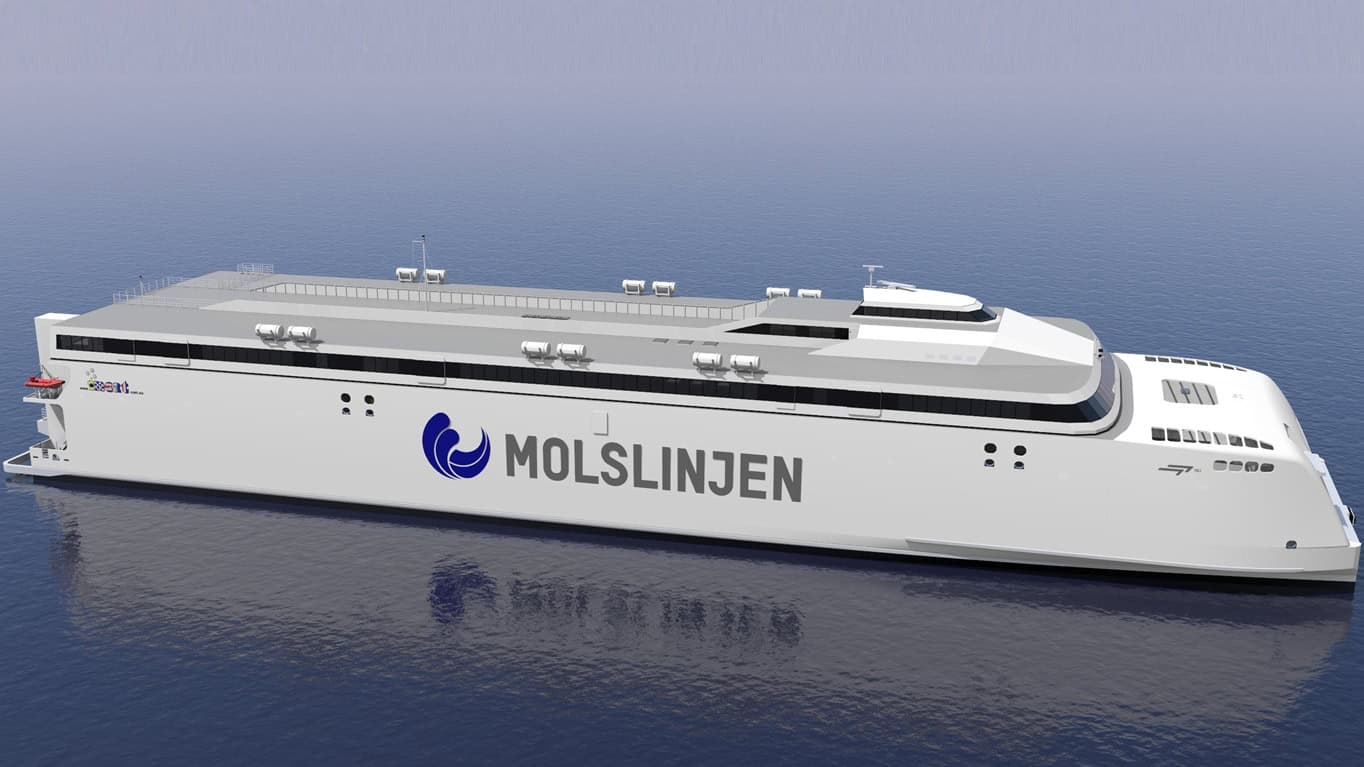
Wärtsilä, a global leader in innovative technologies and solutions for the marine industry, has been selected to deliver fully integrated electric propulsion systems with waterjets for two new high-speed battery-electric catamaran ferries being built for Danish ferry operator Molslinjen. These revolutionary ferries are currently under construction at the Incat shipyard in Tasmania and represent a significant milestone in maritime electrification. The ferries will serve the busy Kattegat route between Jutland and Zealand, substantially contributing to the green transition of ferry services in Denmark.
Wärtsilä will be supplying the integrated electric propulsion system, the DC power conversion system, its energy management and automation systems, eight electric propulsion motors and waterjets, as well as the Wärtsilä ProTouch propulsion control system for smooth and efficient sailing.
“This is a major project that supports the ferry industry’s move towards more decarbonised operations. With these electric ferries built by Incat and powered by Wärtsilä’s electrification technology, we aim to remove thousands of tons of CO₂ emissions from Denmark’s climate footprint each year,” comments Kristian Durhuus, CEO, Molslinjen.
Ferries play a vital role in meeting the growing demand for more sustainable transport options, with ship electrification being a key solution for enabling the sector to transition towards net-zero emissions.
“Our partnership with Molslinjen and Incat not only brings electric vessels to the Kattegat route, but also continues our joint commitment in accelerating the industry’s path towards net-zero emissions shipping. Wärtsilä’s values and principles in shipping are deeply rooted in sustainability, innovation, and performance, and through our experience in vessel electrification, we have already delivered solutions for 150 hybrid-electric ships, with this number continuing to grow,” explains Roger Holm, President of Wärtsilä Marine & Executive Vice President at Wärtsilä Corporation.
The two ferries will each measure 129 meters in length and 30.5 meters in width, accommodating up to 1,483 passengers and 500 cars. The addition of these new vessels will increase total capacity for cars and passengers on the Kattegat route by more than 25 percent. The ships are expected to join the fleet in Denmark during 2027 and 2028.
“We’re not just building ships – we are building the future,” says Stephen Casey, CEO, Incat Tasmania. “Large-scale, low-emission transport solutions are not only possible, but are ready now. Incat Tasmania has always been at the forefront of innovating and pioneering new technology and design. The vessels address the market’s needs and requirements by utilising batteries, making this a very viable option for owners and operators looking to increase the sustainability of their fleets. Wärtsilä is a key player in the success of this project, supporting our goal of large-scale, low-emission transport with a completely integrated propulsion package.”
The eight electric driven waterjet configuration feature low weight, shallow draft operation, low maintenance and easy access, safety and reliability, as well as superb manoeuvrability as a result of its integrated steering and reversing with quick response times. The waterjets have been designed for the highest overall propulsion efficiency. As the power is divided over more jets, the power density is lower, which means a higher efficiency. The Wärtsilä equipment is scheduled for delivery to the yard commencing in 2026.














