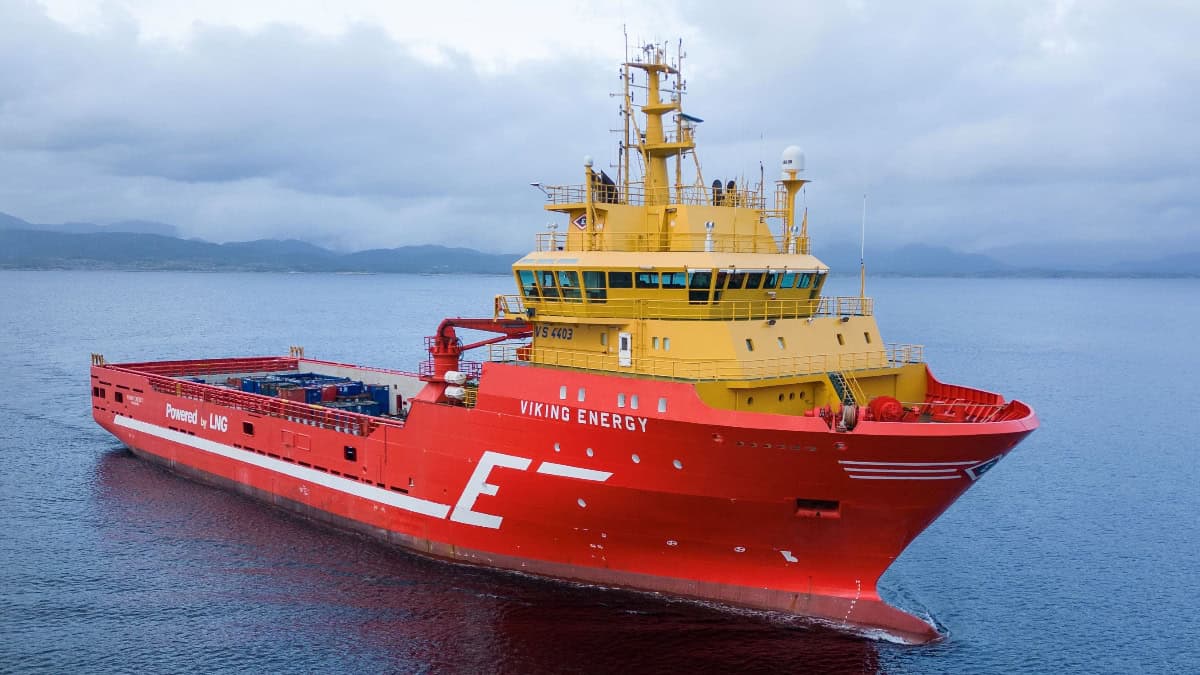
Technology group Wärtsilä has signed a contract with Norwegian shipowner Eidesvik to supply the equipment for the conversion of an offshore platform supply vessel (PSV) to operate with ammonia fuel.
The vessel, ‘Viking Energy’, which is on contract to energy major Equinor, is scheduled for conversion in early 2026 and is expected to start operating on ammonia in the first half of 2026, becoming the world’s first ammonia-fuelled in-service ship. In addition to chartering the vessel Equinor contributes with financing for the conversion. Wärtsilä will then supply the engine and complete fuel gas supply system and exhaust after-treatment needed for the conversion, making it also the first vessel to use Wärtsilä’s recently released ammonia solution.
Ammonia has emerged as a promising alternative fuel as the shipping industry looks for more sustainable fuel options. With new global regulations having set a clear destination for shipping – net zero emissions by mid-century – ammonia will play a significant role in enabling the shipping industry to reduce its emissions.
A recent report by Wärtsilä highlights the role that sustainable fuels will play in achieving this target which is set by the International Maritime Organization (IMO). According to the report, existing decarbonisation solutions, such as fuel efficiency measures, can cut shipping emissions by up to 27 percent; however, sustainable fuels, such as ammonia, will be a critical step in eliminating the remaining 73 percent.
In this context, Håkan Agnevall, President and CEO of Wärtsilä highlights the importance of cross-industry collaboration: “In just 25 years – the lifetime of a single vessel – shipping needs to get to net zero emissions. Achieving this will require coordinated action by all maritime industry stakeholders to bring about the system change needed to accept a new generation of sustainable fuels.”
“With this new contract, together with Eidesvik, Wärtsilä is proud to be at the forefront of this movement. Decarbonisation is front and centre of our strategy and we are committed to developing and delivering sustainable solutions which not only ensure the viability of sustainable fuels, but also their safety.”
Wärtsilä, Eidesvik and Equinor share a commitment to support the industry’s efforts to decarbonise. The conversion of Viking Energy is the latest project in a history of collaboration between the three companies. Viking Energy has an impressive record of demonstrating new environmental technologies, which includes three “world records”.
For example, using Wärtsilä dual-fuel engine technology, Eidesvik was the world’s first shipowner to have an LNG-powered offshore platform supply vessel. It also received the world’s first Battery Power notation, given to Viking Energy, for a battery system installed by Wärtsilä.
This latest partnership is a result of the ‘Apollo’ project which is co-funded by the Horizon Europe framework programme. The programme aims to accelerate the transition towards a climate-neutral Europe by 2050 through funding projects, such as Apollo, which contribute research and innovative solutions in various sectors related to climate, energy and mobility.
“Close collaboration throughout the value chain is key to succeed in the green transition. Eidesvik has a unique history of pioneering the implementation of innovative emission-reducing technologies, and we are proud to spearhead yet another groundbreaking project together with Wärtsilä and Equinor,” said Gitte Gard Talmo, CEO & President of Eidesvik Offshore.
In addition to the Wärtsilä 25 Ammonia engine, Wärtsilä will supply the complete ammonia solution, including its AmmoniaPac Fuel Gas Supply System, the Wärtsilä Ammonia Release Mitigation System (WARMS), and a selective catalytic reduction (SCR) system designed for ammonia. A service agreement, covering maintenance, is a highly essential part of the deal. The conversion project is planned for early 2026, with final commissioning expected in Q2 2026.