


WEstack offers inland vessel owners a faster and more cost-effective route to battery-electric and hybrid propulsion adoption
Dutch maritime technology company Wattlab has unveiled WEstack, a standardised battery system designed specifically for inland shipping that can be installed on board within a single working day, offering vessel owners a faster and more cost-effective route to decarbonisation.
The new solution addresses one of the industry’s key challenges: the high costs, engineering complexity and lengthy installation periods typically associated with marine battery systems. By standardising the design and delivering the system fully assembled and tested, Wattlab has reduced onboard installation time from several weeks to just one day, minimising vessel downtime and lowering project costs.
Where existing systems are often fully customised and require weeks of installation work, WEstack is fully assembled and tested in Wattlab’s workshop. Once delivered on board, the system only needs to be connected. This reduces installation time from several weeks to just one day.
According to Wattlab, this represents a major opportunity for inland shipping. “Generators on vessels operate most of the time at only 10 to 15 percent of their capacity,” says Bo Salet, founder and CEO of Wattlab. “That is extremely inefficient. At low loads, a generator consumes relatively large amounts of fuel. By adding a battery pack, the generator can charge the battery at its optimal operating point, after which the battery supplies power to the vessel.”
WEstack is designed to reduce generator running hours by as much as 80 to 90 percent. According to Wattlab, this results in significant fuel savings, lower maintenance costs, and a substantial reduction in CO₂ emissions. In addition, the system improves onboard comfort by reducing noise, vibrations, and exhaust fumes, while also reducing dependence on shore power.
The battery system is available in four standard capacities: 100, 200, 300, and 400 kWh. This standardisation enables faster production and installation while keeping costs lower than those of traditional custom-built systems.
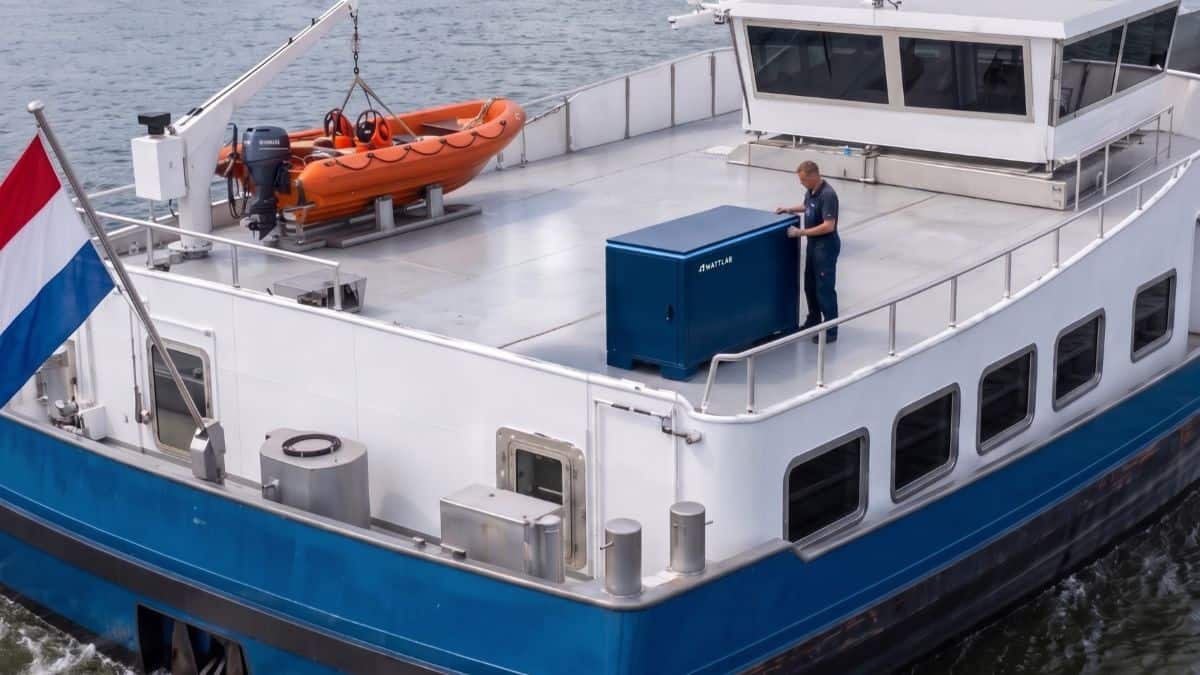
WEstack is installed on the aft deck of the vessel and is designed for both newbuild and retrofit projects. According to Wattlab, the system can be applied to a wide range of inland vessels, from older dry cargo ships to modern tankers and small coastal vessels.
In addition to direct fuel savings, Wattlab sees an important role for battery systems in future emissions regulations and port operations. “More and more ports want to reduce emissions and noise pollution,” says Salet. “With a battery system, vessels can operate silently and emission-free for much longer periods without relying on shore power.”
Wattlab was founded in 2017 and previously developed solar energy systems for the maritime sector. The company gained international recognition through large-scale solar installations on inland vessels and is currently also developing Solar Flatrack systems for seagoing vessels. With the introduction of WEstack, Wattlab is taking the next step in the decarbonisation of shipping.
“Alternative fuels are likely to remain scarce and expensive for the foreseeable future,” says Salet. “That is why we believe energy efficiency is the fastest and most cost-effective route to reducing emissions in the sector.”