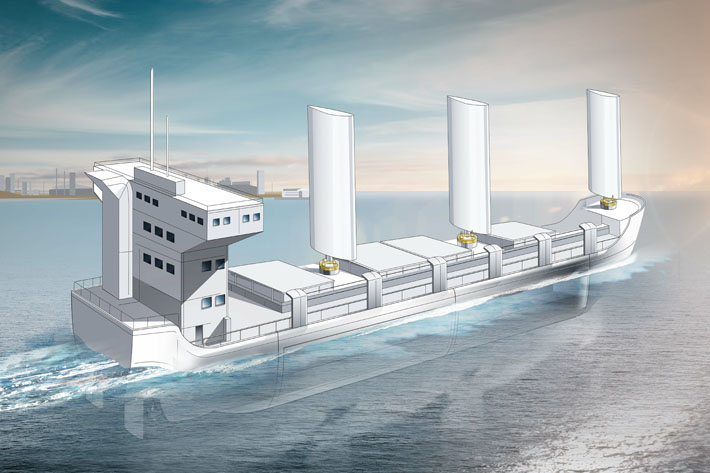



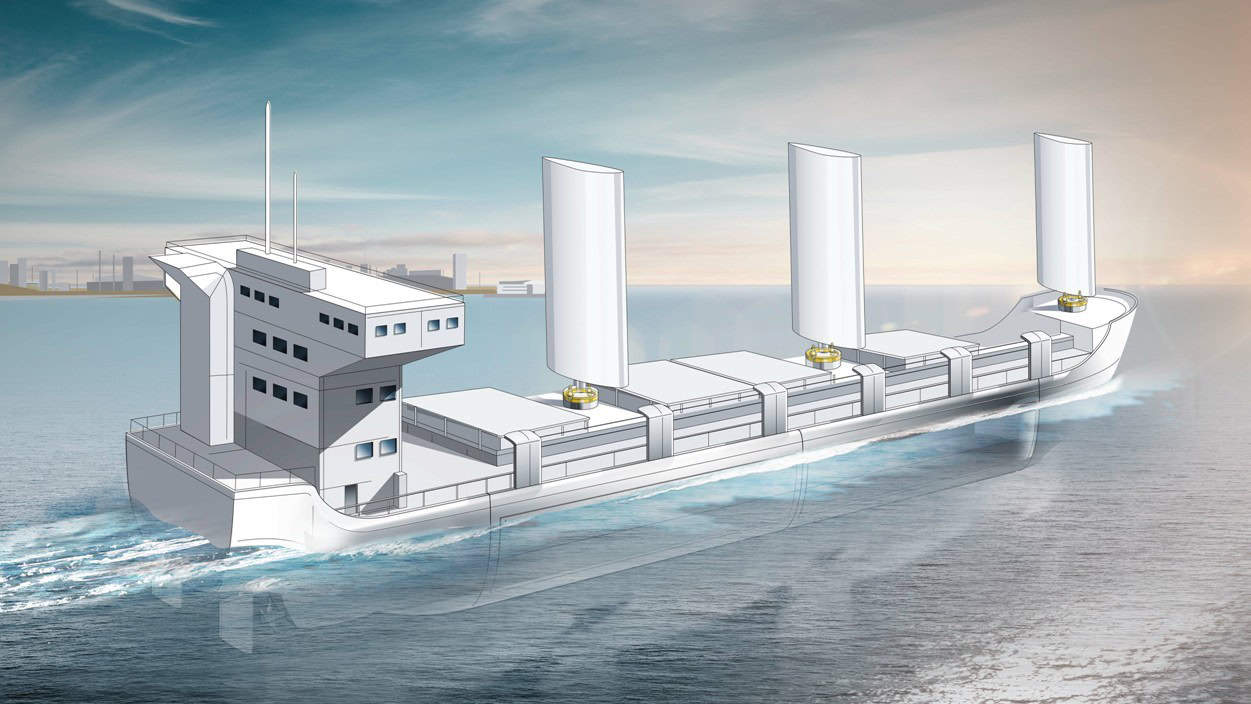
Liebherr makes use of the wind as a resource for clean energy shipping, as well, and offers wind-assisted propulsion as an alternative solution. Slewing bearings and slewing drives excel at working together perfectly on high seas. The overall design of the wind-assisted propulsion consists of high, futuristic-looking sails that turn towards the wind and complement conventional ship propulsion still driven by diesel engines, for example. Hence, the technology harnesses the wind to propel a wide variety of vessels, such as bulk carriers, and thus ensures greater energy efficiency.

Almost 90 per cent of global trade is handled via commercial shipping. As of today, most giants of the sea still rely on heavy oil as fuel. Burning heavy oil does not only produce carbon dioxide, but also emits sulphur dioxide, which is harmful to the environment. To reduce the impact on global ecosystems, ships in certain areas are only allowed to have 0.1 per cent sulphur in their fuel or have to retrofit gas scrubbers to minimise sulphur dioxide emissions. However, this means that fuel or equipment is of higher quality and, therefore, more expensive. Hence, shipping companies face a major economic challenge – the reduction of environmental pollution and fuel consumption. One possible solution would be to use the power of the wind.
The high seas offer plenty of wind. It is freely accessible and above all, it is environmentally friendly. Therefore, it would make sense to harness it for clean energy shipping. “Wind-assisted propulsion is the key word here,” explains Benjamin Schmid, Key Account Manager Maritime at Liebherr-Components AG. Liebherr offers a solution that includes two essential components: a slewing bearing and a slewing drive. Together, they prove their worth on high seas. The overall design of the wind-assisted propulsion consists of high, futuristic-looking sails that turn towards the wind and complement conventional ship propulsion, which is still driven by diesel engines. Hence, the technology harnesses the wind to propel a wide variety of vessels, such as bulk carriers, and, thus, ensures greater energy efficiency. “The sails convert wind power into direct propulsion. In this way, they can support conventional propulsion on the ship and reduce fuel costs by up to 30 per cent without losing speed,” explains Benjamin Schmid.
Time to get things moving
In the development of components, Liebherr draws on decades of experience in the production of offshore cranes, as well as on its expertise in the field of offshore wind turbines or blade bearings. The approach to the calculation of the forces on high seas can be derived from said technology. The size of the sail, the weight and the centre of gravity can all be used to make assumptions about the forces that occur. Thereon, Liebherr has created its own tool, in order to better grasp the green technology. It allows the ideal design of the slewing bearings, drives and swivel drives, which are responsible for the turning of the sails in the wind.
The power lies in the detail
To prevent salt water from penetrating the bearing and grease from leaking out, Liebherr pays close attention to the seal. Special sealing systems in the slewing bearings for offshore applications ensure safety during seawater operation. The double sealing system consists of two sealing lips: While the first protects against coarse dirt, the second prevents the intrusion of contaminants. The double seal, thus, prevents seawater from entering the raceway system to avoid major damage to the slewing bearing. In addition, the maritime CX coating according to DIN EN ISO 12944 ensures that the surface of the slewing bearing remains resistant to seawater.
The slewing drive with lubrication pinion comes with an optional tooth safety geometry. This safety aspect ensures that the gear does not jam and protects the entire system – the slewing bearing and the slewing drive – from major damage.
In perfect harmony: the electric adjustment system
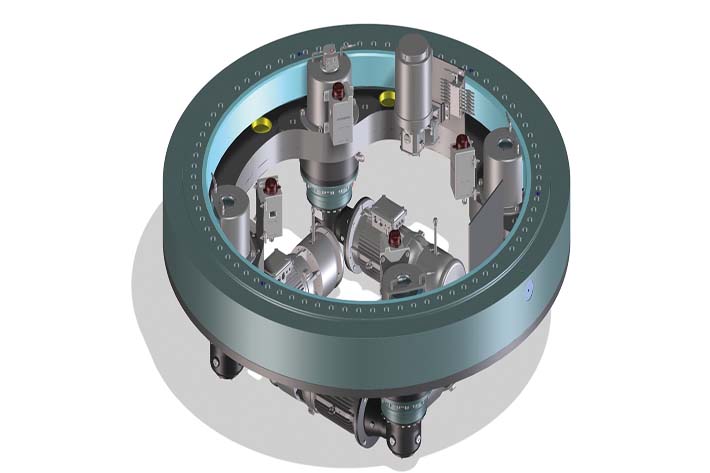
To make the most of wind, the sails must be able to turn in the right direction. This is where the electric adjustment system from Liebherr provides an ideal solution. As a pre-assembled module, the components underneath the sail work together to align the sails. In the process, a higher-level control system gives the sails a specific value for rotation. The Liebherr electric adjustment system then implements this rotation, including a comparison of target/actual value comparison.
“The electric adjustment system for the wind-assisted propulsion is a completely pre-assembled module. It consists of a slewing bearing, a slewing drive and an electric motor. Together with control and power electronics built into a control cabinet, it makes the sail turn,” Benjamin Schmid continues. An integrated position detection and monitoring system takes care of the constant comparison of the target/actual rotation. In addition, a lubrication system is built into the module. Controlled via the control cabinet, the system triggers appropriate lubrication intervals for the bearing raceway, the gearing and the pinions. The module comes as a plug-and-play solution. Since it is completely pre-assembled, the module allows an extremely quick deployment. The tedious assembly of the gearbox or the adjustment of the tooth-flank backlash, for example, is no longer the case.
With this innovative solution for wind-assisted propulsion, Liebherr is also contributing to a more sustainable shipping and a lower-emission world.