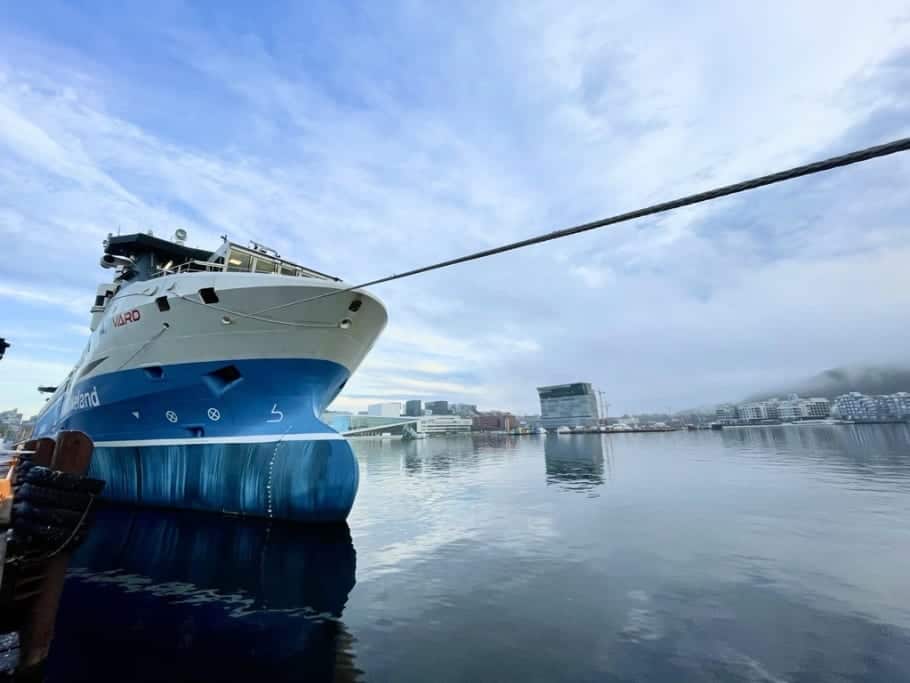
The world’s first electric and self-propelled container ship – Yara Birkeland – has departed for its maiden voyage in the Oslo fjord. Today, the Norwegian Prime Minister was given a tour by CEO of Yara, Svein Tore Holsether.
“We are proud to be able to showcase the world’s first fully electric and self-propelled container ship. It will cut 1,000 tonnes of CO2and replace 40,000 trips by diesel-powered trucks a year, said Svein Tore Holsether, CEO of Yara.
Friday morning, he welcomed Prime Minister Jonas Gahr Støre and Minister of Fisheries and Ocean Policy Bjørnar Skjæran on Yara Birkeland, after the ship had completed its maiden voyage to Oslo, Norway.
Emission-free shipping
The Yara Birkeland, which has already received wide coverage in Norwegian and international media, has been developed in collaboration with the Kongsberg Group (KONGSBERG). The ship was built by VARD with financial support from Enova, and will be in commercial operation from 2022.
“We have been looking forward to this day for a long time. The Yara Birkeland will transport mineral fertilizer between Porsgrunn and Brevik and will contribute to significant emission cuts during transport. This an excellent example of green transition in practice, and we hope this ship will be the start of a new type of emission-free container ships. There are a lot of places in the world with congested roads that will benefit from a high-tech solution like this,” said Holsether.
Now begins a two-year testing period of the technology that will make the ship self-propelled, and finally certified as an autonomous, all-electric container ship.
A shared ambition
Yara Birkeland is a collaborative project between several partners, where KONGSBERG is responsible for the development and delivery of all newly developed technology on the ship. The ship will be operated from Maasterlys’ monitoring and operation’s center in Horten. Massterly is a joint venture between KONGSBERG and Wilhelmsen.
“Norway is a major maritime nation, and other countries look to Norway for green solutions at sea. Yara Birkeland is the result of the extensive knowledge and experience we have available in the Norwegian maritime cluster and industry. The project demonstrates how we have developed world-leading innovation that contributes to the green transition and provides great export opportunities for Norwegian technology and industry,” said Geir Håøy, CEO of the Kongsberg Group.
Enova, a government enterprise responsible for promotion of renewable energy, has allocated up to NOK 133.5 million to build the world’s first electric and autonomous container ship.
“On the way to a low-emission society, transport emissions must come down to almost zero. To achieve that, we need projects that can transform the market – projects that have the potential to pave the way for others and increase the pace of change in their sector. This is exactly what we believe the world’s first autonomous and all-electric container ship will do,” said Nils Kristian Nakstad, CEO of Enova.
Green shipping is the future
In parallel with the construction of Yara Birkeland, Yara has initiated the development of green ammonia as an emission-free fuel for shipping, through the newly started Yara Clean Ammonia.
“Renewable energy was our starting point in 1905. Now, ammonia can bring us back to our roots. Our large shipping network and existing infrastructure means that ammonia has the potential to become the leading fuel for long-distance shipping globally,” said Magnus Krogh Ankarstrand, CEO of Yara Clean Ammonia.
As the world’s largest producer of fertilizers, Yara relies on ammonia for manufacture, and to help feed an ever-growing population. At the same time, current ammonia production represents 2 per cent of the world’s fossil energy consumption. This corresponds to about 1.2 percent of the world’s total greenhouse gas emissions.
“As the world’s largest producer of ammonia, Yara has launched an aggressive plan of international scale, both to remove current emissions and to establish the production of new, clean ammonia,” said Ankarstrand.