



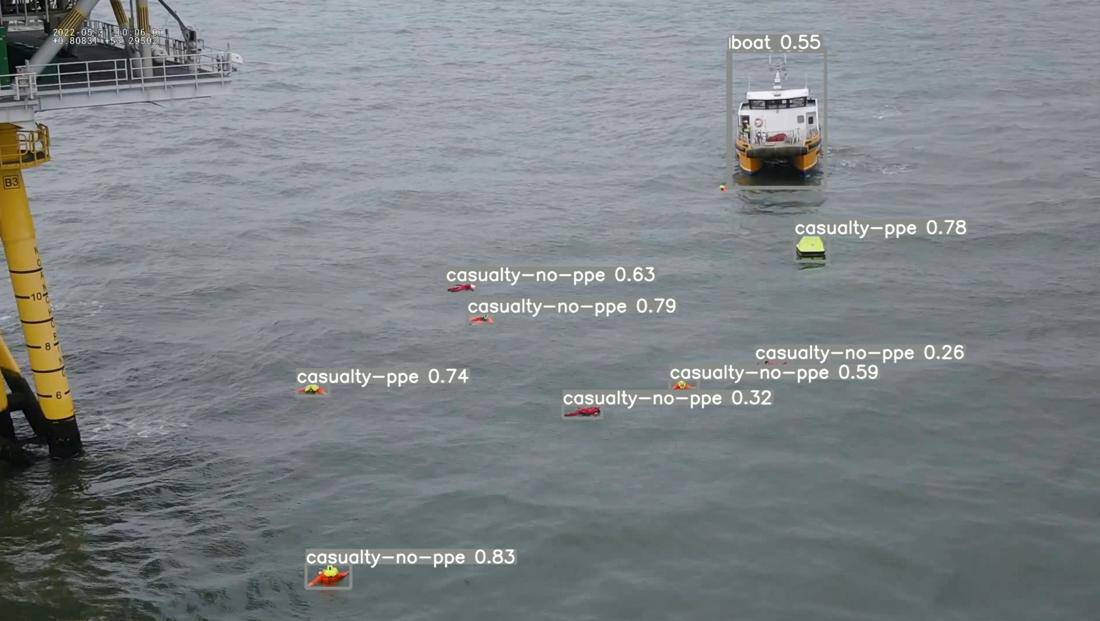
The US Coast Guard Research and Development Center has signed a Cooperative Research and Development Agreement (CRADA) with Zelim, a start-up based in Edinburgh, Scotland, to jointly explore the potential application and effectiveness of AI-enabled detection and tracking technology in search and rescue.
Finding someone in the water is the most fundamental challenge that search and rescue (SAR) organisations face around the world. As Pete Lloyd MBE, former SAR helicopter pilot and Director of SAR at Zelim put it, “If you can’t find someone then you can’t save them.”
Over the last century this task has been undertaken by SAR Units, their pilots and, more recently, drone pilots who often scan the sea surface for hours looking for an object no larger than a football, as much of the human body remains hidden below the surface.
With human-in-the-loop searches, detection performance is inconsistent; human eyes are vulnerable to dust, age, lighting, glare, and fatigue. As a result, the success of a search can depend on the eyesight and level of fatigue of the individual pilot and Search Unit. Every year, survivor statements recount Search Units flying, sailing or driving past, only to return later. Indeed, search profiles assume a proportion of missed detections within a search. It is unsettling but accepted that missed detections will occur.
Over the last three years, Zelim has been developing ZOE, a solution that employs AI to detect and track multiple people, boats or target objects in the water by day or night, storm, or fog. Like the driving aids that reduce driver fatigue, provide hazard alerts and timely information in cars, ZOE aids the search operator by consistently scanning the searched area looking for anomalies and providing visual and audible alerts.
The US Coast Guard has identified in its Strategic Plan that rapidly advancing technologies, including those in artificial intelligence, and machine learning need to be harnessed for possible use in mission execution. The ability to detect, locate, characterize, identify, and track people or objects in the water in near or real-time has the potential to improve mission support to meet the needs of the Coast Guard today and in the foreseeable future.
Captain Chien, Commanding Officer of the USCG RDC stated: “The Coast Guard Research and Development Center investigates and develops methodologies and technologies to improve Coast Guard Mission Performance. Both the Research and Development Center and Zelim are interested in better understanding the potential contribution of AI detection technologies to improve maritime safety, security, and stewardship.”
The overarching objective of the CRADA is to determine methods to evaluate the effectiveness of AI technology with unclassified optical sensors in various environmental conditions. This will require the Coast Guard and Zelim to scientifically develop an objective method for determining AI technology effectiveness compared to current accepted standards.
Doug Lothian CTO of Zelim said: “We have developed ZOE as a tool to support search and rescue units, making it easier for them to spot and track multiple people and boats in the water, whatever the conditions. We are extremely proud to be partnering with the US Coast Guard, who operate the world’s largest SAR fleet. Bringing their operational experience into the project is vital to making sure the technology meets the needs of SAR operators now and in the future.”






 with Zelim, a start-up based in Edinburgh, Scotland, to jointly explore the potential application and effectiveness of AI-enabled detection and tracking technology in search and rescue.)