



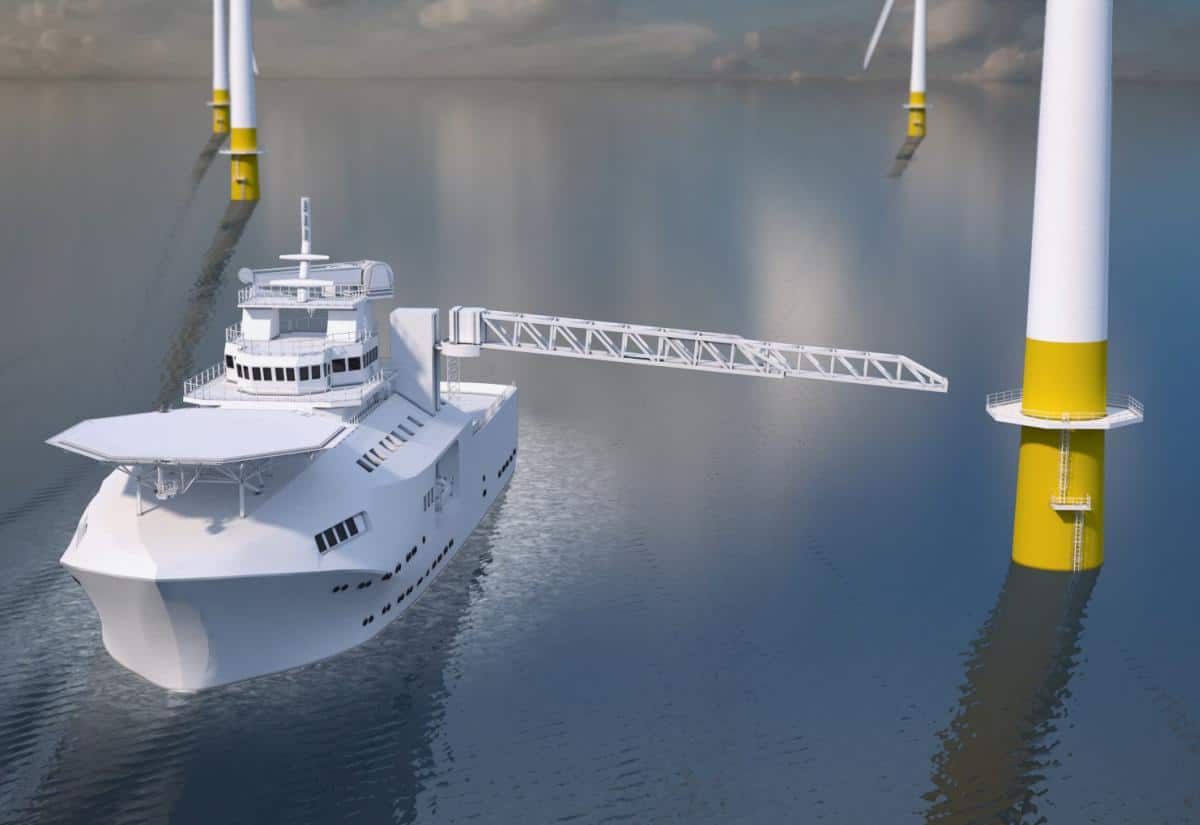
ABB introduces new Operational Planner module for its ABB Ability™ OCTOPUS – Marine Advisory System to help offshore fleet managers plan and optimize the maintenance of offshore wind farm operations.
Offshore support vessels typically operate close to their shore base with frequent trips to fixed assets, such as wind turbines at sea, which sets specific requirements to their ability to perform in demanding conditions. Moreover, as the vessels perform time-sensitive and demanding marine operations, planning is of utmost importance.
For support vessels moving between turbines or rigs during a single shift, OCTOPUS Operational Planner forecasts vessel workability across multiple sites, benefiting decisions on deployment, safety, efficiency and sustainability. Offshore fleet managers can rely on the system to optimize the performance of offshore support vessels, as well as the equipment and crew onboard.
The Software as a Service (SaaS) OCTOPUS Operational Planner is an industry-first functionality, allowing users onboard or ashore to plan and optimize operations for various offshore locations. Whereas an offshore support vessel typically relies on an onboard weather routing system to predict weather and wave heights, OCTOPUS incorporates the weather forecast into the system, combines it with the vessel’s hydrodynamic properties based on size and design, and calculates the expected vessel motions. Thus, instead of weather, the operational limit of the vessel is based on its maximum allowable motions for offshore operations, for example safety in deploying robotic platforms for inspection and maintenance.
The module represents ABB’s contribution as a key technology partner for the EU-funded ATLANTIS research project. ATLANTIS is exploring remote offshore inspection and maintenance techniques using advanced robotic systems for wind farms and developed two Testbeds in the Atlantic Ocean to be used by the international community.
“ATLANTIS project is all about optimizing safety and efficiency with smart robotics when performing maintenance tasks at offshore wind farms,” said Dr. Andry Maykol Pinto, Project Coordinator, ATLANTIS. “The OCTOPUS Operational Planner plays a vital role in planning these offshore tasks, by giving the vessels and the shipowners onshore access to a motion-based mission planner, determining the operational window and thereby reducing the costs and increasing the safety of these operations.”
“The Operational Planner is a great addition to the OCTOPUS – Marine Advisory System suite of products,” said Osku Kälkäjä, Head of Digital Business, ABB Marine & Ports. “This is a significant step forward in the offshore wind and energy industries. Rough seas can mean cancellation of offshore projects at short notice but making the wrong call has an opportunity cost, at a time when wind turbine installation vessel rates are on the rise.”
Enhancing operational efficiency in maintenance is a growing challenge for the offshore wind sector. The Global Wind Energy Council forecasts the sector will add 680 GW of new capacity in the period 2023-2027, and Clarksons estimates there will be surge in demand for support, crew transfer and maintenance vessels to maintain wind farms over the course of their lifespan.1










 OCTOPUS Operational Planner is an industry-first functionality, allowing users onboard or ashore to plan and optimize operations for various offshore locations. Whereas an offshore support vessel typically relies on an onboard weather routing system to predict weather and wave heights, OCTOPUS incorporates the weather forecast into the system, combines it with the vessel’s hydrodynamic properties based on size and design, and calculates the expected vessel motions. Thus, instead of weather, the operational limit of the vessel is based on its maximum allowable motions for offshore operations, for example safety in deploying robotic platforms for inspection and maintenance. The module represents ABB’s contribution as a key technology partner for the EU-funded ATLANTIS research project. ATLANTIS is exploring remote offshore inspection and maintenance techniques using advanced robotic systems for wind farms and developed two Testbeds in the Atlantic Ocean to be used by the international community. “ATLANTIS project is all about optimizing safety and efficiency with smart robotics when performing maintenance tasks at offshore wind farms,” said Dr. Andry Maykol Pinto, Project Coordinator, ATLANTIS. “The OCTOPUS Operational Planner plays a vital role in planning these offshore tasks, by giving the vessels and the shipowners onshore access to a motion-based mission planner, determining the operational window and thereby reducing the costs and increasing the safety of these operations.”)