Accurate Industrial Controls’ AI-powered situational awareness and collision avoidance system gains Indian Register of Shipping approval following Arabian Sea trials
The Indian Register of Shipping (IRS) has certified Pune-based automation specialist Accurate Industrial Controls’ collision avoidance system following successful sea trials, marking a significant milestone for India’s ambitions in the rapidly expanding marine autonomy sector.
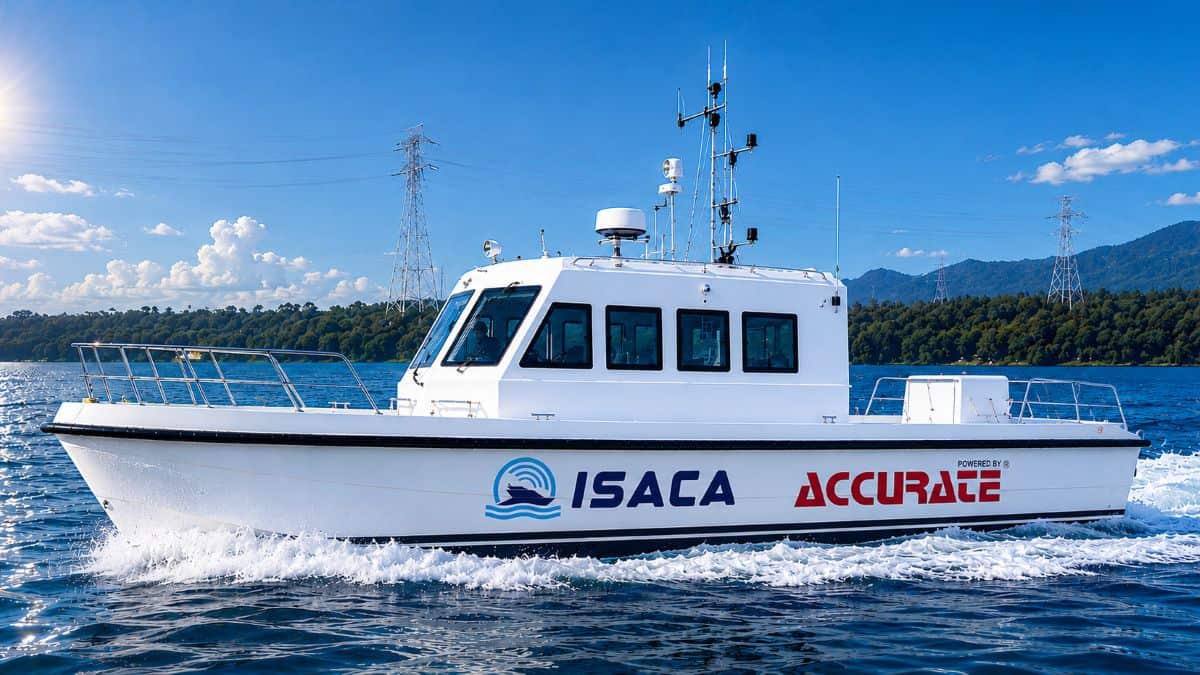
The certification covers the company’s Intelligent Situational Awareness and Collision Avoidance (ISACA) technology stack, which was demonstrated aboard a newly built 13-metre patrol workboat constructed by SHM Shipyard Limited in Mumbai. The vessel underwent a series of sea trials in the Arabian Sea off Karwar, validating the performance of the autonomous navigation and collision avoidance system under operational conditions.
Dharmesh Popatlal Gala Accurate’s director of AI and Robotics confirmed the ISACA system includes Multiple Situational Awareness Sensors including radar, GNSS, echo sounder, CCTV and a full collision avoidance stack. He said it achieved IRS AUTN 4-R(N) certification in line with the specific IMOs International Regulations for Preventing Collisions at Sea (COLREGs) rules.
Dharmesh said, “This is an exciting moment for Accurate, we have worked for more than 30 years in automation across the steel, auto and aerospace industries. We saw an opportunity to expand into marine around five years ago when we were working with the Indian army. We now see massive growth potential for our collision avoidance software and autonomous navigation solutions to be supplied at scale into Europe, the Middle East, India and beyond. We are seeing queries from navies and coastguards as well as port, harbours and the offshore market.”
“As India is showing in space with the orbiter sent to Mars, India can innovate tech at a fraction the cost of other countries. For that reason, we believe we have one of the most advanced and competitive autonomous navigation solutions available in the world. With the ISACA system we are aiming to democratize the cost of autonomous navigation solutions without compromising safety or performance.”
“Autonomous boats using the ISACA solutions can replace crews and provide 24/7 monitoring and persistent awareness at a fraction of the operational cost. This matters more than ever in the naval arena where threats are changing and the nature of warfare evolving.
Accurate has further built a smaller 5m autonomous ‘SAR Craft’ at the Sumit Shipyard, Kochi which it is also bringing to the patrol boat market with the full ISACA tech stack.
The ISACA platform is directly compatible with Mercury, Cox and any CAN/MODBUS based propulsion systems and can integrate also non-digital propulsion employing appropriate actuators, enabling autonomous control of steering and propulsion of wide class of vessels.
Key capabilities include:
- Persistent autonomous operations – 24/7 surveillance and mission execution without onboard crew.
- Advanced sensor fusion – Combines radar, electro-optical cameras, AIS and inertial navigation into a single real-time operational picture.
- Situation perception – Detects, classifies and tracks multiple vessels and objects simultaneously while assessing potential risks.
- 360° situational awareness – Provides continuous all-round monitoring and target tracking in complex maritime environments.
- Autonomous mission planning – Generates and continuously optimises routes, patrol patterns and mission plans as conditions change.
- COLREGS-compliant collision avoidance – Performs real-time collision risk analysis and executes safe manoeuvres in accordance with specific IMOs International Regulations for Preventing Collisions at Sea (COLREGs) rules.
- Precision vessel control – Converts navigation decisions into steering and throttle commands while compensating for wind, waves and currents via the integrated DTS/CAN/MODBUS propulsion interface.
- Remote command and control – Enables operators to monitor vessel status, sensor feeds and missions in real time, with manual override capability when required.
Applications include: port and harbour security, critical infrastructure protection, offshore energy, coastal surveillance, environmental monitoring, hydrographic survey, inspection missions, border security and maritime defence operations.