Alewijnse Alewijnse has expanded its successful collaboration with offshore service provider Windcat Workboats by securing a contract for the complete electrical system integration of four new offshore Crew Transfer Vessels (CTVs). The CTVs are being built at Dok- en Scheepsbouw Woudsend and Neptune Shipyards.
The offshore wind sector is experiencing significant growth. Not only is wind energy technology becoming increasingly cost-efficient, but international agreements on the energy transition and CO2 reduction are also driving this development. By 2030, the EU aims to double its energy production from wind power. Achieving climate targets requires substantial infrastructure investments and an accelerated deployment of installations. Many offshore wind farms are being constructed in the North Sea due to its favourable conditions, including relatively shallow waters, a stable wind climate, and proximity to ports and industrial energy consumers.
Developments in the offshore wind sector demand specialist knowledge and advanced technical solutions. Over the years, Alewijnse has built extensive expertise in electrical systems for offshore vessels and has established a long-term relationship of trust with Windcat Workboats. Together, Windcat and Alewijnse have delivered 45 CTVs over a period of sixteen years.
Now, four new vessels are on the way. Windcat 58, 62, and 63 are being built at Neptune Shipyards in Hardinxveld-Giessendam, while Windcat 61 is docked at Dok- en Scheepsbouw Woudsend. Alewijnse is supplying the complete electrical installation on board, including control consoles and alarm and monitoring systems. Additionally, Alewijnse is assisting the shipyard with the production and installation of aluminium cable trays and foundations.
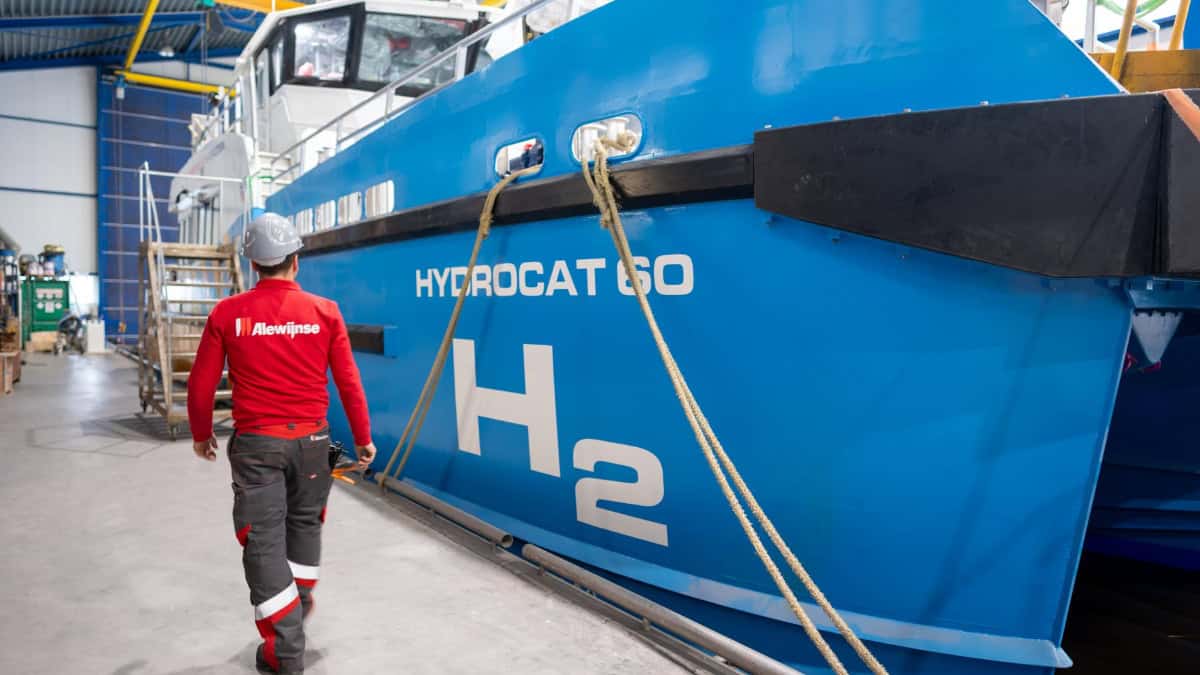
An important innovation in Windcat vessels 40 to 56 is the integration of Lithium-Ion batteries, which contribute to more sustainable energy management due to their high energy density. From Windcat 57 onwards, two generators are installed on board for an even more robust energy supply. The Windcat vessels Hydrocat 48 and 55 are the world’s first hydrogen-powered CTVs, achieving a significant reduction in CO2 emissions.
Windcat operates a fleet of more than forty small, fast catamarans in various models, active in the waters of Northwest Europe, from England to Denmark and Germany. As wind farms are being constructed further offshore, Windcat has also started building Commissioning Service Operation Vessels (CSOVs), designed to remain in an offshore wind farm for extended periods and provide safe and comfortable accommodation for up to 120 technicians.
Alewijnse has successfully collaborated with Dok- en Scheepsbouw Woudsend for many years. Alewijnse project manager Bertran Smit: “We have been working at this shipyard since 2009 for the new build and refit of Windcat vessels. The projects run smoothly for all parties involved. Both Woudsend and Windcat are very satisfied with the quality of the delivered vessels and the flexibility of Alewijnse.”
Regarding the partnership with Neptune Shipyards, Alewijnse project manager Eef Uittenbogaard states: “Neptune Shipyards is a large shipyard with the capacity to build multiple CTVs simultaneously. Alewijnse is the ideal partner for this, thanks to our extensive experience with the technology on these vessels. We have now been working together successfully for six months and are proud of this new step towards further sustainability and optimization of offshore transport in the wind energy sector.”