


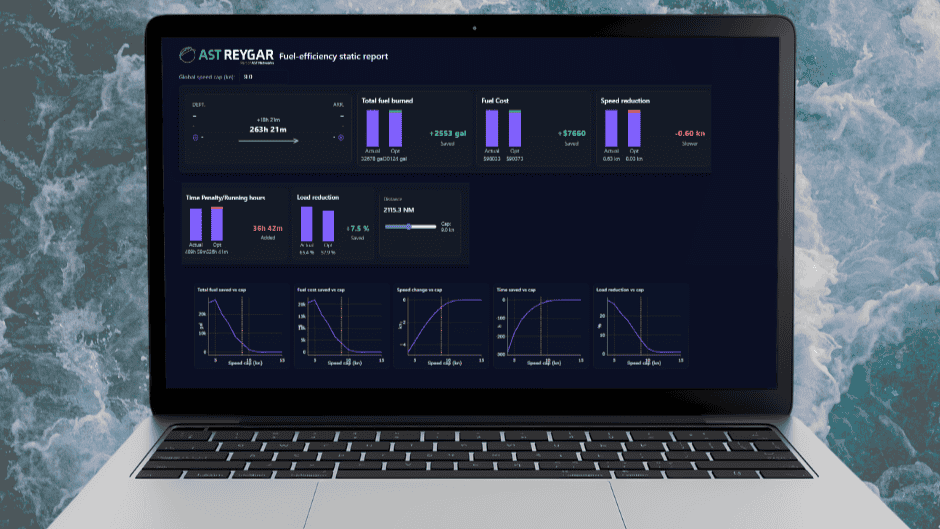
Maritime operators are under growing pressure to improve efficiency, reduce emissions, and keep vessels healthy, without compromising vessel availability. For fleets using AST Reygar’s advanced fuel efficiency and optimisation tool – the most recent feature launch within BareFLEET – the results have been immediate and substantial: up to 15% reductions in fuel consumption, alongside smoother engine loading and fewer unplanned maintenance events.
This is the outcome of applying data-driven models that give crews and shoreside teams clear, actionable guidance on optimal vessel speed, power settings, and optimised arrival times.
The Challenge: Fuel Waste Hidden in Plain Sight
Even highly experienced crews face a complex optimisation problem on every transit. Weather, schedules, port congestion, operator expectations and vessel handling all influence real-world decisions. The consequence is that vessels frequently run at speeds – or engine loads – that are not optimal for the required arrival time.
For example, a vessel aiming to “run fast to arrive early” may end up:
- Burning fuel at a disproportionately high rate
- Arriving ahead of schedule only to wait
- Operating engines at much higher load than is optimal
These inefficiencies accumulate quickly across a multi-vessel fleet.
How AST Reygar’s Fuel Efficiency Tool Works: Scenario Modelling for Real Operations
The tool alongside AST Reygar’s, data consultancy approach, gives operators the ability to model and compare transit scenarios by evaluating:
- Actual vs. optimised vessel speed over ground
- Fuel burn across the entire voyage
- Engine load profiles and reduction potentials
- Time saved or added based on speed choices
- Optimal port arrival timing to avoid idle waiting
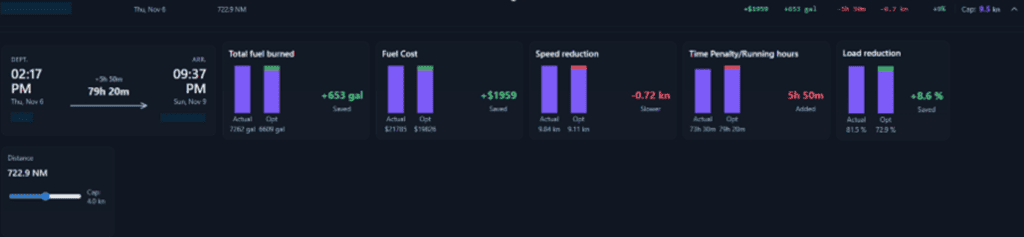
The report’s visual and interactive tools present this data in a format that’s easy to interpret and analyse. Operators can see exactly how different speed settings affect fuel burn, transit time, and engine load.
This empowers teams to make strategic decisions that ensures the lowest possible fuel burn for the required arrival time while keeping the vessel within its most efficient power range.
Why 15% Savings Are Achievable: The Science Behind the Optimisation
The system’s savings come from aligning three technical factors:
1. Operating within the engine’s optimal load band
Real-world data often shows actual load sitting well above optimal values. The tool highlights this clearly, showing both actual and optimal load bars, along with the percentage reduction achievable. Lower load means lower wear on key components and smoother long-term engine performance.
2. Adjusting transit speed
Each vessel is different by design, and operates most efficiently under varying transit speeds. The optimiser tool evaluates actual data to find the optimal speeds for the vessel and identifies the point where speed can be slightly reduced to dramatically reduce fuel burn.
3. Eliminating early arrivals and idle time
By modelling port or site arrival windows, operators can avoid burning unnecessary fuel just to sit waiting at anchor or alongside.
Together, these adjustments generate meaningful, route-by-route savings that add up quickly across a fleet.
Turning Insights into Action Onboard and Ashore
The tool is designed for practical use:
- Onboard crews can reference the optimised profile before departure to adjust power and speed settings and utilise on board displays to track performance against the targets.
- Fleet managers can analyse actual vs. optimal performance for each voyage to identify training opportunities or vessel-specific behavioural patterns.
- Technical teams benefit from the reduced engine load and more predictable maintenance cycles.
Because the system compares your vessel’s own historical performance with mathematically optimised predictions, the guidance is unique to each hull, route, and operating condition.
Reduced Engine Load: A Hidden Win for Reliability and Uptime
Beyond fuel savings, the tool makes one trend unmistakably clear: optimised profiles consistently reduce engine load.
Lower load reduces:
- Wear on fuel injection components
- Thermal stress
- Frequency of unplanned downtime
- Maintenance costs over a vessel’s lifecycle
Many fleets find that engine health improvements alone justify the adoption of the Fuel Efficiency Tool, even before fuel savings are considered.
BareFLEET – A Tool Built for the People Who Use It
Although powerful, the design is intentionally user-friendly:
- Clean dashboards
- Coloured overlays showing where fuel can be saved
- Speed limit indicators for visualisation
- Scenario sliders to model “what if” changes instantly
Operators don’t need to interpret dense spreadsheets or abstract curves, the insights are presented directly and visually.
The result is a system that supports confident decision-making on every voyage.
Charting a More Efficient Future
With rising fuel costs and tightening emissions standards, operators must make data-driven decisions at every stage of the voyage. AST Reygar’s fuel efficiency tool transforms raw telemetry into clear operational guidance that protects engines and supports predictable, cost-effective operations.
For fleets already using it, 15% fuel savings are only the beginning. The real value lies in empowering crews with the insight they need to run smoother, safer, more sustainable transits – voyage after voyage.