



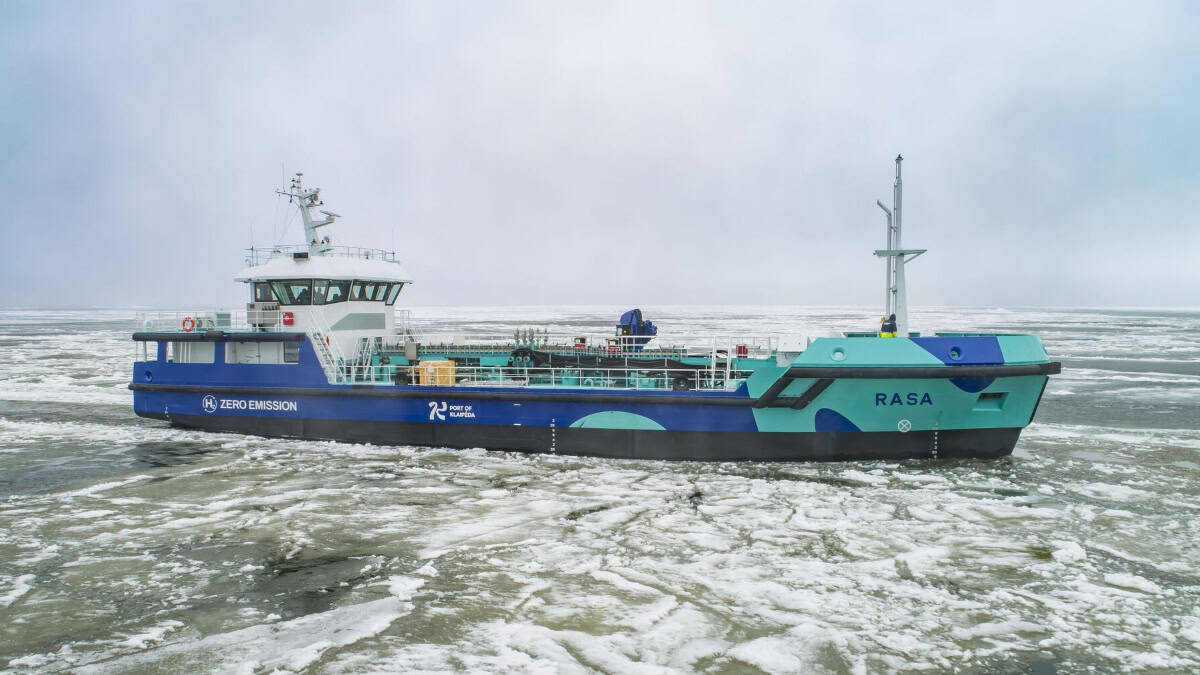
Newbuild waste tanker RASA supports round-the-clock environmental services at the Port of Klaipėda
Baltic Workboats has successfully delivered RASA, a 42-metre waste collection tanker, to Klaipėdos uostas (Port of Klaipėda), marking a major milestone in sustainable port operations and vessel innovation.
The delivery represents two firsts for Baltic Workboats: RASA is the first tanker constructed at the company’s Nasva shipyard and its first vessel utilising hydrogen as an onboard energy source.
Designed to support environmentally responsible port services, RASA features a hybrid energy system combining an approximately 2 MWh energy storage solution from EST-Floattech with two 40 kW hydrogen fuel cells supplied by Genevos. The vessel’s fully electric propulsion system, delivered by Danfoss Drives, enables zero-emission operations for more than 10 hours continuously.
With an overall length of 42 metres and a beam of 10 metres, RASA offers a cargo capacity of 400 m³ for the collection of liquid waste and sludge from vessels operating in the Port of Klaipėda. The tanker can maintain speeds of up to 8 knots for approximately eight hours on battery power alone, supporting efficient and uninterrupted port operations.
Advanced automation and monitoring systems allow the vessel to be operated by a crew of just three, optimising power consumption and operational efficiency while ensuring safe, round-the-clock performance.
The vessel was developed through close collaboration within the BLRT Grupp. Western Baltic Engineering completed the detailed design, while Western Baltija Shipbuilding constructed the hull and installed the majority of auxiliary systems. Baltic Workboats was responsible for the integration of the electric propulsion and control systems—including battery packs and power management—as well as navigation, automation systems and interior outfitting.
RASA is equipped to collect and treat waste, sludge and rainwater from ships calling at the Port of Klaipėda, with additional waste transported to onshore treatment facilities. The vessel is expected to operate on a 24/7 basis, supporting the port’s environmental objectives and contributing to cleaner maritime operations in the Baltic region.








, marking)