


38m multi-purpose workboat KRATT combines biomethane and battery-electric propulsion for lower-emission maritime operations
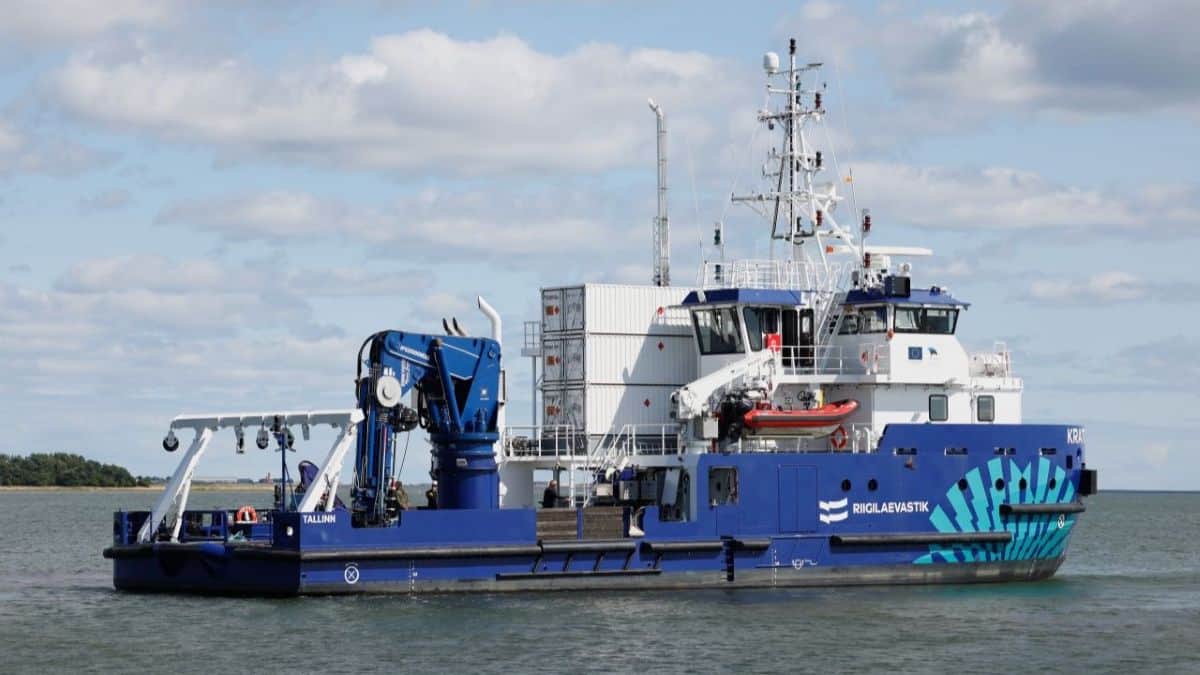
Baltic Workboats has completed the 38-metre multi-purpose workboat KRATT at its Nasva shipyard in Saaremaa, Estonia, with the vessel set to undertake a wide range of maritime operations in Estonian waters from autumn 2026. Christened at the shipyard on 12 August, KRATT has been built for the Estonian State Fleet (Riigilaevastik) to support buoy handling, fairway maintenance, marine research, pollution response and rescue operations.
The vessel is Estonia’s first large workboat designed to use biomethane as its primary fuel and is also equipped with a battery bank supporting electric propulsion. The combination of biomethane fuel and battery-electric propulsion is intended to reduce the environmental impact of the Estonian State Fleet while providing the flexibility required for a broad range of operational missions.
KRATT will strengthen Estonia’s maritime capabilities by combining multi-purpose functionality with lower-emission propulsion technology, enabling the vessel to support both routine marine infrastructure work and emergency response operations.
Estonia’s Minister of Infrastructure Kuldar Leis noted at the christening ceremony that KRATT marks a significant milestone in Estonia’s transition towards more sustainable shipping and sets a strong example for others. “The new vessel is a good example of how the state fleet can be renewed to become both more capable and more environmentally friendly at the same time. We need to develop our fleet intelligently – one vessel must be able to perform as many different tasks as possible while doing so with a smaller environmental impact. I am particularly pleased that this innovative workboat was designed and built here in Estonia.”
KRATT is one of Baltic Workboats’ largest and most technologically exciting projects to date. We designed and built the vessel for the Estonian State Fleet at our Nasva shipyard in Saaremaa.
“During the vessel’s construction, it was important to find a solution that would combine the high operational capability and versatility of a workboat with a reduced environmental impact. Combining biomethane and electric power provides strong opportunities for this and makes the vessel’s solutions unique on a global scale,” said Margus Vanaselja, Chairman of the Management Board of Baltic Workboats.
The new vessel’s primary fuel is compressed biomethane (CBM), and it is equipped with a 400 kWh battery bank. On biomethane, the vessel can travel up to 1,000 nautical miles at a speed of seven knots. On battery power, it can operate for up to two hours at five knots. The battery bank also allows the vessel to use electric power for up to ten hours while at anchor, reducing the need to run auxiliary engines as well as fuel consumption, emissions and noise levels.
According to Andres Laasma, Director General of the Estonian State Fleet, the gradual renewal of the state-owned fleet is essential to ensure the country’s ability to carry out its maritime duties. “Our main workboats today are on average 30-40 years old, and maintaining their reliability is becoming more difficult and costly year by year. The new workboat KRATT will help ease this situation, as it is a multi-purpose vessel capable of performing a wide range of tasks,” Laasma said.
According to Laasma, for a small country it is important to develop its fleet in a way that avoids vessels spending most of the year idle at the quay.
“We need to move from single-purpose vessels to multi-purpose vessels, because it does not make sense to invest millions in ships that can be used for only one task,” Laasma added.
KRATT is the first major workboat ordered by the state in the past ten years. The most recent major workboat currently in service with the Estonian State Fleet that was purchased by the state is the hydrographic survey vessel Jakob Prei, completed in Germany in 2014.
The vessel’s primary task is seasonal buoy and fairway maintenance, but it also serves as an important platform for modern marine research. The vessel is suitable for environmental, oceanographic, hydrographic and geological surveys throughout the Baltic Sea.
The vessel provides accommodation for six crew members and ten scientists. It also includes a mess, recreation and fitness room, galley, utility and office spaces, and laboratories.
Scientists have access to approximately 50 m² of wet and dry laboratory space equipped with the vessel’s permanently installed research systems and equipment, including a seawater flow-through system, sampling equipment, workstations and connection options for additional equipment.
The deck is equipped with the systems and fittings needed to launch and recover research equipment, containers, buoys and seabed stations. The vessel can support activities including water and sediment sampling, seabed sonar surveys, towing research equipment, the use of remotely operated and autonomous equipment, and meteorological and biological observations. Without resupply, the vessel can operate at sea for up to seven days.
The vessel’s design and procurement contract was signed in January 2024. Design and construction works took 30 months.
The vessel’s design and construction costs totalled nearly EUR 22 million. The project was financed entirely through the European Union’s NextGenerationEU recovery fund.