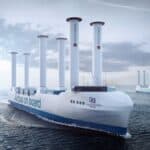
Bureau Veritas Marine & Offshore , a global leader in testing, inspection, and certification, is supporting the maritime energy transition by classifying a new series of methanol-ready oil and chemical tankers for Union Maritime. The vessels are being equipped with Norsepower Rotor Sails (NPRS™), an innovative wind propulsion technology that significantly reduces fuel consumption and emissions.
The first two vessels in this series, Buran and Ostro, have been delivered in February and April 2025 respectively, following their construction at Fujian Southeast Shipbuilding. Union Maritime have two additional 18,500 dwt tankers currently under construction at Fujian Southeast Shipbuilding and two more at Wuhu Shipyard Co., Ltd, which will all be equipped with Norsepower Rotor Sails™, with deliveries scheduled throughout 2025.
These six vessels mark the first wave of a broader new build programme for Union Maritime under BV class. More than 25 additional tankers are scheduled for delivery between 2026 and 2028, including a significant series at Wuhu Shipyard, with further vessels being built at other major Chinese shipyards. These vessels will either be delivered with wind propulsion systems installed or prepared for future integration, using technologies from various suppliers such as Norsepower.
By incorporating wind propulsion systems and methanol-ready configurations, Union Maritime is aiming to improve energy efficiency and support long-term emissions reduction across its expanding fleet.
BV supports the integration of these systems by conducting evaluations on the vessels to assess compliance with the relevant rules and notations to help ensure they meet the latest standards for both wind propulsion and alternative fuels, like methanol. This includes its Rules for Wind Propulsion Systems (NR 206), the Wind Propulsion 1 and Wind Propulsion 2 notations for vessels equipped with wind propulsion systems, as well as the METHANOLFUEL-PREPARED notation. BV has provided comprehensive support throughout the project, including an efficient and thorough review of the upgraded design to meet class requirements and delivery schedules.
Bhuvnesh Dogra, Head of Technical at Union Maritime: “The deliveries of Buran and Ostro mark an exciting first step in our broader new build programme under Bureau Veritas class. These six vessels represent the beginning of an ambitious plan to modernize our fleet with advanced wind propulsion systems. Bureau Veritas’ expertise in classing these vessels helps ensure that we meet the highest safety and regulatory standards, while also positioning ourselves at the forefront of sustainable shipping. This collaboration with Bureau Veritas is critical as we continue to build a fleet that not only meets the evolving demands of the industry but also leads the way in emissions reduction and energy efficiency.”
Matthieu de Tugny, President of Bureau Veritas Marine & Offshore, said: “BV is delighted to support Union Maritime with the integration of sustainable shipping solutions into its fleet. Safety remains paramount in the adoption of new technologies, and our classification framework helps ensure that the innovations meet safety and regulatory standards. By classing these vessels, we support ship owners and operators in navigating the transition to more sustainable operations, while maintaining the safety and reliability of their fleets.”
Heikki Pöntynen, CEO, Norsepower, said: “We’re proud that six of Union Maritime’s new methanol-ready tankers are being equipped with Norsepower Rotor Sails ™, marking a strong commitment to wind propulsion as a key decarbonisation solution. This growing fleet demonstrates how wind-assist technologies can be scaled in parallel with alternative fuels to deliver immediate and long-term emissions reductions. Having the classification of Bureau Veritas — one of the most respected classification societies — is a clear validation of the quality, reliability, and safety of our technology. It’s an exciting milestone, and one that reinforces wind propulsion as a core component of sustainable shipping.”