



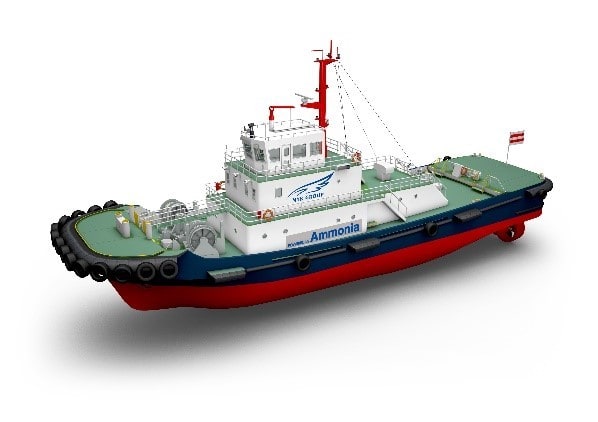
ClassNK has issued an Approval in Principle (AiP) for an ammonia-fueled tugboat (A-Tug) jointly developed by Nippon Yusen Kabushiki Kaisha (NYK Line) and IHI Power Systems Co., Ltd.
Ammonia is expected to be used as ship fuel for decarbonization since it does not emit CO2 when combusted. Meanwhile, adequate safety measures are imperative as it has been pointed out that ammonia is toxic to humans and corrosive to materials. ClassNK has been involved in projects aiming for zero-emission ships using ammonia fuel in terms of safety assessment, and has issued its “Guidelines for Ships Using Alternative Fuels” as a necessary standard to minimize the risks related to ammonia-fueled ships for the ships, crews, and environment by stipulating requirements for installation, controls, and safety devices.
ClassNK just carried out a design review of the A-Tug under R&D by NYK Line and IHI Power Systems in accordance with Part C-1 of its guidelines and issued the AiP on verifying that it complies with the prescribed requirements. That is the world’s first AiP for a tugboat using ammonia as fuel issued by the society.
For two companies’ goal to realize the demonstration operation at the port of Yokohama in fiscal 2024, ClassNK will continue to support as the certification body, and will strive to provide appropriate standards for ammonia-fueled ships through the expertise gained from the collaboration.
AiP Handover Ceremony
Right: Mr. Yuichi Tamura, Division Director/Engineering & Technology Center, IHI Power Systems Co., Ltd.
Middle: Mr. Toshi Nakamura, Executive Officer, Nippon Yusen Kabushiki Kaisha
Left: Mr. Masaki Matsunaga, Corporate Office/Director of Plan Approval and Technical Solution Division, ClassNK
Image of ammonia-fueled tugboat (courtesy of NYK Line) 
Approval in Principle (AiP):
At the initial stage of designing or before the specific target ship to be implemented is decided, the design is examined based on the existing regulations such as international conventions and ship classification rules, and an Approval in Principle (AiP) is issued as proof of conformity with requirements. It also prevents rework of regulatory aspects in the post-process, shortens the examination time at the time of class registration, and can be used as a technical basis for external appeal of the design status.






 for an ammonia-fueled tugboat (A-Tug) jointly developed by Nippon Yusen Kabushiki Kaisha (NYK Line) and IHI Power Systems Co., Ltd. Ammonia is expected to be used as ship fuel for decarbonization since it does not emit CO2 when combusted. Meanwhile, adequate safety measures are imperative as it has been pointed out that ammonia is toxic to humans and corrosive to materials. ClassNK has been involved in projects aiming for zero-emission ships using ammonia fuel in terms of safety assessment, and has issued its "Guidelines for Ships Using Alternative Fuels” as a necessary standard to minimize the risks related to ammonia-fueled ships for the ships, crews, and environment by stipulating requirements for installation, controls, and safety devices.)