Offshore WindFloating Offshore WindClean-Fuel Floating Offshore Wind Installation Vessel Design Underway

Clean-Fuel Floating Offshore Wind Installation Vessel Design Underway

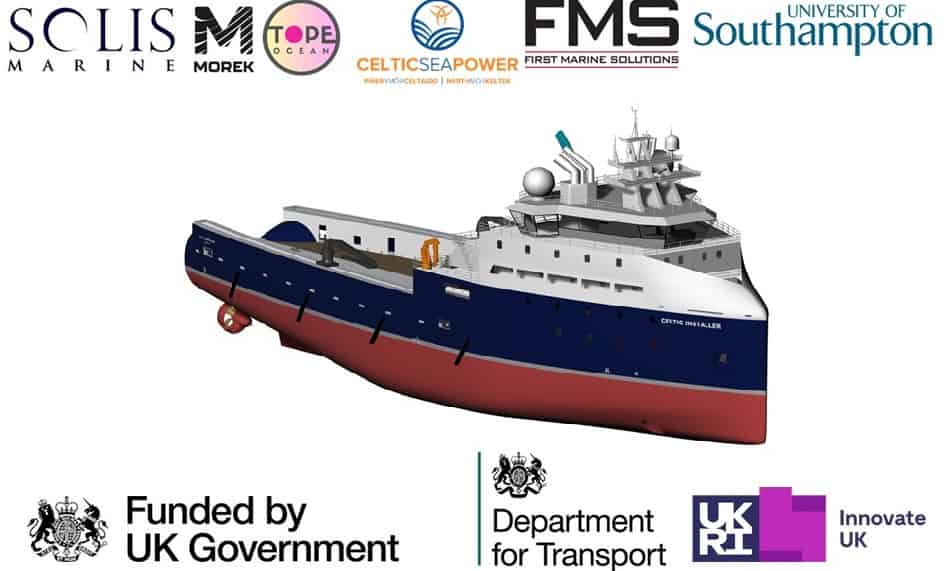
Solis Marine is collaborating on the development of a next-generation installation vessel designed to support gigawatt-scale floating offshore wind projects, utilising vessels powered by sustainable, low-emission fuels.Building on the successfully funded Clean Maritime Demonstration Competition (CDMC) Round 4 project, ‘Future Floating Offshore Wind Installation Vessel ’, Solis Marine will continue its collaboration with industry partners to undertake the next design phase for the vessel ‘CELTIC CONSTRUCTOR’.

Working with a strong consortium, including the University of Southampton, First Marine Solutions, Celtic Sea Power, Tope Ocean, and Morek Engineering, the team brings extensive expertise in offshore operations, naval architecture, marine engineering, and floating offshore wind technology. This breadth of knowledge ensures a practical and robust design outcome and will look to commercially de-risk the overall package.

The project will focus on reducing uncertainties identified in the earlier concept design by refining stability, hydrodynamics, synthetic handling systems and techno-economic aspects. The aim is to deliver a more detailed design that can be considered by shipowners and yards for future construction.

The project aims to advance the ‘CELTIC CONSTRUCTOR’ design towards commercialisation, with a clear roadmap and certification pathway aligned to emerging low-carbon fuel regulations.

By addressing technical gaps, particularly around methanol propulsion, bunkering, and supply, the project will deliver a practical, low-carbon installation vessel design with strong industry backing and a pathway to large-scale deployment.

This project is funded by UK Government through the UK Shipping Office for Reducing Emissions (UK SHORE) programme in the Department for Transport. UK SHORE has allocated over £230m since 2022 to develop the technologies necessary to decarbonise the UK maritime sector and capture the economic growth opportunity of the transition. InnovateUK, part of UK Research and Innovation, is the main delivery partner for UKSHORE interventions.


‍

Latest News

The International Institute of Marine Surveying (IIMS), working in collaboration with the International Marine Contractors Association (IMCA) and the Workboat Association, has announced the publication of the International Workboat Code of Practice, a 122-page guide providing best-practice guidance for the construction, operation and surveying of commercial workboats.

IIMS, IMCA and Workboat Association Launch International Workboat Code of Practice

IIMS, IMCA and the Workboat Association collaborate on a 122-page guide covering vessel safety, operational standards and crew competency for commercial workboats worldwide The International...
The world’s largest battery-electric ship has officially entered commercial passenger service, marking a major milestone for maritime electrification and zero-emission vessel operations. Built by Incat Tasmania for long-standing customer Buquebus, the 130-metre China Zorrilla has completed its maiden commercial voyage between Buenos Aires, Argentina, and Colonia, Uruguay, across the River Plate.

China Zorrilla Begins Electric Ferry Operations

Built for Buquebus to connect Argentina and Uruguay, the China Zorrilla, the world’s largest battery-electric ferry, marks a major milestone in large-scale marine electrification...
Boluda Towage has expanded its Norwegian fleet with the addition of VB NORWEGIAN FALCON, a new tug built by Sanmar Shipyards to support towing, vessel assistance and offshore operations in demanding maritime environments.

Boluda Towage Takes Delivery of VB NORWEGIAN FALCON

Sanmar-built VB NORWEGIAN FALCON features RAstar 3200 SX design, ASD propulsion and more than 6,700 hp Boluda Towage has expanded its Norwegian fleet with the...
SWITCH Maritime has secured a Design Basis Agreement (DBA) from the United States Coast Guard (USCG) for its SWITCH-150 hydrogen fuel cell-electric ferry, marking a key milestone in the development of the 150-passenger vessel. Designed by naval architecture firm Incat Crowther, the SWITCH-150 combines hydrogen fuel cell-electric propulsion with onboard hydrogen storage to support high-frequency ferry operations without compromising service schedules or requiring shoreside charging infrastructure.

SWITCH Hydrogen Ferry Clears Key US Coast Guard Milestone

The US Coast Guard agreement establishes a regulatory framework to guide construction, commissioning and future commercial operation of the hydrogen-powered ferry SWITCH Maritime has secured...

Related news