


Battery-electric variant of Conoship International’s proven CIP3800 targets zero-emission coastal corridors, shuttle routes and environmentally sensitive waters
Conoship International is expanding its CIP-Series with a purpose-designed fully electric version of the proven CIP3800 coastal coaster platform, targeting short-sea applications where battery-electric propulsion can deliver zero-emission operations.
The new configuration is aimed at dedicated coastal corridors, fixed shuttle routes and operations in environmentally sensitive waters, where predictable sailing patterns and access to shore-based charging can support full electrification.
The foundation of the fully electric CIP3800 general cargo vessel is rooted in the optimised hull form carrying it. Battery-electric propulsion requires extreme energy efficiency, and the CIP3800 platform provides an ideal, field-proven baseline.
With numerous vessels of the CIP-Series already built and trading, the platform’s optimised hull lines and low resistance profiles have been rigorously validated both in model tanks and real-world operations. This proven hydrodynamic performance directly translates into lower power demands per nautical mile, making large-scale battery storage commercially feasible for targeted short-sea operations.
“The strength of the CIP3800 lies in its versatility. Shipowners don’t need to adopt unproven, experimental ship designs to explore zero-emission options. By building on a platform with an outstanding track record at sea, operators retain all the core advantages of the CIP series: optimised hold volume, low fuel/power demand, and building flexibility. All this while unlocking electric capability for specific trade loops.” – Maarten Sickler, Sales Director at Conoship International
Key Operational Capabilities
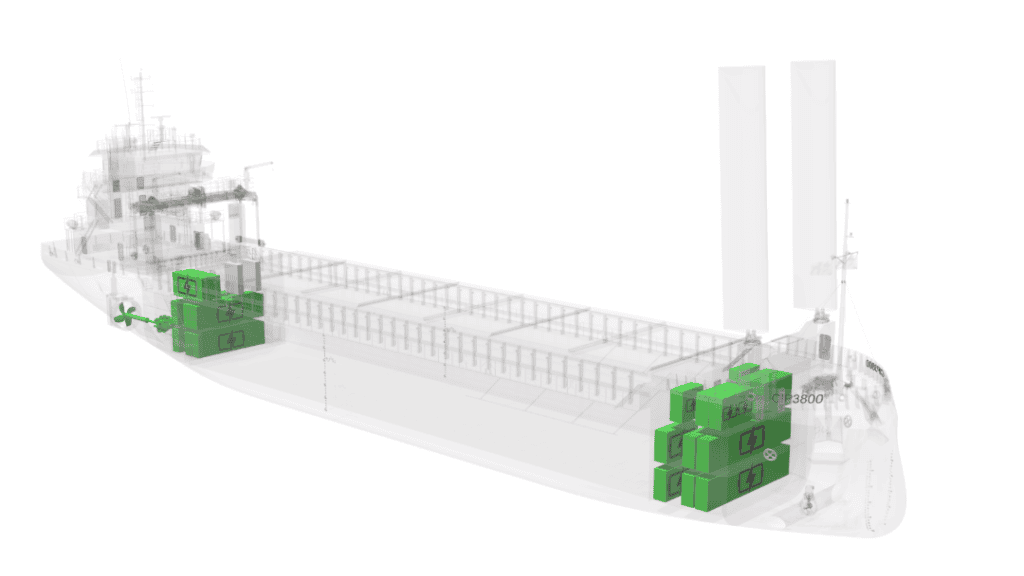
- 40 MWh Modular Energy Storage: Configured with a high-capacity 40 MWh battery installation, the vessel offers an operational range of 350 nautical miles at 10 knots or up to 650 nautical miles at 8 knots (including sea margin and hotel load allowances).
- Optimised Cargo Space: The design retains its signature single, box-shaped cargo hold design. It comes with a capacity of 4,737 () and an intake of 3,200 t, making it perfectly suited for bulk commodities and project cargo.
- Split-Room Weight Distribution: To prevent excessive trim and eliminate the need for extra deadweight water ballast, the 40 MWh battery plant is intelligently distributed across dedicated forward and aft battery compartments.
- Competitive Net Payload: While energy storage systems add lightship weight, the complete removal of heavy fuel oil, marine gas oil, lubricating oils, and sludge tanks offsets this difference. This ensures net usable payload remains highly competitive for short-sea trades.
- Chemistry-Agnostic & Future-Proof: Built on Conoship’s modular design philosophy, the battery architecture accommodates different cell chemistries (such as high-density NMC or long-lifecycle LFP) depending on specific route requirements, lifetime cycle profiles, and shore-charging setups.
The electric CIP version will not be a direct replacement for other general cargo operations; rather, it is a specialised, zero-emission tool for short-sea routes where shore power infrastructure and fixed sailing schedules allow it. Scandinavian fjord corridors and zero-emission ECA zones are some of these examples. Additionally, as infrastructure develops, and technology progresses, we expect more options to become available for (fully) electric solutions.
Whether powered by diesel-electric generators, methanol-ready engines, or a 40 MWh battery plant, the CIP-Series remains the premier platform for modular, flexible, and sustainable short-sea logistics.
To account for evolving shore power availability and unpredictable operational profiles, the battery-electric architecture can be integrated with a compact, downsized generator set. Potentially running on sustainable drop-in biofuels, serving as an optional range extender or emergency take-home system. This gives shipowners operational flexibility on unconstrained routes while maintaining the sustainable baseline for green shipping corridors.
Vessel Specifications
| Length Overall | 89.43 m |
| Breadth Moulded | 13.20 m |
| Draft | 5.20 m |
| Cargo Intake | 3,200 t @ 5.20 m draft |
| Cargo Hold | 4,737 m³ / 167,300 ft³ |
| Battery Capacity | 40.0 MWh |
| Operational Range | Up to 650 NM (@ 8 kts) / 350 NM (@ 10 kts) |
| Direct Emissions | 0% CO₂, NOx, SOx, PM |