


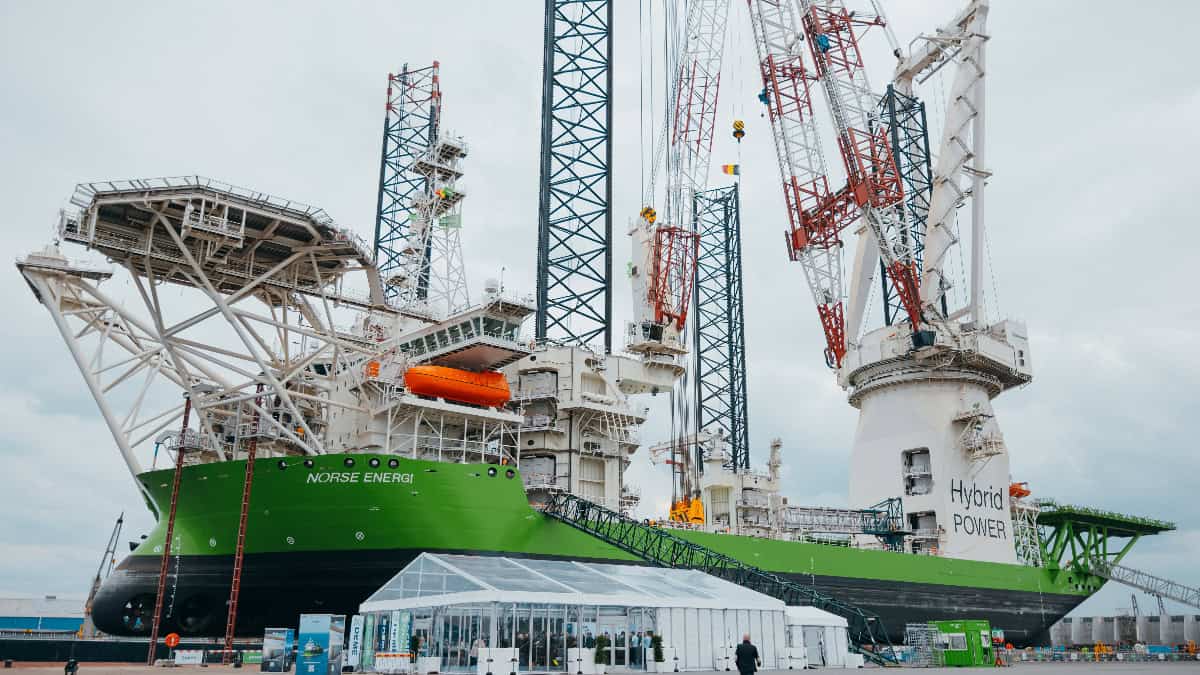
Norse Energi is sister vessel to Norse Wind will support offshore wind installation campaigns across the Baltic Sea and North Sea
DEME has officially named its new jack-up offshore transport and installation vessel, Norse Energi, during a ceremony held at the company’s base in Flushing, the Netherlands.
The event follows the recent naming of sister vessel Norse Wind in Oslo and represents another key milestone in DEME’s strategy to expand and modernize its offshore installation fleet with next-generation assets tailored for the growing offshore wind sector.
Together, the two vessels are expected to significantly enhance DEME’s offshore transport and installation capabilities across Europe.
Norse Energi is scheduled to begin operations in the Baltic Sea and North Sea, with its first assignments including Iberdrola’s Windanker offshore wind farm in the German Baltic Sea, set to commence in June 2026. The vessel will then move to Ørsted’s Hornsea 3 offshore wind project in the UK, where work is due to begin in the third quarter of 2026.
“We are proud to mark the naming of Norse Energi and to complete this new generation of jack-up offshore transport & installation vessels alongside Norse Wind,” explains Luc Vandenbulcke, CEO of DEME. “These vessels reflect our ambition to push boundaries and support our customers in delivering the next wave of offshore wind projects. With the addition of Norse Energi and Norse Wind to our fleet, DEME is further reinforcing its commitment to accelerating the energy transition and delivering innovative and sustainable solutions for offshore wind projects worldwide.”
The vessel was officially named by Mrs. Fabienne Ackermans. She is a descendant of the founding family of DEME.
Together, Norse Energi and Norse Wind represent a major step forward with regard to DEME’s offshore transportation and installation capabilities. Purpose-built to transport and install the next generation of wind turbines and XXL monopiles in water depths of up to 70 meters, the vessels will play a key role in supporting the continued global expansion of offshore wind. Equipped with a powerful 3,200-ton crane and optimised for maximum operational efficiency, both vessels have been designed to handle multiple high-capacity turbines per trip, enabling faster and more efficient project execution while reducing installation timelines.
Designed by GustoMSC and built by CIMC Raffles Shipyard, like its sister vessel Norse Wind – is engineered to install turbines with rotor diameters measuring over 300 meters and XXL monopiles weighing up to 3,000 tons, even in water depths of 70 meters.
The vessels’ advanced designs include a hybrid power plant and a 4.2 MWh battery system, which absorb energy peaks and reduce the load on diesel engines,