


Workboat efficiency emerges as a key lever in cutting lifecycle emissions for offshore wind projects.
As the UK and its North Sea partners accelerate plans to build out offshore wind capacity towards 100 GW by 2030 and beyond, two leading British marine-technology companies are warning that one essential part of the system remains under-addressed: the workboats required to construct, operate and maintain offshore wind farms.
While offshore wind produces zero-carbon power, its turbines depend on daily marine logistics. Under UK and North Sea operating conditions, this means a combination of service operation vessels (SOVs) and fast crew transfer vessels (CTVs) working year-round in demanding sea states. These vessels are essential to keeping wind farms productive, but today they still represent a material source of emissions within the offshore wind value chain.
For BAR Technologies and Diverse Marine, the challenge is not theoretical. It is operational and solvable.
Meaningful emissions reductions are already being delivered today through proven vessel designs operating in the North Sea. Crew transfer vessels equipped with BAR Technologies’ Foil Optimised Stability System (FOSS) reduce fuel consumption and associated CO2 emissions by approximately one tonne of CO2 per vessel per operating day, while also increasing uptime and improving crew comfort in rough offshore conditions.
These individual savings compound rapidly at scale. Under typical UK operating models, a 100 GW offshore wind portfolio in the North Sea is expected to require approximately 150–250 CTVs, depending on distance from shore and the balance between CTV and SOV deployment. Across a fleet of this size, FOSS-equipped vessels could therefore avoid 150–250 tonnes of CO2 every day, equivalent to 55,000–90,000 tonnes of CO2 per year, purely through efficiency gains.
Crucially, these reductions are achieved without compromising safety or operational capability. They are the direct result of improved hydrodynamic performance and smarter vessel design.
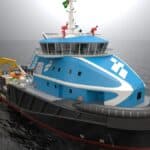
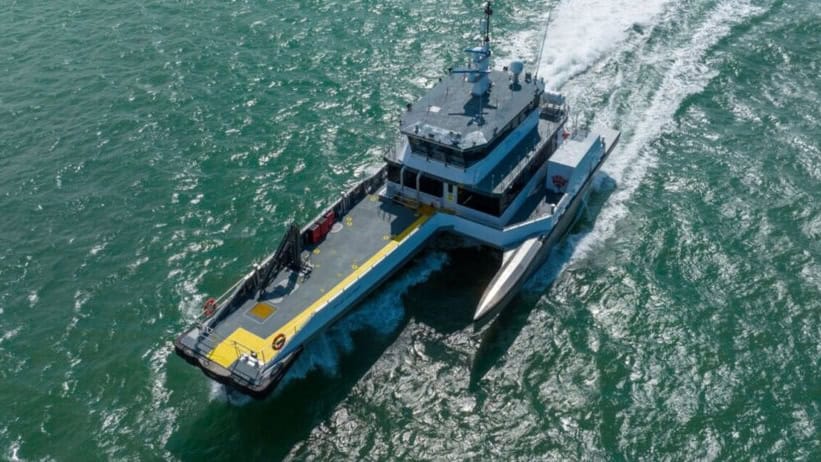
A clear example of this approach is Seacat Columbia, a 30-metre crew transfer vessel designed by BAR Technologies and built by Diverse Marine. Designed around the BARTech 30 platform, Columbia combines a distinctive proa hull form with a patented foil-assisted stability system, delivering up to 50 per cent fuel reduction during transits and up to 70 per cent improvement in motion stability. Since entering service with Equinor in 2022, the vessel has operated continuously in the North Sea, supporting the Sheringham Shoal and Dudgeon wind farms.
Alongside Columbia, other FOSS-equipped vessels, including Seacat Sovereign and Seacat Sceptre have accumulated extensive operational hours across European wind farms. Operating reliably in some of the harshest offshore environments, these vessels demonstrate that foil-assisted stability is not experimental technology but a commercially proven solution that delivers measurable performance and emissions benefits.
“These vessels show what is possible today using technology that already works in the North Sea,” said Oliver Pendleton, Head of Operations & Vessels at BAR Technologies. “But efficiency alone is not the end goal. If offshore wind is to be genuinely net zero, then the vessels servicing it must also become zero emission.”
That transition is now firmly in sight. Building on the operational success of FOSS-equipped vessels, BAR Technologies’ technology and product roadmap is focused on delivering fully zero-emission crew transfer vessels for future offshore wind farms. By combining advanced hull optimisation, foil-assisted stability and zero-carbon propulsion, the next generation of vessels will eliminate operational emissions entirely, removing tens of thousands of tonnes of CO2 per year from offshore wind operations.
For Diverse Marine, the direction of travel is clear. “The next phase of offshore wind growth demands vessels that are not only capable in harsh North Sea conditions, but aligned with long-term decarbonisation goals,” said Ben Colman, Director at Diverse Marine. “By combining advanced design with build quality and operational insight, zero-emission support vessels can become a practical reality, not a future aspiration.”
With the UK expected to formalise further North Sea wind commitments this year, BAR Technologies and Diverse Marine are urging developers, operators and policymakers to ensure that vessel procurement and chartering strategies align with net-zero targets. Maritime logistics may represent a small proportion of offshore wind project costs, but they are a critical part of its carbon footprint and one that can be addressed using technology already available today.