



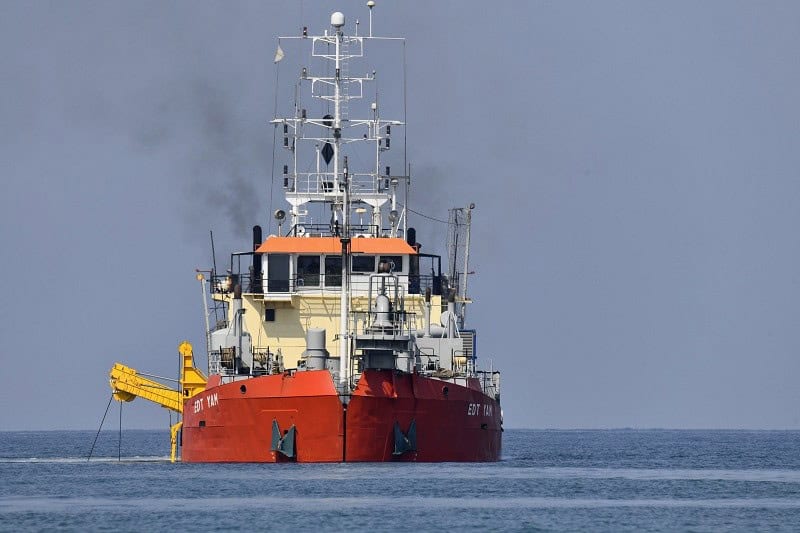
In a panel at the Central Dredging Association (CEDA) Dredging Days, panellists from CE Delft, Royal IHC, DEME and Van Oord discussed the steps that lie ahead in the transition to a low-or-zero-carbon dredging. The emerging consensus is that decarbonisation will not be possible with today’s fuels — but also, that better measures are needed to ensure that the origin of new renewable fuels can be traced.
“Decarbonisation will require the use of post-fossil fuels,” said Dagmar Nelissen, Senior Researcher at CE Delft. “[Many] are still to be developed and upscaled. There is no silver bullet.”
Referring to the sourcing of fuels like hydrogen and methanol, which can be reformed from fossil fuels at huge carbon expense, or generated using renewables in a truly low-carbon fashion, Nelissen added: “Certification of fuels is still an issue to be solved.”
However, encouragingly, “the sector might be able to profit from solutions developed for other fleet segments,” and on a larger scale, “the entire [maritime] sector may profit from demand and logistics for fuels by other sectors.”
A study, cited and partly authored by Royal IHC Research & Developer Benny Mestemaker, considered three possible scenarios – “business as usual”, in which fossil fuel prices remain at today’s levels, and no external emissions costs are levied; a carbon tax; and “sustainable development”, in which fossil fuels are costly, punitive CO2 taxes are implemented, and separate nitrogen oxide (NOX), sulphur oxide (SOX) and particulate matter (PM) are also levied.
“We do not want a vessel which offers benefits now, but in ten years will be outdated and unable to sail,” he said. “So during the newbuild phase we have a lot of options which influence design.”
Crucially, the study took into account not just tank-to-wake emissions from the vessel itself, but also well-to-tank emissions – those associated with refining and transportation of the fuel to the ship. Taking into account newbuild, operating costs and all other factors, it was found that renewably-generated (‘green”) hydrogen was generally competitive in all scenarios at EUR2.30/m3, though more expensive than HFO and LNG in the business-as-usual scenario, in which both were below EUR2/m3.
“Liquid hydrogen from natural gas has one of the highest CO2 emissions per megajoule – whereas hydrogen from renewable sources has one of the lowest, so it is important to know where your fuel comes from,” said Mestemaker. “A long term solution for greenhouse gas emissions requires a transition from fossil fuels to renewable fuels [such as] renewable methanol and renewable hydrogen… as well as effective policies. Policy will be more important than CAPEX to make renewable-fuelled vessels economically viable.”








 Dredging Days, panellists from CE Delft, Royal IHC, DEME and Van Oord discussed the steps that lie ahead in the transition to a low-or-zero-carbon dredging. The emerging consensus is that decarbonisation will not be possible with today’s fuels -- but also, that better measures are needed to ensure that the origin of new renewable fuels can be traced.)