


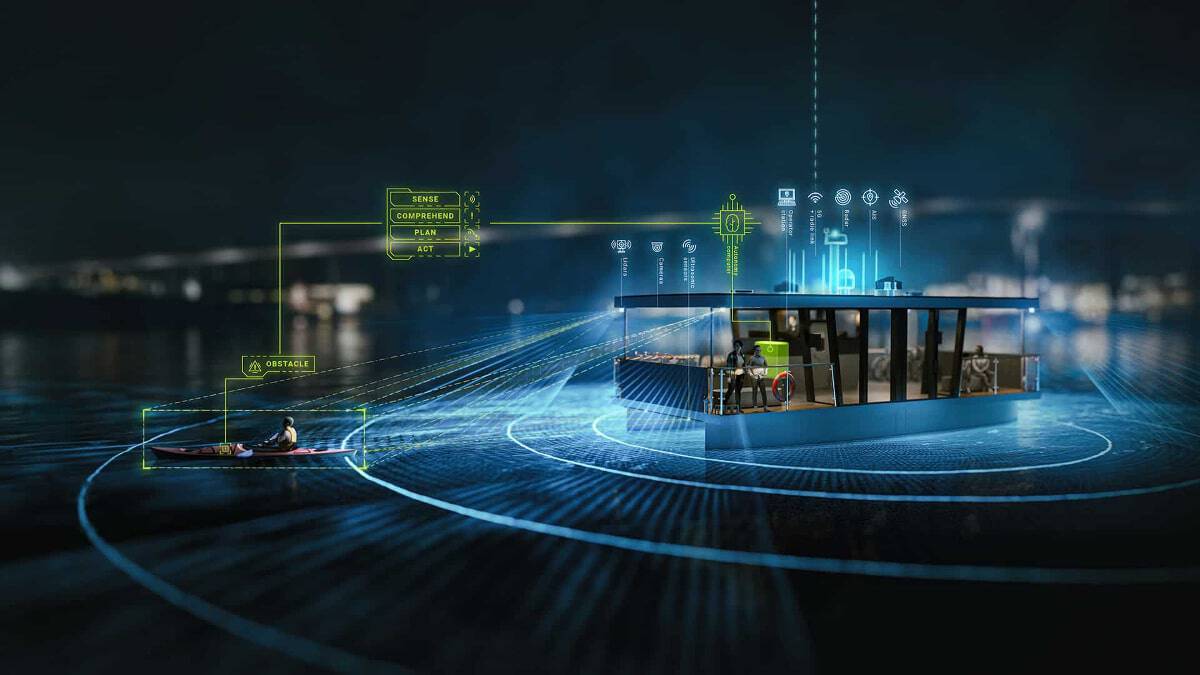
In the next decade, game-changing innovations in the maritime industry will make mobility easier, leaner, and greener. Combining Evoy’s electric motor systems with autonomous navigation technology from Zeabuz will have a huge positive impact on boating, from ferries and workboats all the way to leisure boats.
Imagine you’re taking your boat for a long summer holiday. You board in your home port in Oslo, Norway. The boat’s running, but it’s silent and smooth. You fall asleep listening to the ocean. When you awake the next morning, you’ve arrived at Sweden’s idyllic Koster Islands.
This scenario is possible when you combine electric boating and autonomy.
Autonomy and electrification: overlapping value propositions for boats
As all maritime sectors move toward a decarbonized future, autonomous electric boats promise an all-encompassing, optimized solution. Evoy is the world market-leader in high-output electric motor systems that fit diverse commercial and recreational boats. Zeabuz is a world-leading provider of autonomous navigation technology, and has launched the world’s first emission-free, autonomous passenger ferry.
With overlapping value propositions for boats ranging from ferry transport vessels to workboats, the potential from this collaboration between two Norwegian Blue Economy pioneers is immeasurable.
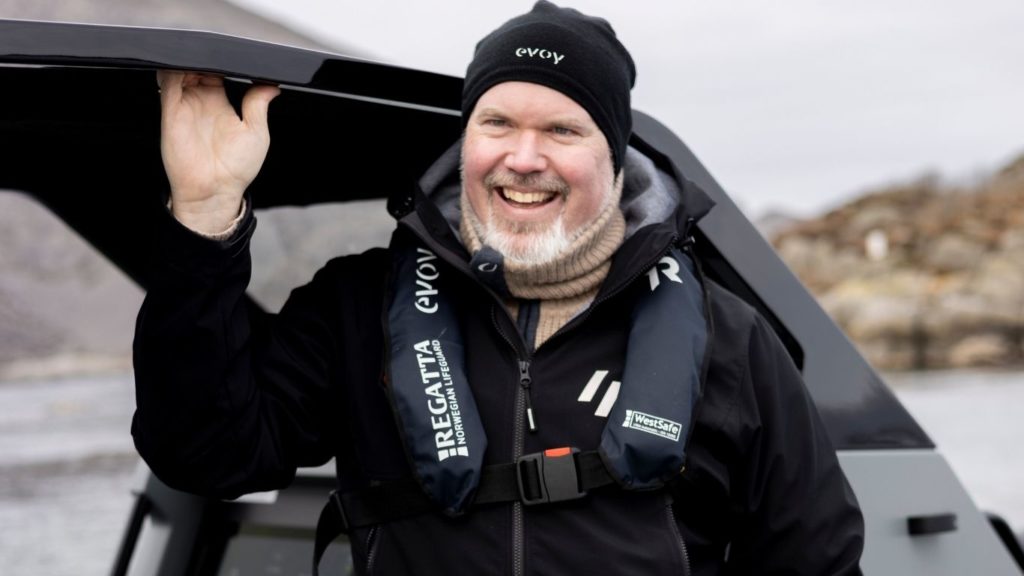
‘We see a tremendous opportunity in this partnership with Zeabuz. The future requires betting on electric vessels and AI now. Self-driving electric boats deliver more flexible, energy- and cost-effective, and sustainable solutions across the board.’ Leif A. Stavøstrand, Evoy CEO and co-founder
A virtuous circle of financial and environmental value creation
Autonomy and electrification in the marine industry perpetuate a ‘virtuous circle.’ Although decarbonization is an expensive proposition for many commercial boat operators, these two future-proof forces optimize efficiency in operations to deliver financial and environmental value.
Electric motor systems have a high ROI, reducing fuel costs dramatically. AI and technology and autonomy solutions are set to change the face of waterborne mobility and shipping forever, enabling a new level of safe, energy efficient, sustainable, crew-optimized operations.
AI enables a leaner crew by streamlining manual, repetitive tasks, reducing crew size, and enabling personnel to better focus on higher-level operations with reduced risk. Both autonomy and electrification also give operators a better understanding of vessel and fleet health, including predictive maintenance, that supports the increase in market interest for safety and cost mitigation throughout a vessel’s life.
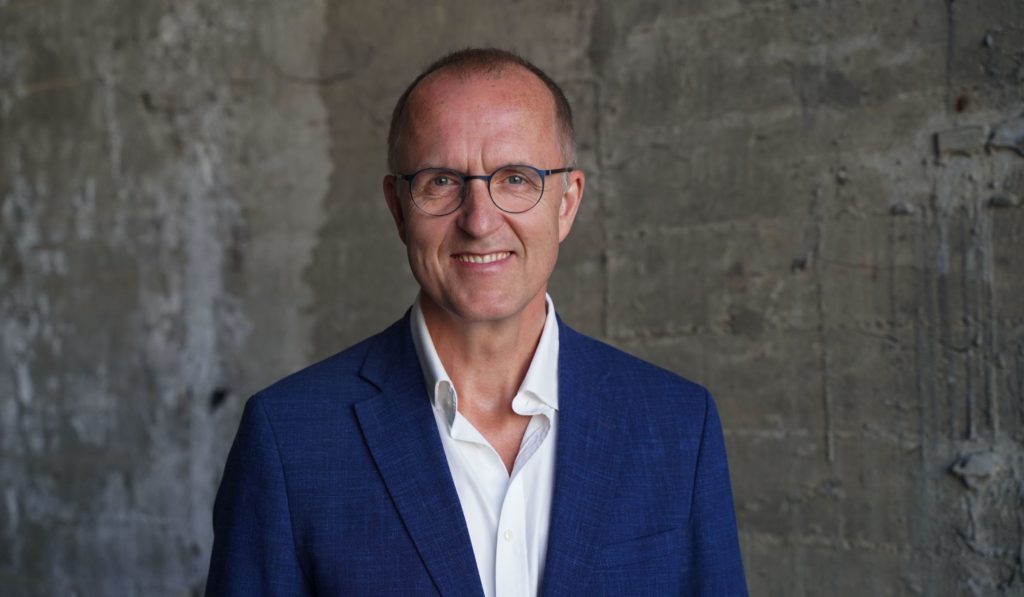
‘With electric, self-driving capabilities and advanced digital security, the collaboration with Evoy sets the stage for key advancements in the maritime industry. Both of our technologies fit many use cases.’ Erik Dyrkoren, Zeabuz CEO
Evoy and Zeabuz sign an MOU to develop an electric test boat with AI technology
In a gesture of good faith, the two Norway-based companies have already signed an MOU. The next part of the voyage includes developing a test vessel that incorporates Zeabuz AI technology and an Evoy electric motor system. The companies plan to launch their test boat on the fjords in summer 2024 to research the fundamentals of technical interoperability, followed by showcasing how it works to the market.
‘Norway has a strong ecosystem of maritime high-tech companies getting ready for commercialization outside of Norway. Both Zeabuz and Evoy are a part of it,’ says Dyrkoren. ‘Now we’re doing it together, and I think it’s awesome.’
While the early adopters of electric AI boating thus far are predominantly urban passenger ferries in cities including Trondheim, Stockholm, London, and Paris, it’s only the beginning. Implementing electric AI systems is a gradual process according to the International Maritime Organization. It’s rolled out in steps starting with a crewed ship with automated processes and decision support, followed by an autonomous vessel with seafarers on board. The final phase is a fully autonomous vessel, remotely supervised from shore.
‘When commuter and harbor vessels normalize automated zero-emission operations, we expect the technology to trickle down to many more vessels and boats. One day, in the not-too-distant future, we will have self-driving taxi boats and recreational boats that go from A-to-B even at high speeds,’ says Stavøstrand. ‘It’s a dream come true, and it will revolutionize the way we travel — opening the waterways to decongest large metropolises sustainably!’