


EcoNavis Solutions, an innovator in marine energy efficiency, has secured its first commercial contract for the Eco Boss Cap, a patented propeller hub cap that reduces fuel consumption and emissions in vessel operations. The order comes from a Thailand-based ship manager, which will retrofit the fuel-saving, emissions-reducing hub to one of its general cargo vessels, with potential expansion to five additional ships pending performance evaluation.
Retrofit work to 177m long vessel’s 5m diameter propeller is scheduled for mid-August at an undisclosed Chinese shipyard, close to Shanghai. EcoNavis engineers will supervise the installation and early operation of the device, with sea trials expected shortly after the retrofit.
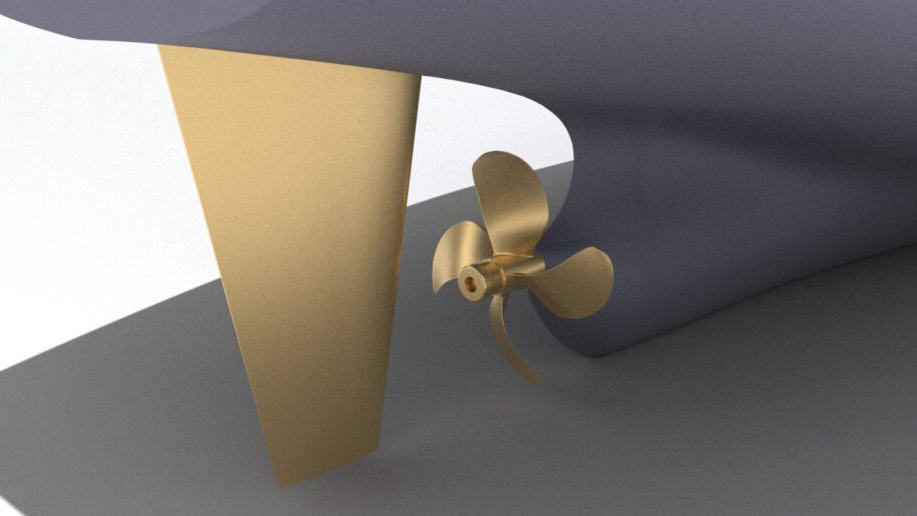
When commissioned, the installation will mark the first full-scale deployment of the Eco Boss Cap, a conically shaped propeller hub featuring a patented arrangement of internal chambers and holes designed to reduce fuel consumption, emissions, and propeller-induced hub vortex cavitation.
Developed following extensive computational fluid dynamics (CFD) analysis and validation in one of Europe’s leading cavitation tunnel test facilities and towing tank tests, the Eco Boss Cap has demonstrated efficiency gains of up to 5% across all speed ranges.
Dr Batuhan Aktas, Founder & CEO of EcoNavis Solutions, and lead inventor of the technology, said the contract validates years of research, modelling and hydrodynamic testing.“This is a significant milestone for EcoNavis as a serious technology partner to the global shipping industry. The ship operators’ interest came directly in response to our earlier work, which speaks volumes about both the industry need and the credibility of the energy efficiency results we’ve achieved,” he said.
Unlike traditional boss cap designs, which use fin appendages to redirect flow and can introduce turbulence, the Eco Boss Cap utilises an internal chamber and a series of precisely angled holes to manage water flow through pressure differential. This configuration eliminates the cavitation responsible for rudder erosion, underwater noise, and thrust losses, and avoids the torque penalties associated with fin-type designs.
With no blades, no fins, no rotating appendages, the Eco Boss Cap is easier to manufacture and install than most other energy-saving propeller hubs caps currently on the market. Cast as a single piece and free of complex geometries, it can be installed during a standard drydock in under six hours.
“This cost-effective production means a lower upfront investment, with a payback time of less than a year for a 180m handy-size bulk carrier burning about 25t of fuel per day,” said Aktas.
The Scotland-headquartered company has secured over £550,000 in grants and private funding to bring the technology to market.
“This is not just a product launch. It’s the start of a new phase in ship efficiency,” said naval architect and EcoNavis Chief Operating Officer Amitavo Wye. “Eco Boss Cap is tailor-made for each vessel to deliver greater fuel savings over a wider operating envelope. Shipowners don’t want a generic solution; they want performance that works for their ships’ actual operating conditions.”
EcoNavis Solutions is currently pursuing partnerships in Europe, the US, and Asia as it brings its retrofittable efficiency solutions to market.
“This is just the beginning,” said Wye. “With early traction in Southeast Asia and strong interest in Greece, Singapore and the U.S., we’re building momentum around a product that directly addresses CII, EEXI and ESG compliance without complexity or disruption.”