Built by Detroit Brasil for Starnav Serviços Marítimos, the hybrid PSV will support Petrobras offshore logistics under a long-term charter
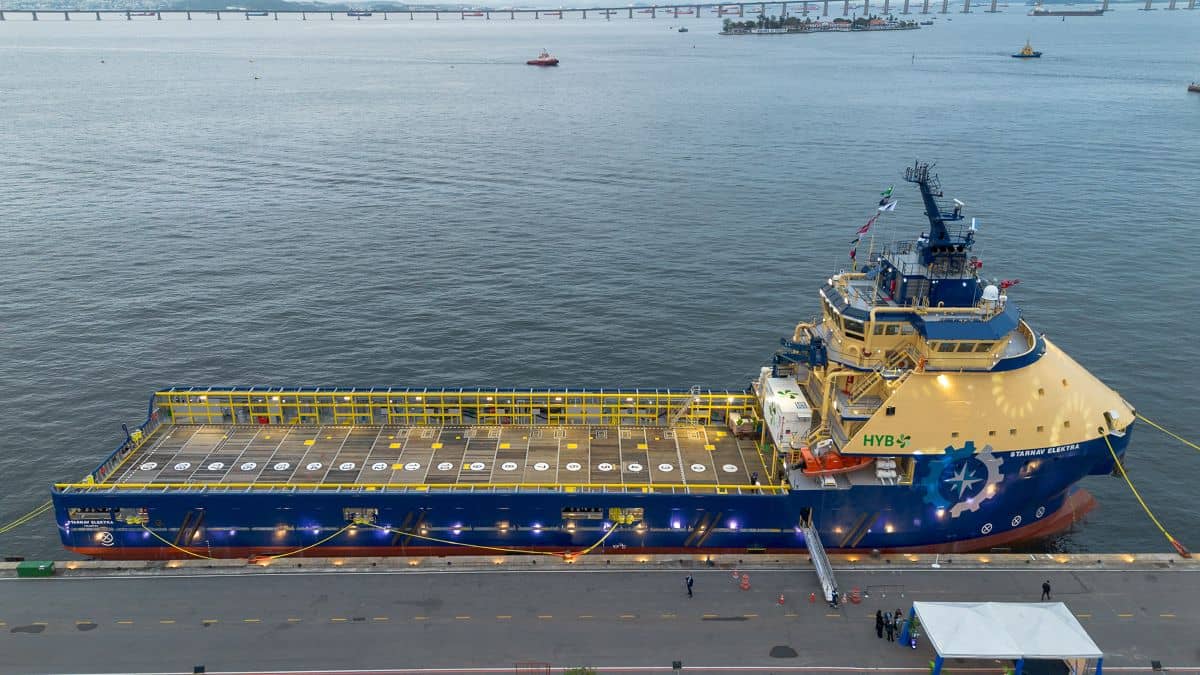
Starnav Elektra, the first hybrid platform supply vessel (PSV) designed and built in Brazil, has been delivered to ABS class, marking a milestone for the country’s offshore support vessel sector.
Built by Detroit Brasil at its Itajaí shipyard for Starnav Serviços Marítimos, the 92.1-metre vessel has a deadweight of 5,500 tonnes and is the first in a planned series of up to 10 battery-hybrid vessels. The programme comprises six PSVs and four oil spill response vessels.
The hybrid PSV carries the ABS ESS-LiBATTERY and HYBRID notations along with the SUSTAIN-1 notation. It will operate under a long-term charter to Petrobras, supporting the company’s offshore logistics operations in Brazilian waters.
The vessel’s 1,322 kWh lithium iron phosphate battery system was developed to meet the operator’s dynamic positioning class 2 (DP2) requirements. This includes the ability to maintain position on battery power for up to 20 minutes in the event of a single engine failure.
“Brazil’s offshore energy sector is expanding quickly, and the vessels that support it need to keep pace with evolving operational demands and regulatory requirements. Starnav Elektra shows what’s possible when an operator, shipyard and class work together to translate technical innovation into operation performance,” said Matt Tremblay, ABS Senior Vice President, Global Markets.
The battery pack is installed on the main deck rather than in the hull, a configuration intended to simplify maintenance access and reduce risk. The system will also allow Starnav Elektra to run on fewer generators while maintaining safety margins, reducing fuel consumption, emissions and engine maintenance cycles.
“Starnav Elektra also represents a technological milestone. We are delivering a vessel built for the next generation of global shipping. She is a hybrid vessel, equipped with an advanced BESS (Battery Energy Storage System) and ready to operate on renewable fuels such as HVO. This vessel was designed not only to meet today’s requirements, but to meet the requirements of the future,” said Carlos Eduardo Pereira, Starnav CEO.
A further milestone came with Starnav Elektra’s arrival in Rio de Janeiro, led by an all-female crew under the command of Captain Isabela Teixeira Ponce de Le. The achievement highlights Starnav’s commitment to promoting talent, diversity and inclusion across the maritime sector.