


Inmarsat seminar Thriving in the Digital Age: A Blueprint for Success highlighted the rapid transformation of an increasingly connected, digitalised, and automated offshore industry while emphasising the importance of a motivated and well-trained workforce.
Against a backdrop of persistent crewing issues, an ever-evolving regulatory framework, and fast-developing technology, the offshore industry is undergoing rapid transformation.
With connectivity as an enabler, offshore supply vessel (OSV) operators are transferring unprecedented volumes of data from ship to shore, allowing shore-based personnel to monitor onboard processes and machinery, provide support, and even execute certain tasks remotely.
Further easing the burden on OSV crews is process automation, with artificial intelligence and machine learning-based solutions performing tasks almost instantaneously that would have previously taken hours for a human to complete.
The objective is clear: seeking to reap the rewards of optimised efficiency, enhanced safety, and regulatory compliance, the offshore sector has its sights set on the increasing interconnection, digitalisation, and automation of its operations.
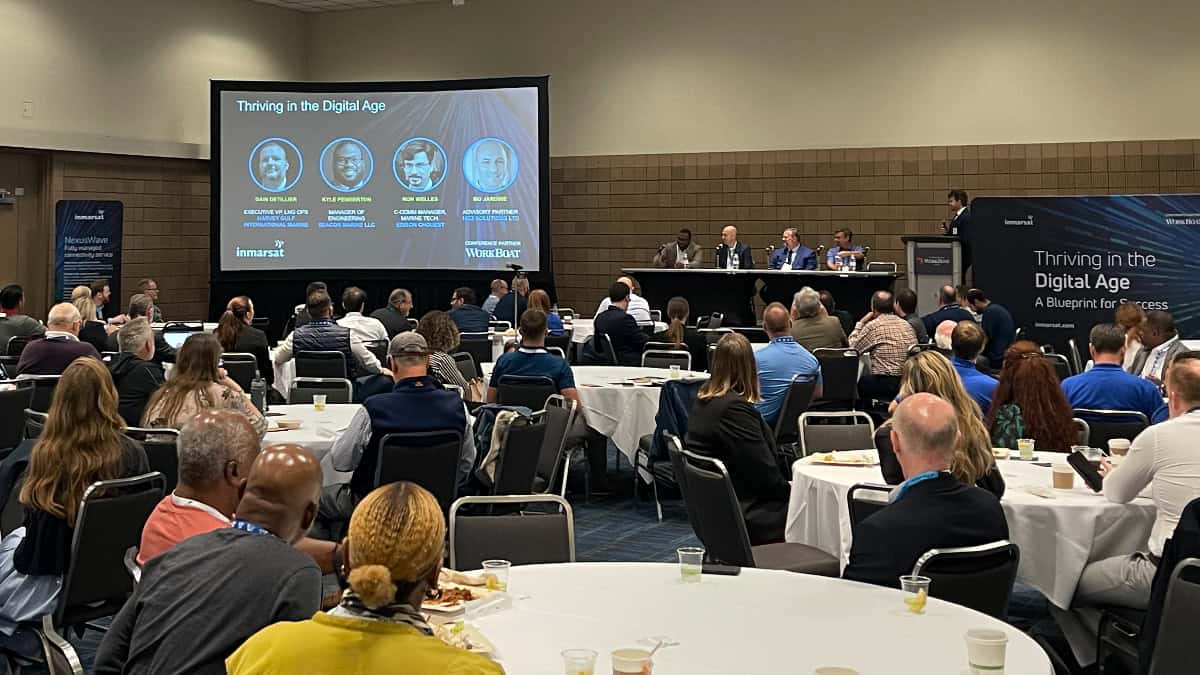
This was the consensus from a panel of leading OSV owners at the Inmarsat seminar Thriving in the Digital Age: A Blueprint for Success, which was organised to coincide with the International Workboat Show 2024 in New Orleans.
According to Ron Welles, C-Comm Manager at Marine Technologies, an Edison Chouest Offshore (ECO) company, ECO can now roll out fleetwide updates “on the fly” through cloud operations. “Things are happening in a day that used to take months,” he said. “That’s where we see the advantage of digitalisation.”
In another move targeting enhanced operational efficiency, ECO has been working towards “reducing the number of people needed on board the vessel” by employing shore-based staff to provide remote assistance, Welles added.
“Instead of needing 10 chief engineers, having one who can access the data on 10 vessels and assist the crew on board – that’s the general direction we’ve been trying to push in to increase efficiency and make the boats that have our system on board work better,” he said.
The offshore industry’s diminishing reliance on onboard personnel also promises improved safety. This is an opportunity SEACOR Marine is looking to grasp, with the company engaged in internal discussions regarding a project to implement remote jacking operations.
“Our lift boats are high-value assets, and operating out in the Gulf of Mexico poses a major risk,” commented Kyle Pemberton, SEACOR’s Vice President of Engineering. “We’re now using digitalisation to operate safely. To eliminate human risk, we’re working on removing people from the jack-up vessels and currently implementing connectivity to perform jacking remotely.”
While the industry’s accelerating digitalisation gives cause for excitement, the speakers were keen to highlight the ongoing role of the human element in OSV operations – and the urgent need for education to ensure crew members are equipped to thrive in the digital age.
Bo Jardine, Advisory Partner at 1852 Solutions Ltd, explained that “AI is there to make your life a little bit better and to help you make better decisions” – not, he added to “take over the world”.
Yet Jardine also acknowledged the extent to which the technology – and digitalisation as a whole – is transforming the offshore landscape, resulting in new training and educational requirements. “It used to be a mechanical engineer’s world on a vessel; now it’s an electrical engineer’s world,” he said. “These things are evolving, and the skillsets people are taught need to change too.”
Dain Detillier, Executive VP – LNG Operations at Harvey Gulf International Marine, LLC, echoed Bo Jardine in calling for renewed focus on crew education as AI becomes more prevalent. “AI is out there, and there are all kinds of ways you can use it to better your company,” he noted. “We’re obviously looking at those things, but if you don’t educate employees about how the AI system works and what it’s used for, it won’t help.” Harvey Gulf is therefore investing significant time and resources into AI-focused education for its staff, Detillier added.
The speakers were also united in reiterating the importance of crew connectivity, with Detillier describing high-speed onboard internet as a “must” and Welles noting that hiring personnel today means providing them with the ability to “talk to their families wherever we send them”.
With the panel in agreement that humans would remain firmly ‘in the loop’ for the foreseeable future, Kyle Pemberton reasoned that autonomy, in the first instance, would apply to onboard equipment rather than vessels as a whole.
“If we can get machinery to make better decisions on its own and interact with other machinery, then we can start having the discussion about removing people from the vessel – but the first step is to have autonomy down to the equipment level,” he concluded.